









A Proof of the Water-Filling Theorem
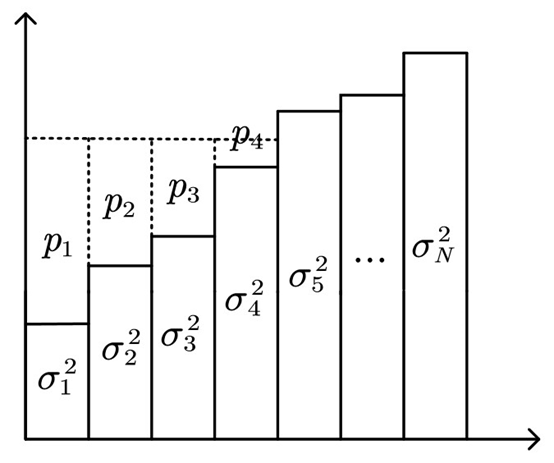
Author: phy-东西 Reviewer: 时光 Problem Statement The water-filling theorem solves a fundamental problem in information theory: how should power be allocated across AWGN channels to maximize their total capacity? Suppose there are KKK parallel AWGN channels with mutually independent noise processes and noise powers σ12,σ22,⋅⋅⋅,σK2σ^2_1,σ^2_2,··· ,σ^2_Kσ12,σ22,⋅⋅⋅,σK2. Given a total power budget PPP, we seek the allocation that maximizes the combined capacity of the KKK channels. As an optimization problem, this becomes: maxp1,…,pK∑k=1Klog2(1+pkσk2)s.t.∑k=1Kpk≤Ppk≥0, k=1,2,…,K(1.1)\begin{aligned} &\max_{p_1, \dots , p_K}\sum^{K}_{k=1} \log_2 \left(1 + \frac{p_k}{\sigma ^2_k}\right)\\ \mathrm{s.t.}&\sum^K_{k = 1}p_k \le P\\ &p_k \ge 0, \ \ \ k = 1, 2, \dots , K\end{ali ...

Boundary-Layer Theory
Author: Boiler-251 Reviewed by: Shiguang Origins of boundary-layer theory Boundary-layer theory grew out of a problem in nineteenth-century fluid mechanics. The theory of the period was based on the Euler equations for an inviscid, incompressible fluid. Because those equations neglect viscosity, their predictions often disagreed with experiments and could not readily explain phenomena such as pressure drops in pipes. The Navier–Stokes equations, which account for friction, had already been proposed, but contemporary mathematicians could not solve them in the cases that mattered. Theory therefore remained far removed from practice. Engineers instead developed hydraulics empirically, relying on experimental data rather than theoretical analysis. Ludwig Prandtl resolved this difficulty ...

Stars: The Fundamentals of Stellar Astronomy
Author: 栗小白 (SDU) Reviewer: 时光 Preface Because this is “popular science,” we will not venture into unfathomable black holes, quantum mechanics, or M-theory—though I make no promises about next time. Nor will I try to scare anyone with impenetrable mathematical symbols or jargon. You can trust me on that, because my own math is not very good. There are not even any formulas, mainly because they are too hard to print. This article covers only the most, most, most, most fundamental concepts about stars and how we study them, leaving plenty of other aspects aside. Let us begin. Part 1: Luminosity and Apparent Brightness As their names suggest, luminosity and apparent brightness both describe how bright a star is. The two are related, but they are not the same quantity. Differences L ...
Flip-Flops: How They Work and What They Do
Flip-Flops: How They Work and What They Do Author: Fucha Reviewed by: Shiguang Sooner or later, any explanation of how computers work must introduce one electronic device: the flip-flop. A flip-flop consists mainly of two vacuum tubes, with current flowing through one tube at a time. It has four terminals: two receive external pulses, and two deliver output pulses. The moment an external pulse arrives, the flip-flop “flips.” The tube that was conducting switches off, and current begins flowing through the other one. As the two tubes exchange roles, the flip-flop produces an output pulse. Now feed the flip-flop a continuous series of pulses and use one of the two tubes in Figure 1—the one on the right—to define its state. When the right-hand tube is not conducting, the flip-flop is i ...
The 2022 Nobel Prize in Physics
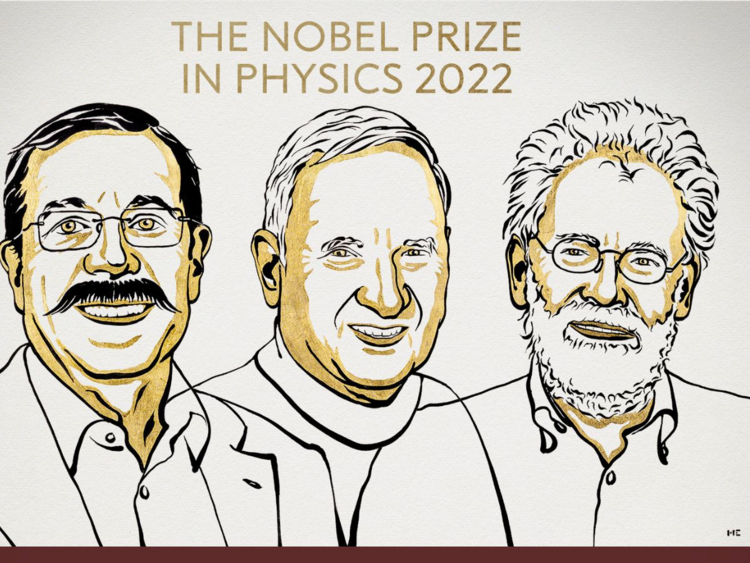
Entangled States: From Theory to Technology Alain Aspect, John Clauser, and Anton Zeilinger conducted pioneering experiments with entangled quantum states. In these states, two particles behave as a single unit even when separated. Their results opened the way to new technologies based on quantum information. Effects of quantum mechanics that once seemed impossible to describe are now finding practical uses. They have become the focus of a major research field encompassing quantum computers, quantum networks, and secure communication through quantum encryption. One key to this progress is a feature of quantum mechanics that allows two or more particles to share what is known as an entangled state. What happens to one particle in an entangled pair determines what happens to the other, even ...
The 2022 Nobel Prize in Physiology or Medicine
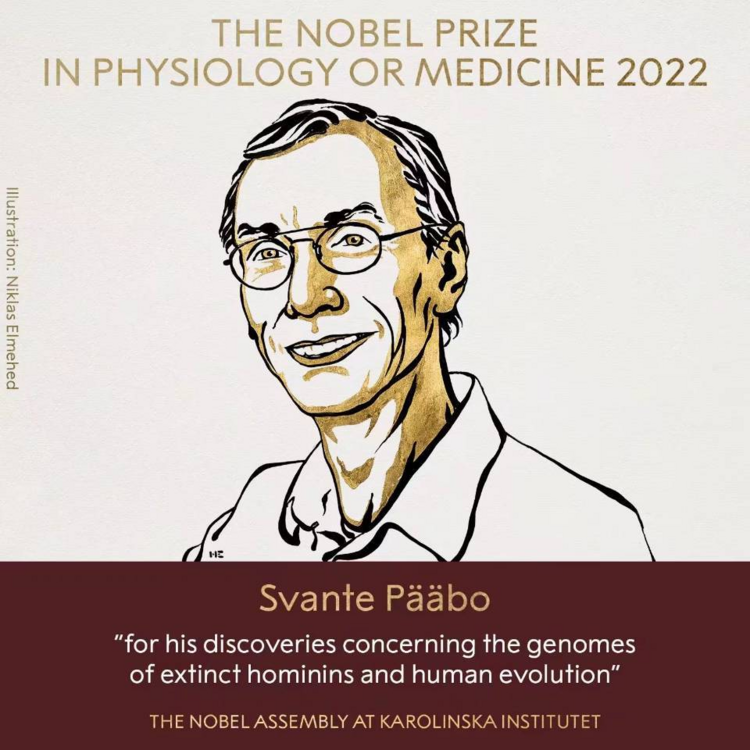
Introduction Humans have always wondered about their origins: Where do we come from? How are we, Homo sapiens, related to the other human groups that came before us? What sets Homo sapiens apart from them? Through pioneering research, Professor Svante Pääbo accomplished what had seemed impossible: he sequenced the genome of an extinct human relative, the Neanderthal. He also discovered a previously unknown human group, the Denisovans. Just as importantly, Pääbo found that genes from these now-extinct groups entered the Homo sapiens gene pool after our ancestors left Africa about 70,000 years ago. This ancient genetic legacy still matters physiologically today, affecting, for example, how our immune systems respond to infection. Pääbo’s work gave rise to a new discipline: paleogenomics. By ...
Variational Inference and Generative Models
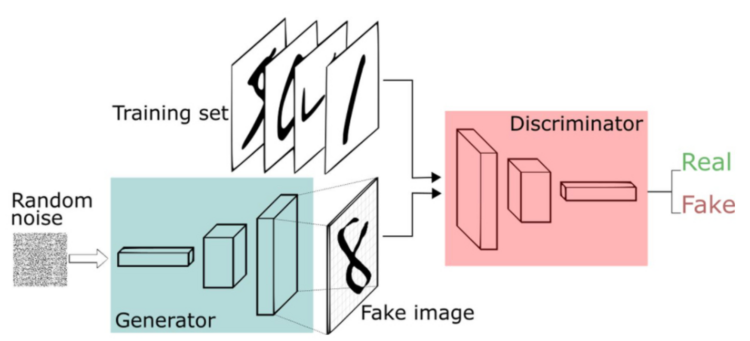
Author: I Am Zhang Yixian Author’s Zhihu profile: Thinker Variational Inference The basic idea is simple: probabilistic models often require us to approximate distributions that are difficult to compute. Inference about any unknown quantity can be viewed as inference about a posterior probability because Bayes’ theorem allows us to construct one: p(x)=∑p(x∣z)p(z)p(x) = \sum p(x|z)p(z) p(x)=∑p(x∣z)p(z) For large datasets, Markov chain Monte Carlo methods are too slow, which is where variational inference comes in. Two kinds of variables appear repeatedly: the observed data, xxx, and the latent variable, zzz. The resulting inference problem is to determine the posterior conditional distribution p(z∣x)p(z|x)p(z∣x) for the input data. Using the ELBO, we seek a tractable distribution q(z) ...

Paradox Interactive: Game Worlds, Politics, and Social Simulation
Author: Enthusiastic A-Jiang Reviewer: Saito Shin Everyone has played a “Paradox” game, right? (Figure 1 shows the company’s official logo.) Anyone who enjoys historical strategy or simulation games will know the name. Headquartered in Stockholm, Sweden, Paradox has created many classic series. Its games go on sale every year from April to May, so if you have not tried one yet, now is the time. You may find something you like. (Figure 1: Paradox logo) Why is Paradox so famous? Its players are said to be the most inhuman people in gaming history. Search for “Paradox players,” and descriptions such as “demons” and “perverts” will appear. But what makes them so inhuman? Take Stellaris. Ordinary players fly spaceships through the galaxy, befriend aliens, and discover unfamiliar civiliza ...

Traditional Chinese Philosophy: A Brief Lecture
Author: Silicon-Based Reviewer: Xian’e I drafted this lecture while my school was locked down during the pandemic. I had already reached the library’s borrowing limit, and all the books I had annotated were at my home far away in southern China. I wrote almost entirely from my not especially reliable memory, so this account of traditional Chinese philosophy is bound to contain substantial omissions and mistakes. Please approach it cautiously and critically. By traditional Chinese philosophy, I generally mean the systems of Chinese thought, sometimes grouped under “Eastern philosophy,” that dominated the intellectual life of East Asia from the Hundred Schools of Thought in pre-Qin China until Marxism entered the country. Compared with its counterpart, “Western philosophy,” traditional ...
The ‘Fixed’ Stars Aren't Fixed: How Their Positions Change
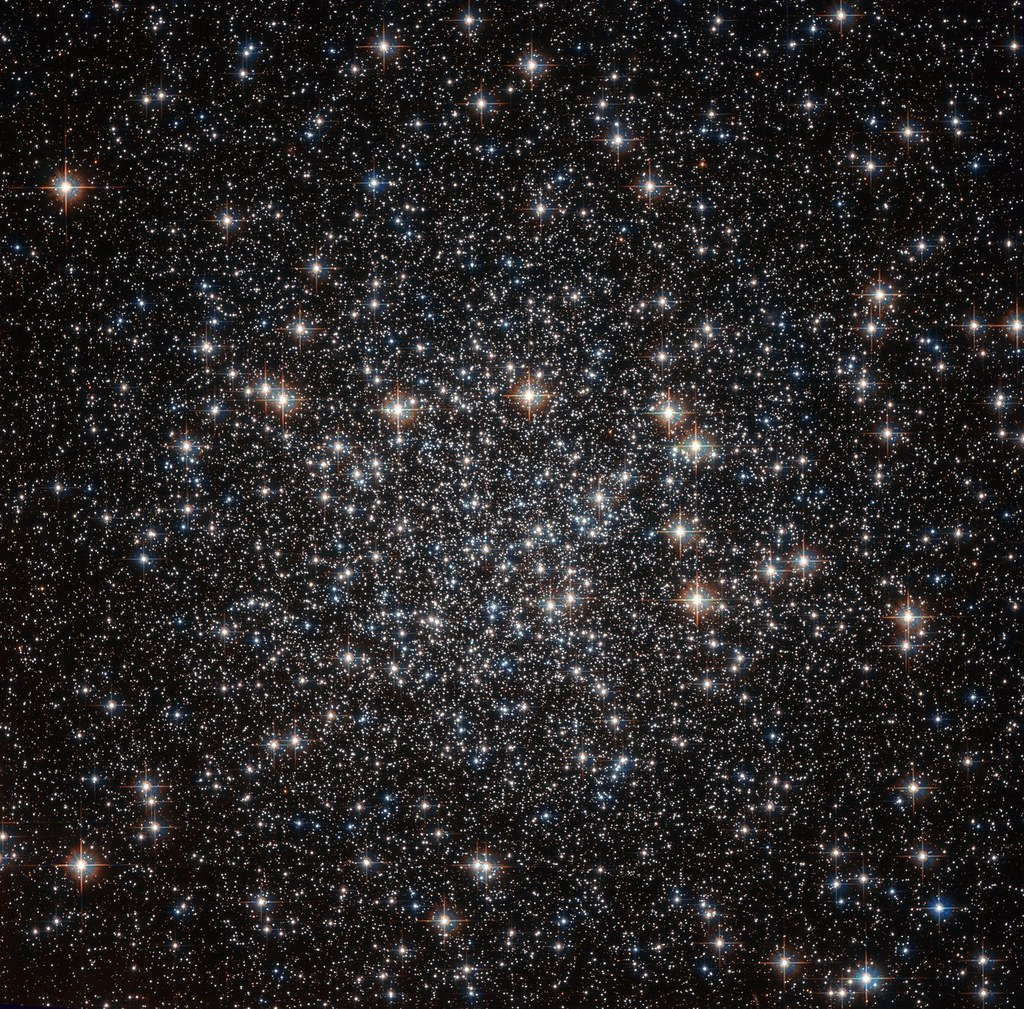
Author: Congyu Reviewer: Baiyan With excellent eyesight, you might pick out more than 2,500 stars on a clear, dark night. Across the entire celestial sphere, nearly 6,000 are visible to the naked eye. Ancient observers noticed that, unlike the five planets Mercury, Venus, Mars, Jupiter, and Saturn, most celestial objects seemed to keep the same positions forever. That apparent permanence gave us the Chinese word for star, which literally means “constant star.” We now know that stars only look fixed: they are so distant that their motion across the celestial sphere is hard to detect. This article introduces three ways their positions shift against the celestial background: Parallax Proper motion Aberration of light Parallax Hold up a finger and look at it first through one eye, the ...
Recent Post