
What Is the Interstellar Medium?
What Is the Interstellar Medium?
Author: Li Xiaobai
Reviewer: Shiguang
Introduction
Our universe contains more than stars and planets. Interstellar space is permeated by matter of extremely low density, far thinner than the best vacuum we can create on Earth. This material, known as the interstellar medium, fills the vast reaches between planetary systems.
The Interstellar Medium
The interstellar medium consists mainly of gas and dust. In most cases, the elemental abundances in interstellar gas resemble those of other celestial objects. About 90% or more of the gas consists of hydrogen atoms or molecules, roughly 9% is helium, and the remainder is made up of heavy elements. Interstellar dust is less well understood. Infrared observations suggest that it contains silicates, graphite, iron, and “dirty ice,” a mixture of water ice, ammonia, methane, and other compounds.
The interstellar medium produces two important observational effects: extinction and reddening. Here is how each arises.
Extinction
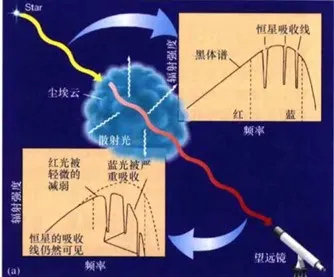
Dust grains can absorb only light with a wavelength less than or approximately equal to their radius. Dust therefore blocks shorter wavelengths more strongly. Interstellar dust grains are about 10^-7 m in diameter, comparable to the wavelengths of visible light, and thus dim the light from stars.Reddening
Because the interstellar medium blocks short-wavelength radiation more effectively than long-wavelength radiation, it is more likely to “seize” the higher-frequency photons traveling from a distant star. The star therefore appears redder than it actually is, an effect called reddening. The principle is illustrated below:
Nebulae
Emission Nebulae
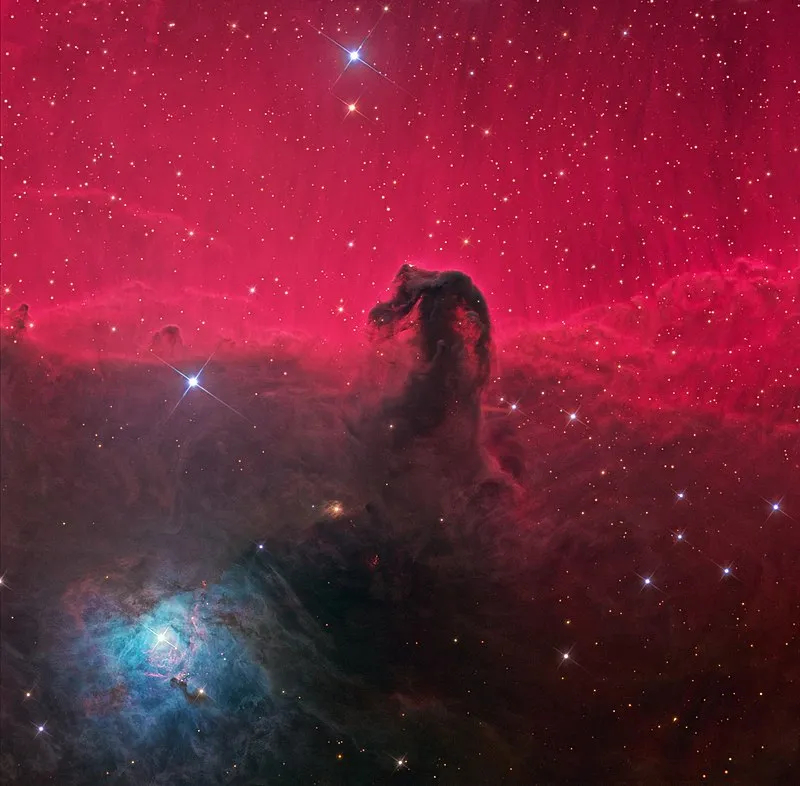
Nebulae come in many forms and appear as hazy patches in the night sky. An emission nebula is an extended cloud of hot, glowing interstellar gas. These nebulae are associated with star formation: hot O- and B-type stars heat and ionize the interstellar matter around them. If a cloud blocks stars farther along our line of sight, it appears as a small black region against a bright background and is called a dark nebula. If objects within the cloud, such as young stars, make it glow, we instead see a bright emission nebula.
Reflection Nebulae
In contrast to red emission nebulae, reflection nebulae appear blue. Dust grains within them scatter starlight, giving the clouds their bluish color. An emission nebula forms when stars at or near the center of a gas cloud produce large amounts of ultraviolet radiation. As the ultraviolet photons travel outward, they ionize the surrounding gas. Electrons then recombine with atomic nuclei and emit visible light, causing the cloud to glow. Because hydrogen predominates in these clouds and much of its visible emission falls in the red part of the spectrum, emission nebulae look reddish. Reflection nebulae, by contrast, arise mainly when dust in a cloud scatters visible starlight.
Reflection nebulae shine by reflecting light from nearby stars. Dust scatters blue light more efficiently than red light, the same process that makes the sky blue and sunsets red, so reflection nebulae usually appear blue.
Dark Nebulae
When no bright star lies near a cloud of gas and dust, the cloud remains dark and is called a dark nebula. It may be dense enough to obscure an emission or reflection nebula behind it, as the Horsehead Nebula does, or to block background stars. Although dark nebulae emit no light of their own and have no nearby light to reflect, they absorb and scatter light from objects behind them. Their silhouettes can therefore be seen against the star-rich Milky Way or a bright diffuse nebula.
Interstellar Bubbles
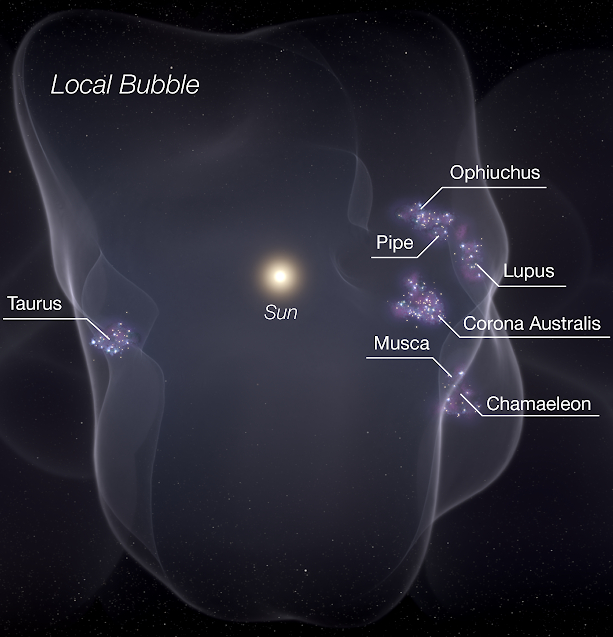
The final concept is the interstellar bubble. Some regions of interstellar space are extraordinarily tenuous yet contain gas even hotter than the gas in emission nebulae. Ultraviolet observations from space telescopes have revealed these superheated interstellar “bubbles.” They make up the medium between clouds and occupy enormous volumes. The hot gas probably formed as remnants of stars that exploded long ago expanded rapidly. Although these regions are extremely hot, they appear faint because their matter is so sparse. Our Solar System lies within one such low-density region, known as the Local Bubble. It contains about 200,000 stars and spans roughly 100 pc. The bubble was most likely formed by ancient supernova explosions whose energy heated the surrounding interstellar gas and drove it out of the Solar System’s immediate neighborhood.
Dark Dust Clouds
Emission nebulae and interstellar bubbles account for only a small part of the interstellar medium. In fact, more than about 80% of the universe is empty space without stars, filled only with darkness and cold at roughly 100 K. Yet another class of object is hidden in this void: dark dust clouds. These clouds are colder than their surroundings, with temperatures of only a few tens of kelvins, but thousands to millions of times denser. For this reason, they are also called “dense interstellar gas clouds.”
The 21 cm Line
The 21-centimeter line of neutral hydrogen is an important tool for studying the distribution of neutral hydrogen in interstellar space and the structure of the Milky Way and other galaxies. It allows astronomers to detect radiation from cold, neutral interstellar gas anywhere in space. The method relies on low-energy radiation emitted by the gas itself.
How is the 21 cm line produced? All matter in the universe tends toward the lowest possible energy state, and the interstellar medium is no exception. In a slightly excited hydrogen atom, the electron and proton spins are aligned. The atom can return to its ground state, in which the spins point in opposite directions, by emitting a photon with an energy equal to the difference between the two states.
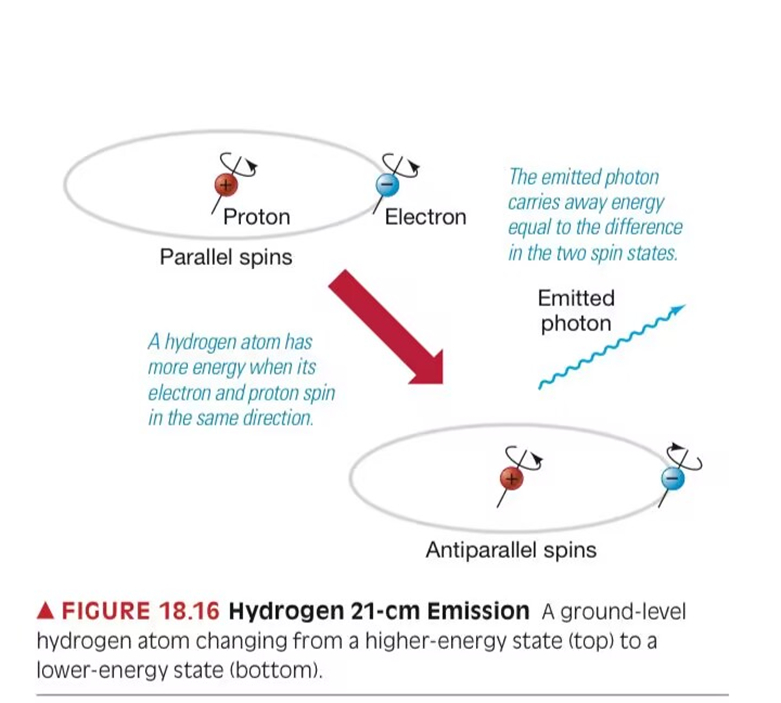
The energy difference between these levels is extremely small, so the emitted photon has very little energy and a long wavelength of 21.1 cm. Astronomers call this 21 cm radiation. Because its wavelength is much greater than the size of interstellar dust grains, the radiation is not scattered by interstellar dust before reaching Earth. It can probe interstellar space thousands of parsecs away, making it extremely important for studying the structure of the Milky Way and other galaxies.
References: Astronomy Today and Baidu Baike
 爱发电(点击图片跳转)