The Sun's Powerful “Earrings”: Solar Filaments
Author: 阿白特尔
When solar activity is intense, point a telescope fitted with a Baader solar filter at the Sun—never look directly at the Sun through an unfiltered telescope or with the naked eye—and you may notice that the Sun’s “skin” looks a little rough. Clusters of dark patches often dot its bright surface. These, of course, are the familiar sunspots. Yet the specialists who know the Sun’s skin ailments best—solar physicists—pay even closer attention to another dark structure above its surface. This is our subject today: the solar filament.
Some readers may wonder, “I have observed the Sun through a Baader-filtered telescope for years. Why have I seen only sunspots and never the ‘solar filaments’ you describe?” If you have watched the edge of the solar disk closely enough, you may actually have seen a filament’s other face: the familiar solar prominence. When the Sun’s rotation carries a filament to the limb, it stands out against the darkness of space as a bright projection—a prominence. To understand why the same filament appears as a dark absorption feature on the disk but as a bright prominence at the limb, we need to examine its physical nature.
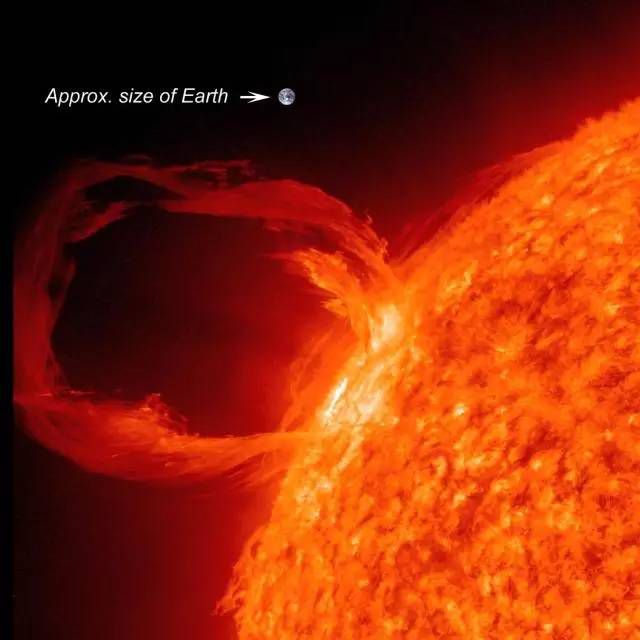
The Sun’s surface and atmosphere are threaded with intricate magnetic fields. A solar filament is a body of relatively cool, dense solar material in the corona, held in place by a balance of magnetic support and confinement. Here, “cool” and “dense” are relative to the surrounding corona. Explaining why a filament has both properties requires a closer look at the physics.
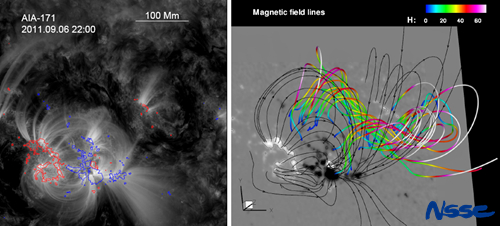
A closer look at a filament’s physical structure shows that it usually lies along closed magnetic field lines. A closed field line emerges from the solar surface in one region and dives back beneath it nearby. Solar material is a highly ionized plasma, and the frozen-in condition restricts its motion across magnetic field lines. Plasma on a given field line in the solar atmosphere therefore tends to stay on that line and move along it. Once a closed field line forms, the material along it must come directly from the solar surface. The surface is much cooler than the corona, so without any additional heating mechanism, the material on a closed field line will remain closer to the surface temperature and far cooler than the surrounding corona. Fluid mechanics tells us that pressure must balance throughout a stable fluid. If the magnetic field is the same, the thermal pressure of a plasma is given by k × (particle density) × (temperature). To balance the pressure of the hot surrounding corona, cooler material must therefore have a higher density. That is why a filament is both cool and dense. The corona lies high in the solar atmosphere, however, where the pressure is lower than at the surface; consequently, the product of a filament’s density and temperature is generally no greater than the corresponding product at the solar surface.
Now that we understand why filaments are cool and dense, we can explain their appearance. Because a filament is cool, it absorbs various spectral lines emitted from the solar surface. When we observe the Sun in those lines, the filament appears as a dark streak across the disk. This also explains why we do not normally see filaments on the solar surface through an ordinary telescope: we are observing the continuum rather than a particular spectral line, so the filament’s absorption is extremely weak and disappears into the vast continuum. Because filament material is denser than the corona, it emits blackbody radiation more strongly. When it rotates to the solar limb, we can therefore see its faint continuum emission as what we call a prominence. That appearance has earned filaments the evocative nickname of the Sun’s “earrings.”
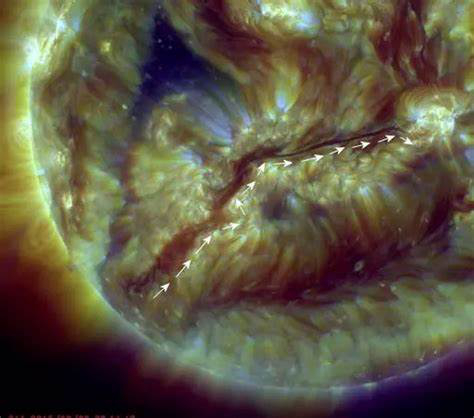
We now know that a filament’s properties are governed by its underlying magnetic field, so determining the structure of the field that supports it is crucial. Because the coronal magnetic field is difficult to measure directly, the field around a filament is hard to observe. The prevailing approach is to extrapolate the coronal field from measurements of the photospheric magnetic field under certain assumptions, chiefly the force-free-field assumption. Limitations in both the theory and the accuracy of these extrapolations mean that we still cannot determine the magnetic structure around a filament precisely. Two main models have been proposed: the sheared magnetic arcade and the magnetic flux rope. Researchers also disagree about how this structure forms. Some argue that a flux rope rises directly from beneath the solar surface; others propose that magnetic reconnection in the corona repeatedly changes the topology of a sheared arcade until it becomes a flux rope. There are likewise two accounts of where the filament material comes from. In the first, material rises with the emerging flux rope and collects in dips in its magnetic field. In the second, after a sheared arcade or flux rope forms, surface material “evaporates” upward from the magnetic footpoints and condenses near the middle of the structure. The magnetic structure of solar filaments remains a frontier topic in solar physics.
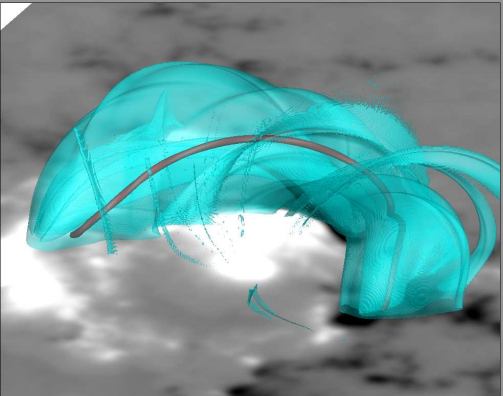
A filament’s magnetic structure determines the property that matters most to us: its potential to erupt. Whether that structure is a sheared arcade or a flux rope, it stores enormous magnetic free energy. This energy comes from the kinetic energy of fluid motions at the solar surface. Under the frozen-in condition, magnetic field lines move with the plasma, gradually building up energy in the magnetic structure. The free energy cannot remain stored there forever. Once conditions permit, it is released abruptly in a violent filament eruption.
Filaments do not erupt for no reason, so what triggers an eruption? Scientists have proposed a range of models, which fall broadly into two groups. The first invokes instabilities in ideal magnetohydrodynamics. Put simply, these models ignore the plasma’s electrical resistivity and treat it as an ideal magnetofluid. This group can be divided further into kink instability and torus instability. Both describe essentially the same situation: the upward magnetic tension of a flux rope exceeds the restraining force of the surrounding background field, and the imbalance persists—or even grows—as the rope rises. The flux rope can then accelerate upward, carrying the filament material cradled in its dips out of the solar atmosphere and into interplanetary space. The other group is based on non-ideal magnetohydrodynamics and centers on magnetic reconnection. These models hold that when a magnetic structure storing free energy reconnects either within itself or with nearby magnetic structures, the resulting change in magnetic topology may destabilize the structure and trigger a filament eruption. Debate among these theories continues.
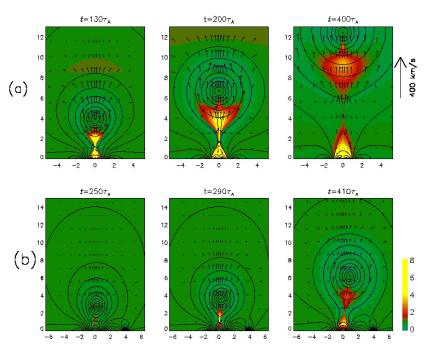
In fact, many observed filament eruptions show signs of these mechanisms working together. An eruption is likely a complex process in which the phenomenon described by one theory dominates while those described by other theories play supporting roles. The way these phenomena interact locally and over time may be the real recipe for a “successful” filament eruption.
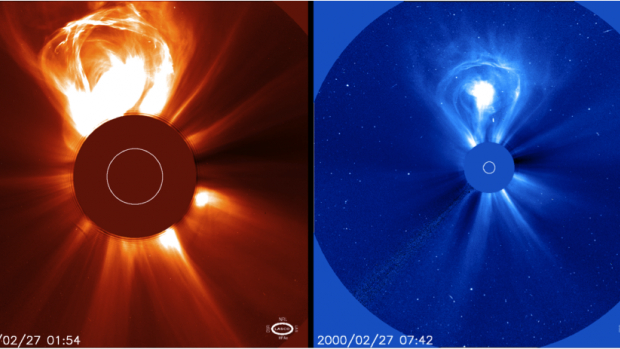
Filament eruptions are an important phenomenon in solar physics. They are immense: a single eruption can eject as much mass as Mount Everest. They are enormously energetic: the chain of events produced by one eruption can radiate energy on the order of one hundred billion Hiroshima atomic bombs. And their physical role is pivotal: they commonly trigger coronal mass ejections (CMEs) and solar flares, while their underlying physics is more fundamental than that of either phenomenon. Understanding filament eruptions therefore gives us a deeper understanding of CMEs and flares. We offered a broad introduction to the space-weather events caused by CMEs and flares in an earlier article, Storms Beyond the Atmosphere: A Conversation about Space Weather; interested readers may wish to explore it further. Because these events pose a growing threat to humanity’s high-technology systems, and because filament eruptions drive many of them, better understanding solar filaments and the eruption process has become a major fundamental problem for solar physicists.
On countless clear days, modern astronomers pointed their telescopes—properly fitted with solar filters—at the Sun and marveled at the beauty of the “earrings” hanging from its edge. They may never have imagined that these beautiful ornaments could erupt violently and someday affect human life and industry. Still less could they have imagined that our understanding of the “earrings” would advance far enough for us to reconstruct their invisible magnetic fields and the physical mechanisms behind their eruptions. Many questions remain unanswered, but I believe that science multiplied by time is our most powerful tool for confronting the unknown. I will close with a remark by Professor Linghua Wang of Peking University’s Institute of Space Physics, from the lecture series Tianfang Yetan: “Technology has two sides. Its development may increase the effects of space-weather events on everyday life, but science will also help humanity understand unknown mechanisms, improve forecasting, and protect itself more effectively.” As the Chinese saying goes, for every force of evil, a still greater power rises to subdue it. In the end, we will overcome the threat, leaving ourselves with stronger means—and a deeper understanding of the universe.
 爱发电(点击图片跳转)