Storms Beyond the Atmosphere: A Conversation About Space Weather
Author: Abaiter
Reviewed by: Lai Yuan
When we hear the word “weather,” we usually think first of wind, rain, thunder, and similar phenomena. They are an important part of our environment and the weather we experience most directly, but all of them occur within the thin troposphere, no more than a dozen or so kilometers above the ground. How far is a dozen kilometers? Walking from one end of a moderately large city to the other can take you farther than that. The sky, as we know, is vast and boundless. The weather we encounter in daily life is therefore only part of the picture. Above the troposphere, and especially beyond the atmosphere, another kind of turbulence unfolds: space weather.
Air molecules are the medium of weather in the troposphere, with water vapor playing an especially important role. Beyond the atmosphere, as everyone knows, air molecules are almost nonexistent, let alone water vapor, which struggles even to enter the stratosphere. Space weather must therefore have a different medium. Its principal medium is space plasma—ionized gas—and its main driver is solar activity.
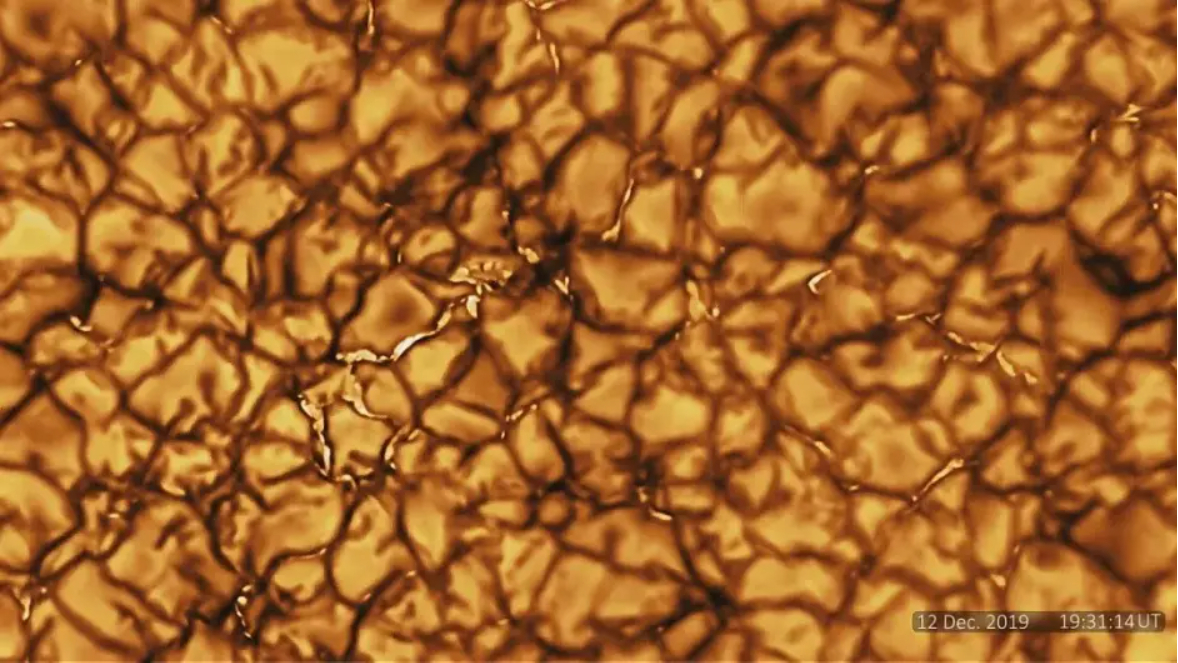
The Sun may look the same from one day to the next, but its surface is constantly changing. Granules emerge and disappear within minutes, while solar activity waxes and wanes over an eleven-year cycle. Every sign tells us that the Sun is far from still: like a human being, it has a heartbeat and breathes. And breathing does not always come easily. At such moments, the Sun lets out a tremendous sneeze—a solar eruption. Solar eruptions are one of the chief causes of severe space weather, so predicting and assessing them accurately is a central priority in space-weather research.
The two main forms of eruptive solar activity are solar flares and coronal mass ejections. A solar flare is the sudden brightening of a region on the Sun’s surface across multiple wavelengths. In a coronal mass ejection, the Sun hurls plasma from its corona into interplanetary space at high speed.
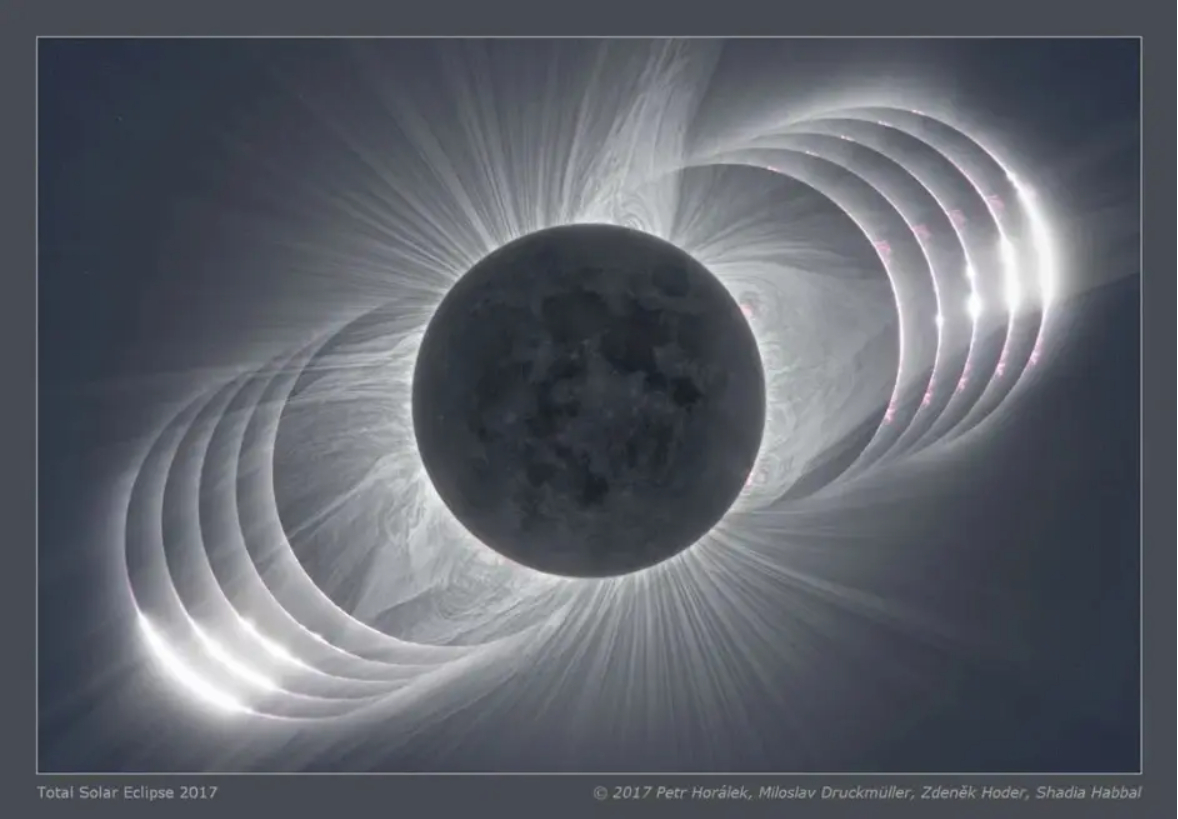
The Sun’s magnetic field drives every kind of solar eruption. Unlike the symmetrical, uniform field of a bar magnet, the solar magnetic field varies enormously across space and time. In some regions, it becomes highly concentrated. An excessively strong field suppresses convection, reducing the transfer of energy from the Sun’s interior into the region. The area cools and darkens, producing a sunspot. Magnetic field lines emerging through the solar surface from a sunspot form complex configurations in the space immediately around the Sun. When field lines of opposite polarity draw close together, the magnetic field breaks and reconnects, releasing an enormous amount of energy. That energy is converted into the kinetic energy of particles, which shoot upward and downward at tremendous speeds.
The high-speed particles directed downward follow magnetic field lines and strike the solar surface, where they decelerate abruptly. Through a process known as braking radiation, or bremsstrahlung, they release large quantities of high-energy photons. The particles also heat the nearby solar atmosphere, increasing its thermal radiation. Together with possible nuclear reactions, nuclear transitions, and other processes, this produces an explosive increase in radiation across multiple wavelengths from that part of the Sun: a solar flare. The flare’s high-energy radiation reaches Earth eight minutes later, changing the degree of ionization in the ionosphere and thereby affecting shortwave communications. This is the first wave of a solar storm’s attack on Earth.
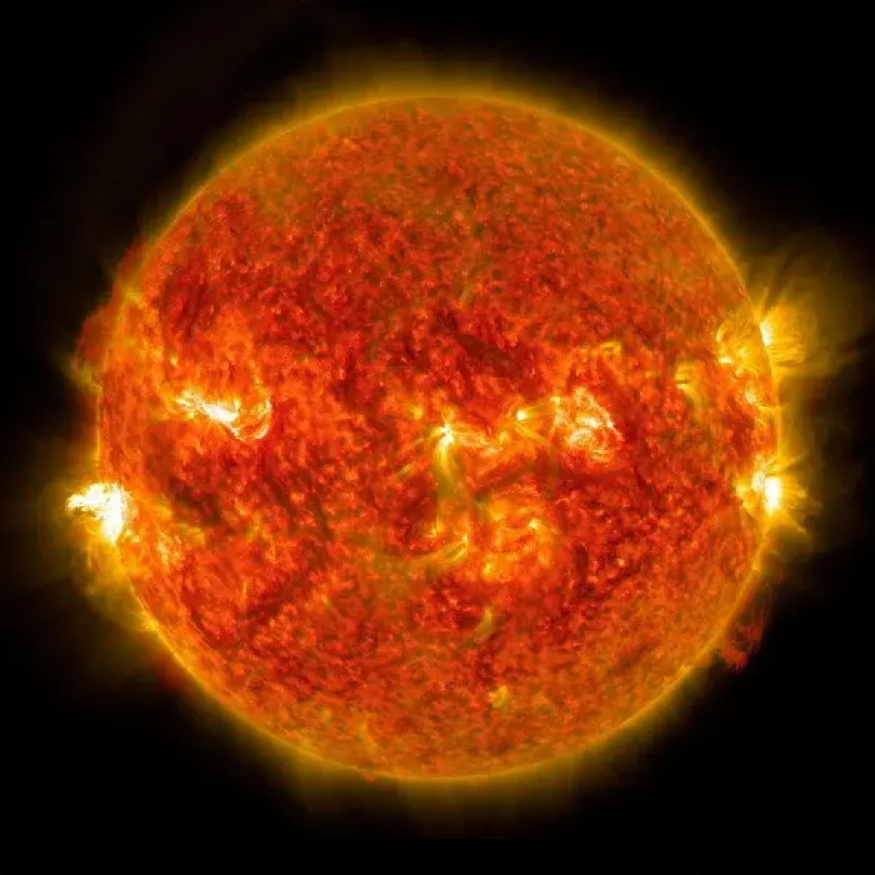
The upward-moving particles are ejected into interplanetary space. Note that this is not the coronal mass ejection mentioned earlier. Because these particles have enormous kinetic energy and travel at extremely high speeds, they do not need to wait for the magnetic field to rise. They race into interplanetary space first and reach Earth’s orbit tens of minutes later. When they bombard artificial satellites, they can charge delicate components, cause electrical breakdown, or even burn those components out. This is the second wave of a solar storm’s attack on Earth.
Finally, reconnection changes the magnetic-field configuration. Part of the upper magnetic field closes around a vast cloud of plasma, carrying it out of the solar atmosphere and hurling it into interplanetary space. This is a coronal mass ejection. Because a reconnected magnetic configuration is not necessarily unstable enough, not every solar flare is accompanied by one. When a coronal mass ejection does strike Earth, however, it has the greatest destructive power. It carries not only plasma but also a magnetic field, so it can strongly affect Earth’s own field. If the ejected field reaching Earth has a large southward component, it breaks and reconnects with Earth’s magnetic field, injecting large quantities of plasma into near-Earth space. Earth’s magnetic field then becomes highly unstable. A changing magnetic field, as we know, induces an electric field, so large induced currents arise in electrical transmission lines on Earth. These currents can disable electrical equipment and bring generators at power stations to a halt. The influx of plasma also increases the plasma content of the atmosphere and interrupts radio communications. Some studies even indicate that more plasma in the atmosphere may intensify typhoons and hurricanes. Hurricane Katrina, which paralyzed New Orleans in 2005, for example, intensified rapidly while Earth was being affected by a severe space-weather event. Finally, plasma injection increases the density of the upper atmosphere and therefore the drag on satellites. This drag lowers their orbital altitude and changes their speed, raising the possibility that a satellite will be lost from tracking, lose contact, and crash. This is the third wave of a solar storm’s attack on Earth.
Because solar storms can affect Earth so profoundly, predicting and monitoring their arrival is critically important. If we can foresee a storm and predict its strength with reasonable accuracy, we can prepare more effectively and minimize the damage. Predicting the future depends on understanding what is happening now. We already have a fairly good understanding of how solar eruptions begin and propagate, and we know several signs that often precede a flare. An active region with an S-shaped or reverse-S-shaped magnetic configuration, for example, has a high probability of producing one. Large-scale magnetic-flux emergence and filament, or prominence, eruptions on the solar surface are often followed closely by flares and associated coronal mass ejections. Alongside these phenomenological theories, numerical work continues to make breakthroughs. Chinese scientist Zhang Mei, for example, proposed that coronal mass ejections are an unavoidable result of accumulating coronal magnetic helicity. When a magnetic field emerges at the solar surface, the upper limit on coronal magnetic helicity falls. If the existing helicity exceeds that limit, a coronal mass ejection results. More recently, Duan Aiying and colleagues studied the characteristics of magnetic flux ropes before flare eruptions. They found that highly twisted flux ropes with high decay indices can predict 90% of flares caused by magnetohydrodynamic instability and the coronal mass ejections that follow them. A growing body of completed and ongoing research is taking our understanding of solar eruptions to a new level.
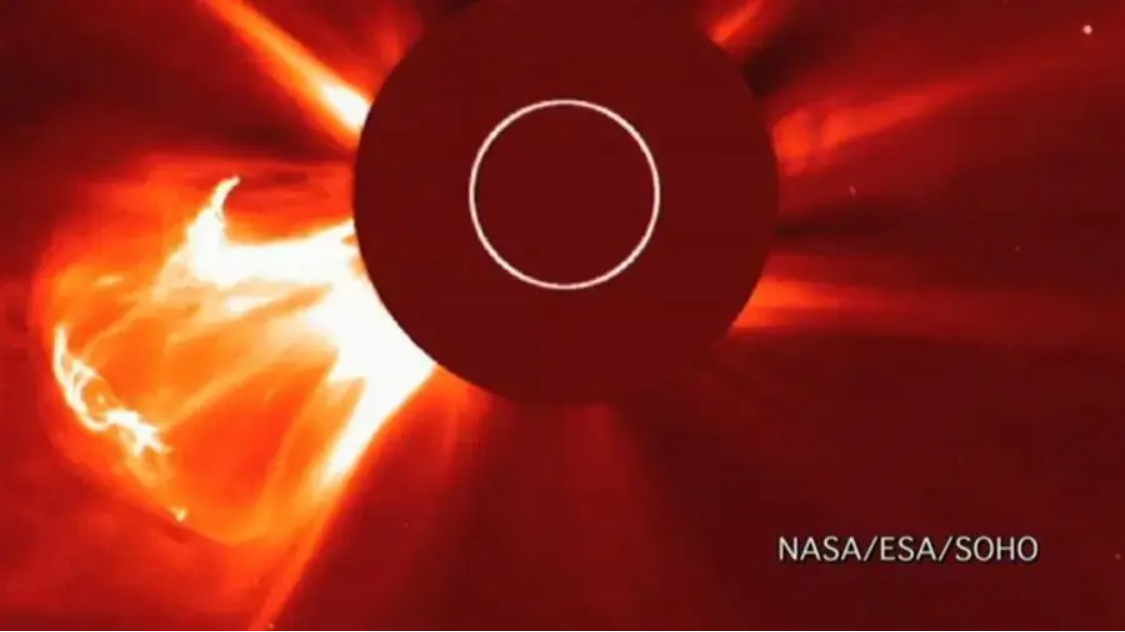
A solar storm’s strength depends not only on the individual eruption but, even more, on how the storm evolves before reaching Earth. Liu Ying and colleagues proposed that a solar storm can become a “perfect storm”: not exceptionally violent in itself, yet capable of producing the strongest effects when several nearly perfect conditions come together. These include a small storm erupting before the main storm and clearing its path; the storm being reflected by a coronal hole, causing the magnetic field to accumulate; and a sustained sequence of flares in which later eruptions catch up with earlier ones, creating intense shocks and regions of compressed magnetic field within the storm. When these conditions align perfectly, Earth can experience a once-in-a-century solar storm. Humanity would need four to ten years to recover from such an event.
Although solar storms are among the most violent forms of space weather, they are not the whole story. Space weather also includes the quiet solar wind; interaction regions between high- and low-speed solar-wind streams, where the high-speed streams emerging from coronal holes carry fast charged particles and a strong interplanetary magnetic field and become another major cause of geomagnetic storms and other severe space weather; the heliospheric current sheet; and cosmic rays from beyond the Solar System. If we are “fortunate” enough to witness a supernova in our lifetimes, we may even receive a dose of space weather from a distant star.
As the discussion above shows, our space environment is far from calm. Hidden currents surge beneath its surface, and at times towering, turbid waves rise around us. What keeps the small ship of Earth moving steadily through this turbulent, dark ocean—and has even allowed fragile life to evolve aboard it and become aware of it all? Earth’s magnetic field. Without that field, the roaring solar wind would quickly strip away the atmosphere. Liquid water would cease to exist, and life would be out of the question.
Where, then, does Earth’s magnetic field come from? Its liquid metallic core. If that core solidified, Earth’s magnetic field would quickly weaken to a negligible level. Why is the core liquid? Because heat released by the decay of radioactive elements warms it. Where did those radioactive elements come from? Scientists generally believe that they came mainly from collisions between binary neutron stars. Why do neutron stars collide? Because the gravitational waves they emit carry away orbital energy, drawing their orbits closer together. Why do gravitational waves exist? Because general relativity predicts them. We should therefore understand why we live in a world where general relativity holds: if it did not, Earth would have no magnetic field to protect us, space weather could take away everything on which we depend at any moment, and we could not still exist today.
When I began writing, I never expected a discussion of space weather to lead from the tip of Einstein’s pen to the rise and fall of humanity. That is precisely what reveals the breathtaking beauty of science and reminds us to explore and to think: When humanity thinks, God laughs; but if humanity does not think, God cannot even be bothered to laugh.
 爱发电(点击图片跳转)