
Deep-Sky Object Catalogs: A Brief Guide
Author: 丛雨
The Messier Catalog
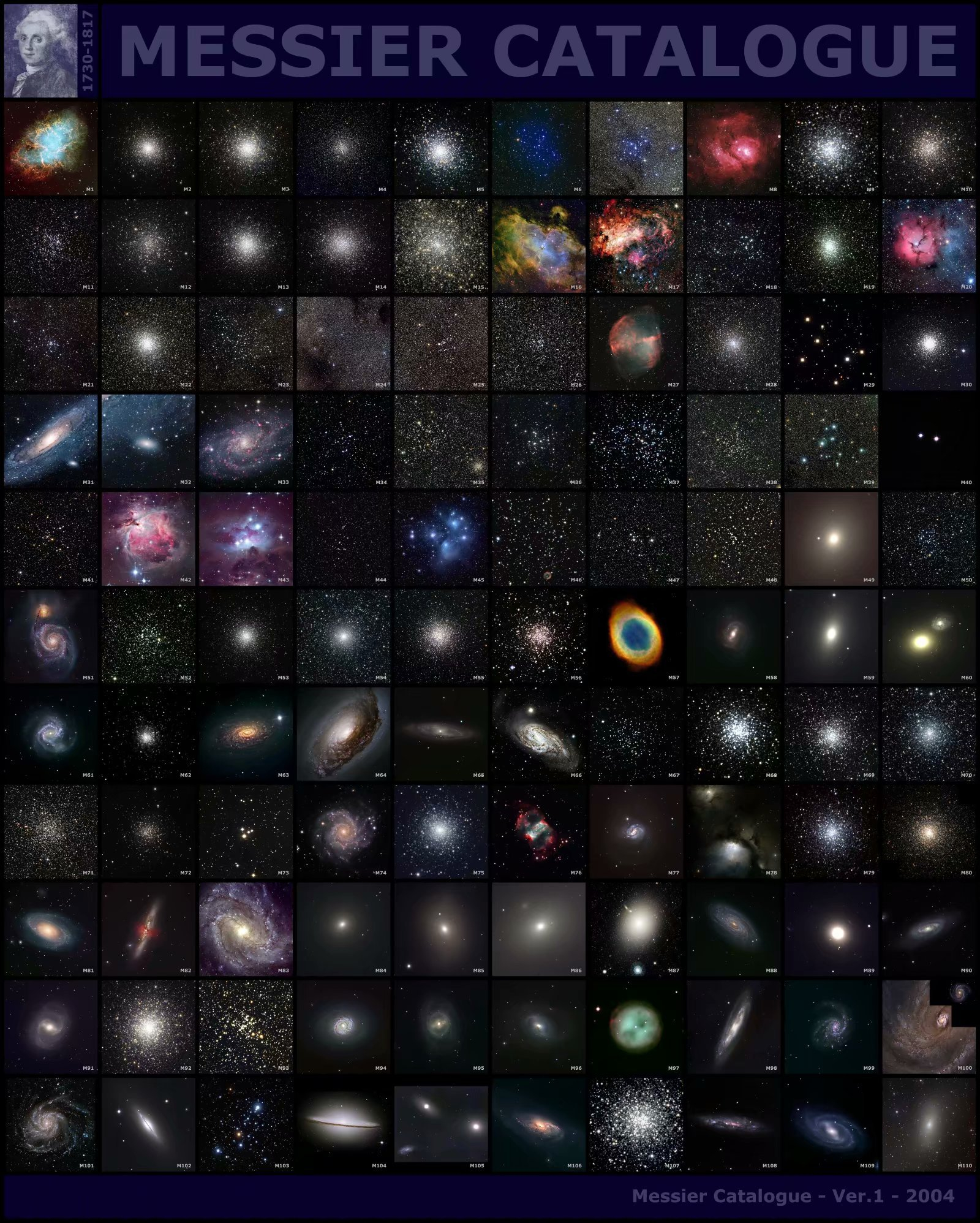
Of all the deep-sky catalogs, the Messier Catalog is probably the best known. Compiled under the direction of French astronomer Charles Messier, it contains 110 deep-sky objects: 12 nebulae (M1, the Crab Nebula, is its only supernova remnant), 57 star clusters (28 globular and 29 open clusters), 40 galaxies, and one double star, M40, included by mistake. Many favorites among amateur astronomers are Messier objects, including the Andromeda Galaxy (M31), the Orion Nebula (M42), and the Pleiades (M45). Messier himself was a dedicated comet hunter. While searching for comets, he kept encountering objects that looked like them but were not, so he compiled a catalog first published in 1771. That original list contained 45 objects. By 1781, observations by Messier and Pierre Méchain had expanded it to 103, and later astronomers added the remaining entries. Because Messier observed from France, he could not survey the entire sky; all Messier objects therefore lie north of roughly −36° declination. The catalog is especially well suited to observers in the Northern Hemisphere. Around late March each year, many amateur astronomers choose a clear, moonless night for a “Messier marathon,” trying to find every object with a telescope in a single night.
The Caldwell Catalog ©
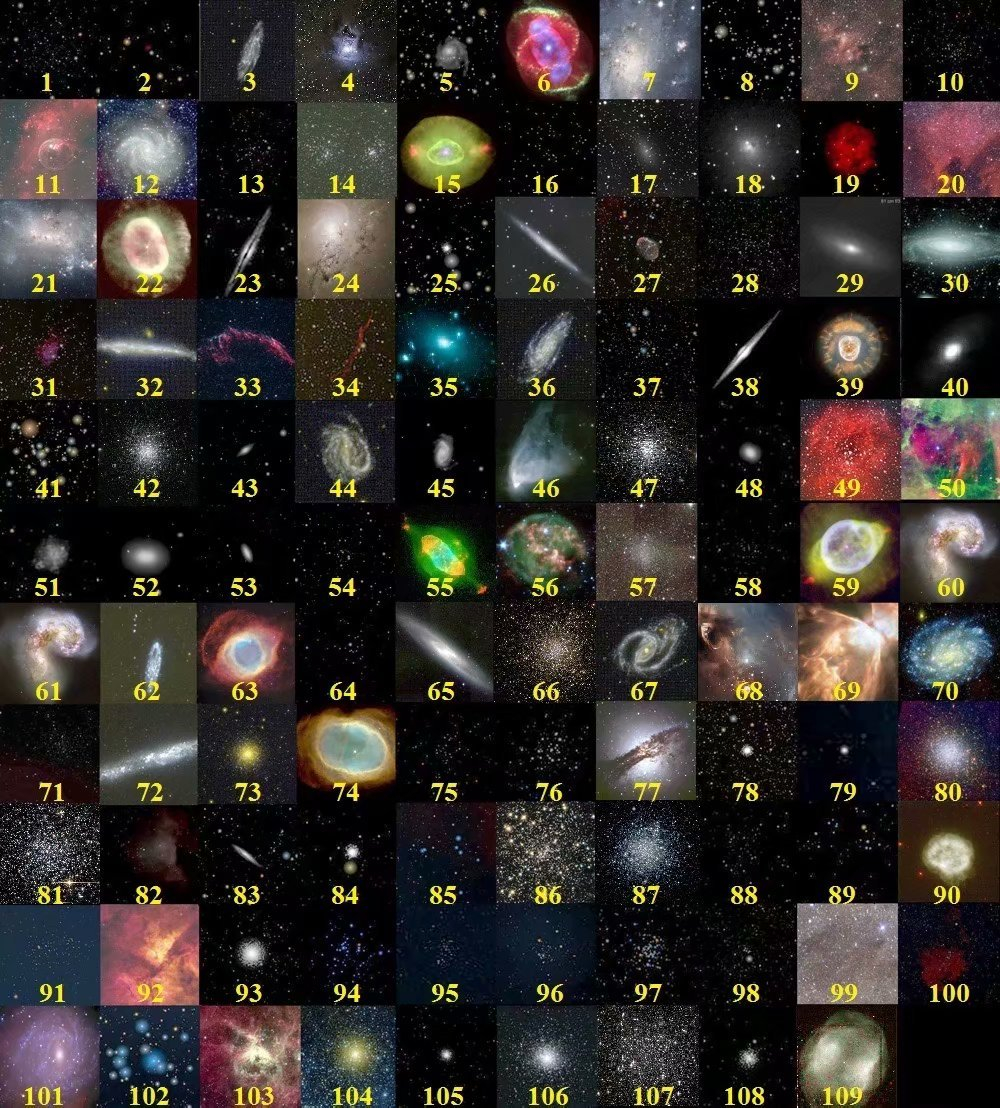
The Caldwell Catalog is less famous than the Messier list. It contains 109 relatively bright deep-sky objects from both the northern and southern skies, none of which appears in the Messier Catalog. The list comprises 25 nebulae, including two supernova remnants, one dark nebula, and 13 planetary nebulae; 43 star clusters; 35 galaxies; and six combined cluster-and-nebula objects. British amateur astronomer and science writer Sir Patrick Caldwell-Moore compiled the catalog in 1995. Better-known entries include the Double Cluster in Perseus (C14) and the Hyades in Taurus (C41). It also includes southern objects that may be less familiar to northern observers, such as the Carina Nebula (C92) and the globular cluster 47 Tucanae (C106). Because Caldwell was designed to complement Messier, none of its objects has an M number, and vice versa. Many of its southern targets are difficult for observers in the Northern Hemisphere to see in full.
New General Catalogue of Nebulae and Clusters of Stars (NGC)
Apart from Messier numbers, NGC designations are probably the deep-sky identifiers we encounter most often. The catalog contains 7,840 nebulae, star clusters, and galaxies, and nearly every familiar deep-sky object has an NGC number. The Andromeda Galaxy, for example, is both M31 and NGC 224. The earliest NGC data came from observations at Dunsink Observatory by William and John Herschel and other members of the Royal Astronomical Society. John Dreyer first organized and compiled the material in 1880. Because the original data contained some errors, later astronomers checked and corrected it several times, producing works such as the Revised New General Catalogue (RNGC).
Index Catalogue of Nebulae and Clusters of Stars (IC)
Usually called the Index Catalogue, the IC extends and supplements the NGC with another 5,386 objects. It consists of IC I and IC II, completed by Dreyer in 1895 and 1905, respectively. The Horsehead Nebula in Orion (IC 434) is one familiar IC object. An object does not have both an NGC and an IC designation.
Beyond these four common catalogs, astronomers use many others for galaxies, nebulae, and star clusters. Here are a few of them:
- Uppsala General Catalogue (UGC): 12,921 galaxies, almost all in the northern sky
- Catalogue of Galaxies and Clusters of Galaxies (CGCG)
- Morphological Catalogue of Galaxies (MCG)
- Principal Galaxies Catalogue (PGC): includes both the Large and Small Magellanic Clouds
- Atlas of Peculiar Galaxies (Arp): 338 morphologically unusual galaxies, including galaxies undergoing collisions and mergers
- Sharpless catalogue of bright nebulae (Sh2): 313 emission nebulae
- RCW Catalogue: 180 emission nebulae, mainly in the southern sky
- Gum Catalogue: 85 emission nebulae, mainly in the southern sky
- Lynds’ Catalogue of Bright Nebulae (LBN) and Lynds’ Catalogue of Dark Nebulae (LDN)
- van den Bergh Catalogue of Reflection Nebulae (vdB): 158 reflection nebulae
- Barnard Catalogue of Dark Markings in the Sky (B): 350 dark nebulae
- Melotte Catalogue of Star Clusters (Mel): 245 star clusters
 爱发电(点击图片跳转)