The Solar System: Our Home and Our Origin
Author: Kon
Reviewed by: Xiao
The Solar System we inhabit contains planets, moons, comets, and other celestial bodies of every size. The Sun itself is a thoroughly ordinary member of the Milky Way’s “family of stars.” That raises two questions:
- Is our existence unique?
In more specific astronomical terms, are planetary systems like the Solar System common throughout the universe? - How did the Solar System we depend on come into being?
Before humanity could search for exoplanets on a large scale, neither question had a satisfactory answer. Without a substantial set of comparison samples, the Solar System itself was our only model for understanding planetary systems. The two questions are also linked to some extent: once we establish how planetary systems form, that mechanism can help predict whether such systems should be common. Historically, several theories have sought to explain “planet formation”:
The first theory ties planet formation to the birth of a planet’s host star. Soon after the star forms, a residual “disk of gas and dust” remains around it, and planets form within that disk. This theory naturally implies that planets are relatively common.
Other theories argue that planet formation is unrelated to star formation and instead begins with a separate event. The “tidal stripping hypothesis,” for example, proposes that when two stars pass close to one another, tidal forces “strip” gas from a star and planets form from that material. Even in a region as densely populated with stars as the Milky Way, however, the number density of stars in space is astonishingly low. The tidal stripping hypothesis therefore implies that planets are exceedingly rare.
Even before the search for exoplanets began, most people tended to believe that planetary systems like the Solar System were common. Modern science seems to prefer stripping anything connected with humanity of as much special status as possible. The Copernican Revolution and the Curtis–Shapley debate both drove humanity from the “most central and exceptional” position into ever less conspicuous corners. That, however, takes us into the philosophy of science, which lies beyond the scope of this article.
Thanks to the launch of the Kepler space telescope, exoplanets began turning up in large numbers after 2010. By 2026, more than 6,000 had been confirmed. Current observations show that even stars in the Sun’s immediate neighborhood host a great many planets. A space artist’s rendering depicts the “hot Jupiter” 51 Pegasi b (left) and the star it orbits, 51 Pegasi (right); this was the first “hot Jupiter” ever discovered. Extrapolate to the whole Milky Way, with its hundreds of billions of stars, and planets naturally appear very common.
As for the second question, the mainstream theory of planet formation holds that a newly formed star does not draw in all the gas and dust around it. The remaining material forms a “protoplanetary disk” around the star. Within that disk, planets grow through collisions, starting as micrometer-sized grains and becoming kilometer-scale planetesimals. Because a protoplanetary disk spans such a large region, matter is distributed differently at different distances from the Sun. The “snow line” marks the boundary beyond which the disk is cool enough for water and other volatile substances to condense into ice. Inside the snow line, planetesimals consist mostly of rock; outside it, most are mixtures of rock and ice. Beyond the snow line, the gravitational feeding zone is larger and icy solids are more abundant, so the planetesimals’ solid cores “grow” extremely quickly. Once they reach a certain mass, they can rapidly capture the gas left in the protoplanetary disk and eventually become enormous gas giants. Inside the snow line, planetesimals have smaller feeding zones and fewer icy solids, so their solid cores remain less massive. They struggle to accrete large quantities of gas and usually must wait until the gas in the protoplanetary disk has gradually dispersed before growing through collisions with other planetesimals. Their increase in mass is consequently very limited, and their atmospheres are extremely thin.
This conclusion was originally developed in an effort to “reconstruct” the Solar System’s present distribution of planets: small, low-mass rocky planets dominate the inner region, while large, high-mass gaseous planets dominate the outer region. Since the first “hot Jupiter”—a Jupiter-mass gas giant orbiting very close to its host star—was discovered in 1995, however, many more hot Jupiters have turned up. Their discovery has called the original theory of planet formation into question to some extent. The discovery of the Kuiper Belt also seems to suggest that the Solar System’s actual formation was far more dramatic than we once thought.
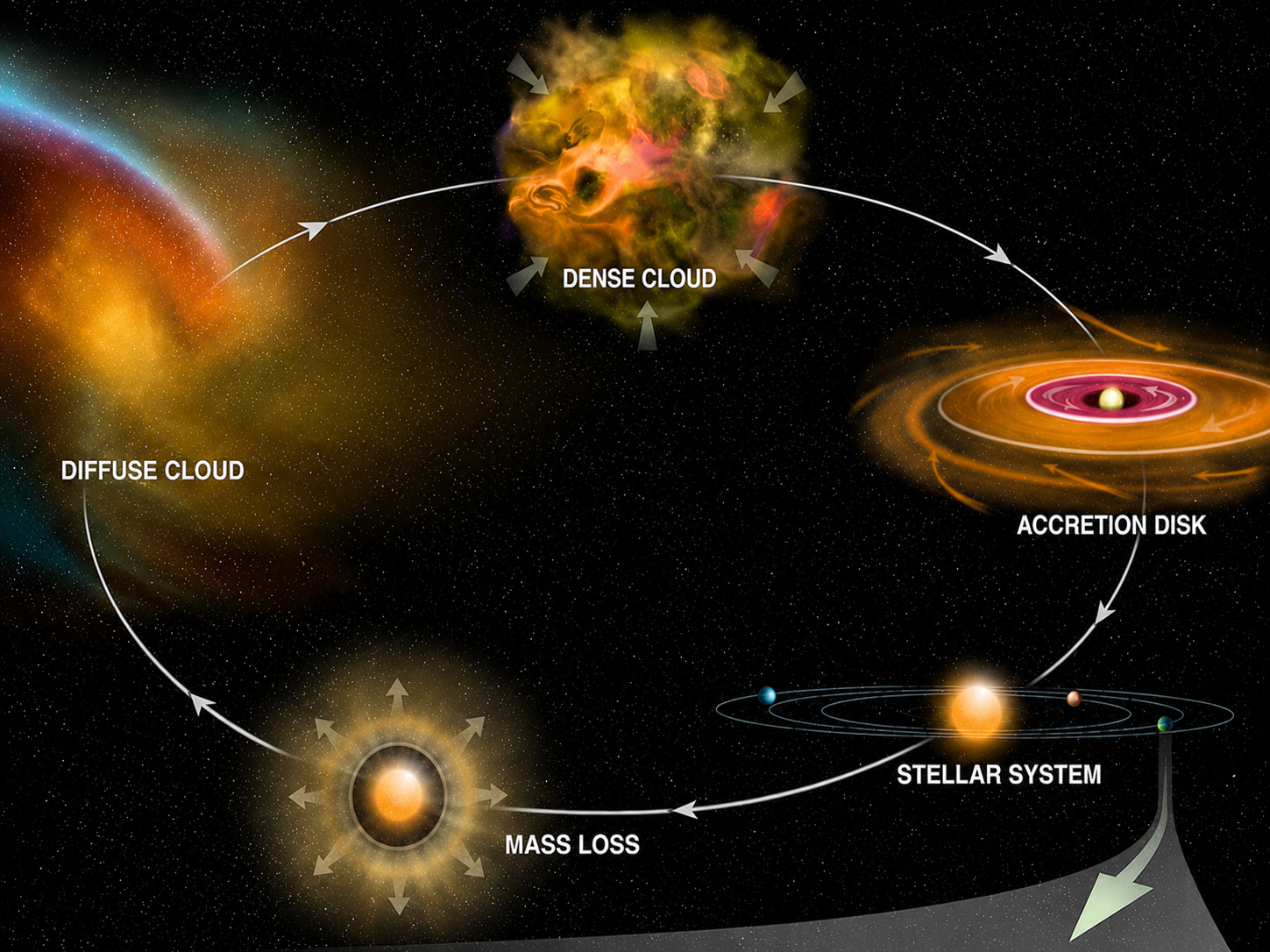
The image below shows the evolution of a star and its planetary system. Under gravity, diffuse gas in space collapses to form a star. The gas and dust left around the newborn star create a “protoplanetary disk,” in which planets then form. Late in its evolution, the star returns some of its material to interstellar space. If that residual gas gathers together, it may form a new star.
 爱发电(点击图片跳转)