How Does the Body Repair an Injury?
Author: Lüshui Qingshan
Reviewers: Shiye; Weiming
Throughout our lives, the body is constantly exposed to environmental stressors. It first tries to adapt, but an excessively strong stimulus can cause injury. This article looks at how the body repairs that damage.
An injury is the destruction or loss of some of the body’s cells and tissues. Repair is the process of replacing and restoring what has been lost. It generally takes one of two forms: regeneration or fibrous repair. During regeneration, cells of the same type divide at the injured site to restore the tissue’s original function. This is usually the more complete form of repair and may restore function fully. In fibrous repair, fibrous connective tissue replaces the damaged tissue, leaving a scar and only partially restoring function.
The body’s capacity for regeneration follows several broad patterns. Tissues that are frequently injured or continually renewed regenerate more readily than other tissues, and less differentiated cells regenerate more readily than highly differentiated cells. Regenerative capacity also varies among species and with evolutionary history. Salamanders, geckos, and many plants, for example, have especially strong regenerative abilities.
Tissue regeneration can be broadly classified as complete or incomplete. After complete regeneration, the repaired tissue functions much as it did before the injury. In incomplete regeneration, fibrous connective tissue replaces the original tissue. Because the repair uses a different cell type, some function is lost and a scar forms.
Different tissues and parts of the body regenerate differently after injury. The following are several examples.
Epithelial tissue
Epithelial cells are labile cells: they divide frequently and therefore regenerate readily. Their regenerative capacity also depends on the surrounding connective tissue. If that tissue remains intact, complete regeneration is likely and the epithelium can recover its original function. If the connective tissue is destroyed and can no longer provide a supporting framework, the body instead relies on fibrous repair. That repair is generally incomplete and does not restore the tissue’s original function.
Fibroblasts
Connective tissue repair depends mainly on fibroblasts. After an injury, these cells become active and proliferate. They produce large amounts of collagen and other “supporting materials,” gradually filling the damaged area. As the new tissue stabilizes, cellular activity declines and the tissue becomes denser, completing the repair.
Blood vessels
Small and large blood vessels regenerate differently. Small vessels such as capillaries usually form sprouts that join nearby vessels into a network, resulting in complete repair. Large vessels are much less likely to regenerate fully. Severe damage may require surgical suturing to restore their function.
With that overview of tissue regeneration, we can now follow the repair of an ordinary wound.
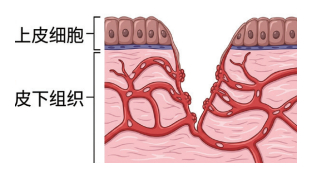
Immediately after tissue is damaged, severed blood vessels begin to bleed. The blood mixes with exudate and shed epithelial cells around the wound, then coagulates to form a scab. Because the scab adheres to the wound surface, pulling it off can enlarge the wound, expose it to the air again, and increase the risk of infection.
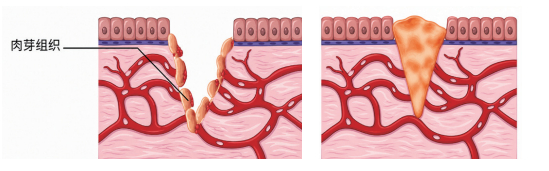
Granulation tissue then begins to fill and cover the wound. Rich in newly formed capillaries and immune cells, it helps clear pathogens and control infection. The abundance of capillaries also means that the wound bleeds very easily at this stage.
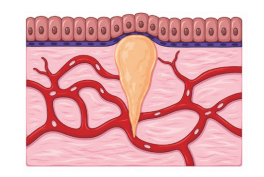
During the next stage, fibroblasts within the wound begin to form scar tissue. The scar contracts, drawing the wound closed. Finally, epithelial cells cover the tissue again and complete the repair process.
 爱发电(点击图片跳转)