Mars One: Ready for Launch!
Author: Baishu
Reviewers: Woniu; A Millisecond of Eternity
Note: “Mars One” was later officially renamed “Tianwen-1.” It successfully completed the three major phases of Mars exploration: orbiting, landing, and roving.
On October 11, 019, the China Aerospace Science and Technology Corporation posted photographs of China’s second Mars probe on its official Weibo account. The images gave the public its first look at the finished spacecraft, which was scheduled for launch the following year.
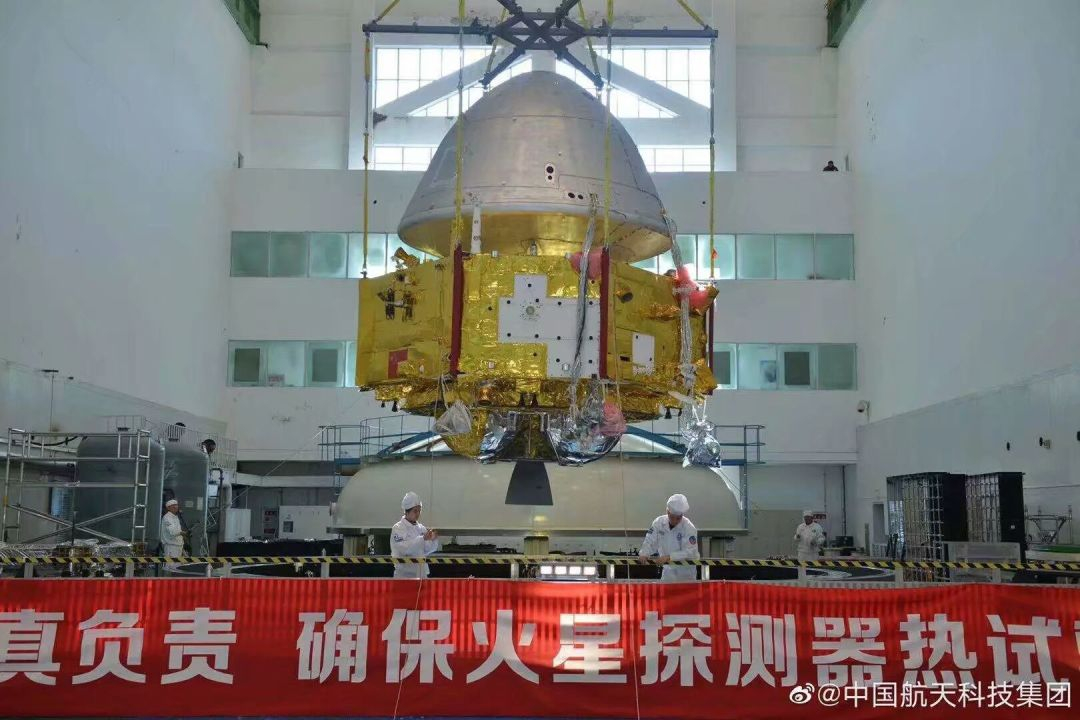
According to Ye Peijian, chief scientist for space science and deep-space exploration at the China Academy of Space Technology, a subsidiary of the China Aerospace Science and Technology Corporation, preparations for China’s Mars mission were complete, with launch planned for 2020. The probe was provisionally named “Mars One” and was later officially renamed “Tianwen-1.” It would carry an orbiter, a lander, and a rover, completing three phases at Mars: orbiting, landing, and roving. First, the mission would observe the entire planet; second, it would land on Mars; and third, the rover would deploy and survey the surface. Under the plan, Tianwen-1 would depart aboard a Long March 5 launch vehicle in July 2020 and land near the Martian equator before the centenary of the founding of the Communist Party of China in July 2021.
The latest progress in China’s Mars program was exciting, but the country had already made one unsuccessful attempt: Yinghuo-1. Let us look back at the probe’s ill-fated life.
Yinghuo-1 measured about 75 centimeters in both length and width and 60 centimeters in height. With both solar panels deployed, it spanned approximately 7.85 meters. The probe had a mass of 110 kilograms, a designed operating life of two years, an average power output of 90 W, and a data-transmission rate of 8,192 bit/s. It carried four types of payload: a plasma-detection package, an optical imager, a fluxgate magnetometer, and a radio-occultation receiver. It was intended to observe Mars from orbit for one year. Its objectives included studying the planet’s magnetic field, ionosphere, particle distributions, and how they change; measuring the escape rate of ions from the Martian atmosphere; surveying Martian terrain, landforms, and dust storms; and investigating the gravitational field around the Martian equator.
Yinghuo-1 was originally scheduled to launch with Russia’s Phobos-Grunt spacecraft aboard a Zenit-2SB launch vehicle from the Baikonur Cosmodrome in Kazakhstan in October 2009. On September 29, 2009, however, Russia postponed the launch until October 2011 to further ensure the project’s reliability.
On November 9, 2011, Yinghuo-1 launched with Russia’s Phobos-Grunt probe and soon entered Earth orbit successfully. Three engine burns were then supposed to send the two probes onto a Mars-bound trajectory. The entire journey was expected to take about 300 days.
After launch, Yinghuo-1 remained mounted atop Phobos-Grunt, and the two were to enter Mars orbit as a single spacecraft. Yinghuo-1 would separate after three orbits of Mars. Phobos-Grunt would move into a circular Martian orbit, wait for an opportunity to land on Phobos, collect soil samples, and return them to Earth. Yinghuo-1, meanwhile, would conduct its mission in a highly elliptical orbit with a periapsis of 800 kilometers, an apoapsis of 80,000 kilometers, and an inclination of less than 5°.
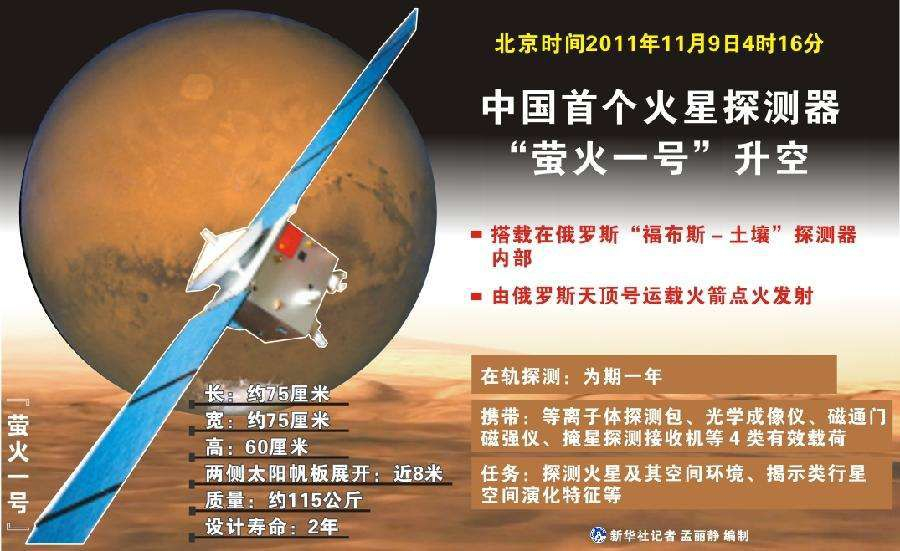
The day after launch, however, Vladimir Popovkin, head of the Russian Federal Space Agency, announced that Phobos-Grunt had failed to change orbit as planned. “It has been a very difficult night,” he said. “For a long time we could not locate the spacecraft. We eventually established its position and found that its propulsion system had not operated; both engine burns had failed.” China’s first Mars-probe mission had therefore ended in failure as well.
On January 15, 2012, Alexei Zolotukhin, a spokesperson for the Aerospace Defense Forces of the Russian Ministry of Defense, told the media that debris from Phobos-Grunt would fall into the Pacific Ocean at around 21:45 Moscow time (01:45 Beijing time on January 16). According to the Space Surveillance Center of the Aerospace Defense Forces’ Space Command, the unburned debris, about 200 kilograms in all, ultimately fell into the Pacific Ocean 1,250 kilometers west of Wellington Island in southern Chile.
The Yinghuo-1 mission had long since ended, but new explorers were ready to depart. Because of the relative positions of Earth and Mars, a transfer window between the two planets opens only once every 26 months. The next would arrive in 2020 and set off another wave of Mars missions. The year 2020 was set to be a major one for Mars exploration: NASA’s Mars 2020, China’s Mars One, and the ESA/Roscosmos ExoMars mission would all head for the planet.
Yinghuo-1 was designed solely for orbital operations. The new Mars One mission, by contrast, would complete all three phases—orbiting, landing, and roving—in a single mission, something never before attempted anywhere in the world. It undoubtedly carried greater risks, but also offered greater opportunities. May China travel ever farther across Mars, and may China’s space explorers venture ever farther into space!
References
- Spaceflight Enthusiasts website
- People’s Daily Online
 爱发电(点击图片跳转)