What Makes Plasma Different from Solids, Liquids, and Gases?
Author: Abaiter
Reviewed by: A Millisecond of Eternity
The three states of matter that usually come to mind are solid, liquid, and gas. In a solid, particles vibrate randomly but remain confined near fixed positions, giving the material a fixed volume and shape. As their random thermal motion gains kinetic energy, the particles eventually break free of those positions and begin to flow. They no longer stay in one place, yet attraction from neighboring particles still keeps them together. The result is the familiar liquid: a material with a relatively fixed volume but no fixed shape. Raise the temperature again, and thermal motion becomes strong enough for the particles to overcome nearly all their mutual attraction and spread freely. The material is now a gas, with neither fixed volume nor fixed shape. At heart, these three states differ in how far thermal motion has overcome—or disrupted—the interactions among their particles.
Once we know those three states, the next question comes naturally: are there more? What happens if the temperature keeps rising? A gas has already overcome nearly all the interactions among the particles—molecules, for example—that make up the material, so additional heat begins to break stronger, tighter bonds. In a molecular gas, it may first sever covalent or coordinate bonds, splitting molecules into atoms or atomic groups and gradually producing an atomic gas. Keep heating, and even atoms can no longer hold on: electrons escape the attraction of their nuclei and become free particles. Once a neutral atom loses negative charge, it becomes a positively charged ion. When electrons and ions grow dense enough for their collective behavior to dominate the gas, a fourth state of matter emerges: plasma.
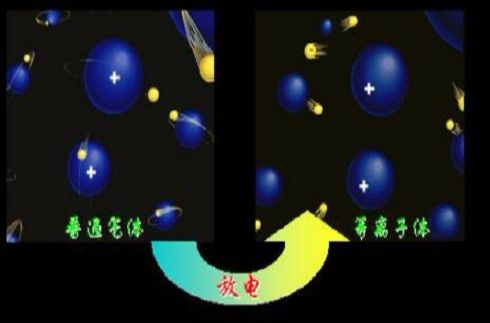
One way to create plasma is through thermal ionization. Heat drives electrons into ever more vigorous motion until they escape their atoms. The resulting plasma is often in thermal equilibrium, with electrons and ions at the same temperature. Plasma in the Sun and in nuclear-fusion reactors forms this way and is in thermal equilibrium. Lightning and fluorescent tubes create plasma differently, through electrical discharge. Electrons emitted by an electrode collide with gas atoms and knock out more electrons, producing electron–ion pairs. Because a discharge gives kinetic energy only to the electrons, the electron temperature in this plasma is much higher than the ion temperature.
Now that we have seen how plasma forms, let us look at two of its unusual collective effects—effects ordinary matter does not have. The first is plasma oscillation. A plasma contains vast numbers of positive and negative charges. By Coulomb’s law, every charge continually feels forces from all the others: like charges repel, and unlike charges attract. Yet a plasma has roughly equal amounts of positive and negative charge, so the attractive and repulsive forces approximately balance and the particles remain in statistical equilibrium. Disturb all charges of one kind away from their equilibrium positions, however, and that balance breaks.
Picture an electron–ion plasma in which a disturbance shifts all the electrons to the right. Their “departure” leaves a region where ions outnumber electrons, giving it a net positive charge. The displaced electrons are negative, so this positive region pulls them back home. That is not the end of the story. The attractive force disappears when the electrons return, but by then they have accelerated and cannot “hit the brakes” at equilibrium. Inertia carries them past it, and they set off in the opposite direction—only to be pulled home again. The cycle repeats: electrons depart → ions pull them back → electrons depart the other way → ions pull them back again. This collective motion is a plasma oscillation. Since an ion has nearly 2,000 times the mass of an electron, the same reaction force gives it far less acceleration. The ions barely leave their original positions; before they can move, the electrons have already crossed to the other side.
Plasma oscillations have many applications. One is explaining why solar storms can disrupt shortwave radio communications. Like any oscillator, a plasma has a natural frequency, and that frequency rises with the density of positive and negative charges. When an external force approaches an oscillator’s natural frequency, resonance lets the oscillator absorb the greatest possible amount of energy and reach its largest amplitude. Radio waves are electromagnetic waves—continually changing electric and magnetic fields—and charged particles such as electrons feel a force in an electric field. A wave passing through plasma therefore acts like a periodic external force on its electrons. If the wave’s frequency is far above the natural frequency of the plasma oscillation, the electron motion and the changing force fall badly out of step. The force does almost no work on the electrons, so the wave passes through the plasma with almost no loss and carries communications as usual.
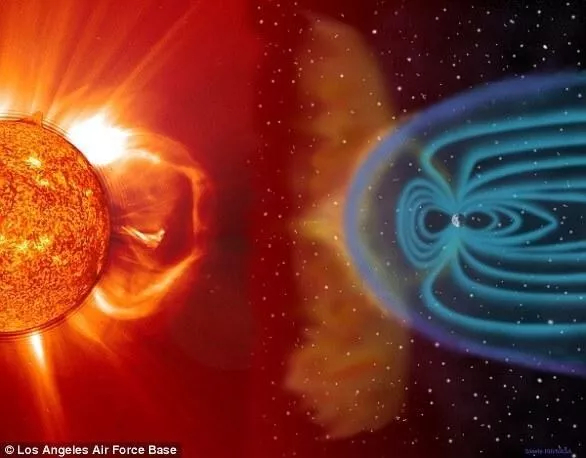
During a solar storm, however, large numbers of charged particles enter Earth’s atmosphere and raise the density of both positive and negative charges. The plasma’s natural frequency rises with them. When it approaches the frequency of the waves used for shortwave communication, resonance transfers as much of the wave’s energy as possible into the plasma. The wave can no longer propagate easily, and communication fails. High-voltage alternating-current transmission also relies on periodically changing electric fields, so solar storms can sometimes cause widespread power outages as well.
Debye shielding offers another curious tale of charge—an “invisibility trick” inside plasma. Picture electron–ion plasma as a rolling ocean, with disturbances occasionally setting off plasma oscillations. Drop a positively charged sphere into it, and the ocean quickly swallows it. The sphere attracts negative electrons and repels positive ions, leaving more electrons than ions nearby. From a distance, it resembles a steamed bun wrapped in an electron “skin.” That negative shell counteracts the positive sphere, so the bun as a whole has little electrical effect on its surroundings. A positively charged object went in, and its charge seems to have vanished. That is Debye shielding.
This is only the tip of the iceberg. Keep exploring, and plasma has many more secrets and surprises in store.
 爱发电(点击图片跳转)