Suicide: The Only Serious Philosophical Problem
Author: Guanfu · Juntian
Camus opens The Myth of Sisyphus by declaring suicide the only serious philosophical problem: deciding whether life is worth living is itself an answer to a philosophical question. His philosophy is therefore centered on individual life, not merely on the external world.
One point needs to be clear: when Camus says that “suicide is the only serious philosophical problem,” he is by no means urging anyone to take their own life. He once wrote: “The absence of hope is not the same as despair; lucidity does not lead to submission. A person should recognize that life is their only wealth: it must inevitably pass away, yet it can also be developed to the fullest possible extent. A person should, and can, find the courage to live in this world—even happiness.” Camus addressed these words to people thinking of giving up their lives. He raised the question of suicide to make us consider the meaning of life and how to face the absurd: the world’s impenetrability and strangeness.
The subtitle of The Myth of Sisyphus is “An Essay on the Absurd.” What, then, is the absurd?
In the second chapter of The Myth of Sisyphus, Camus describes the absurd as “a wall.” He writes: “Rising, streetcar, four hours in the office or the factory, meal, streetcar, four hours of work, meal, sleep; Monday, Tuesday, Wednesday, Thursday, Friday, and Saturday, according to the same rhythm—this path is easily followed most of the time. But one day the ‘why’ arises, and everything begins in that weariness tinged with amazement.”
“Why?” I suspect many people have asked themselves that question. The absurd often lies in the conflict between our desire for meaning and the world’s inability to satisfy it. Anyone who can still ask “why” has encountered the absurd, but has also opened a door to resisting it.
Unfortunately, most people around us do not usually ask “why.” The Stranger begins with the famous line: “Mother died today. Or maybe yesterday.” Many people spend their entire lives estranged from everything they do, even from their own lives.
I often hear people say that even a wretched life is better than a good death. Camus would answer that even in a wretched life, a person will still ask questions. No one can escape this one: Why am I alive? “The world’s impenetrability and strangeness—this is the absurd.”
Three Possible Responses to the Absurd
Camus sees three possible responses to the absurd:
The first is straightforward: suicide, the ending of one’s life. Someone who believes life has no meaning or value may choose it. In Camus’s view, however, suicide does not resolve the absurd. It removes the person and thereby evades the problem. This is the coward’s way out, not an act of genuine revolt.
The second is to seek a transcendent world through religion. For Camus, answering the absurd with a transcendent explanation means surrendering the courage to confront it; this is “philosophical suicide.” He regards the approach as another form of self-destruction. Religion, then, offers no viable way past the absurd.
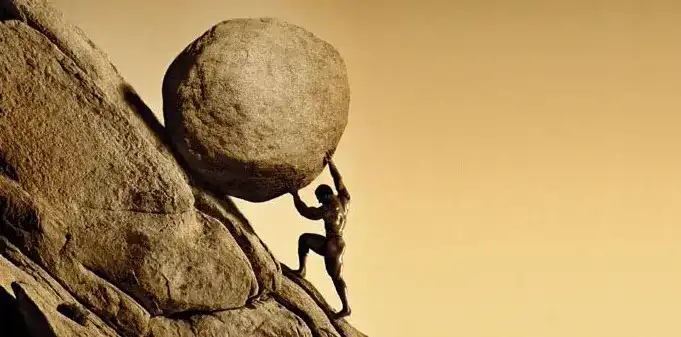
The third possibility is to accept the absurd. For Camus, this is the only authentic and effective answer. “Acceptance” here does not mean passive submission. It means facing the absurd with open eyes and creating one’s own meaning and value within meaninglessness. Camus wrote: “There is no fate that cannot be surmounted by scorn.” The line captures the heart of Sisyphus’s attitude: even if fate is fixed, we can still rise above it through the stance we take. Walking back down the mountain, Sisyphus knows the stone will roll down again, yet he chooses to climb once more. Resistance remains possible precisely where it seems impossible. Sisyphus, in other words, embodies humanity’s ultimate revolt against fate.
 爱发电(点击图片跳转)