
Earth at the Spring Equinox, Seen from Space
Author: A Millisecond of Eternity
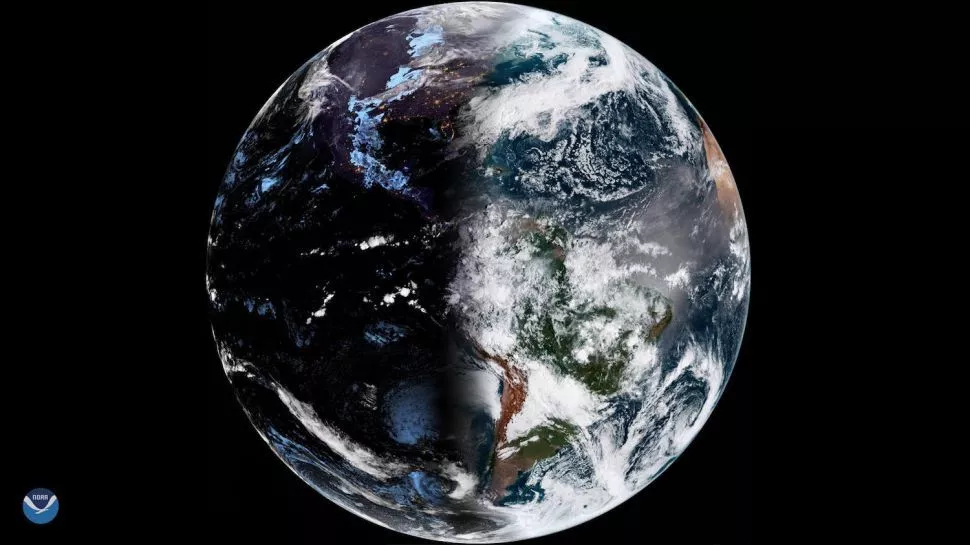
On March 20, 2019, a GOES satellite photographed Earth at the spring equinox. In the image, half the planet is bathed in light while the other half lies in darkness, like a black-and-white cookie.
This beautiful symmetry will not surprise anyone familiar with astronomy and geography. Yet a real photograph—especially an astronomical one—can be more powerful than the theories we learn, leaving us in awe of the universe’s extraordinary beauty. In Latin, “equinox” means “equal night.” As geography teachers tell us, the spring and autumn equinoxes occur in March and September each year, when day and night are nearly equal in length at every latitude.
Earth’s rotation axis is tilted 23.5 degrees relative to its orbital plane. The subsolar point moves between the Tropic of Cancer and the Tropic of Capricorn, so sunlight is usually distributed unevenly across the planet. Depending on Earth’s position in its orbit around the Sun, day and night are generally unequal in length in both the Northern and Southern Hemispheres.
“At the spring and autumn equinoxes, the Northern and Southern Hemispheres receive essentially the same amount of daylight,” said C. Alex Young, associate director for science in the Heliophysics Science Division at NASA’s Goddard Space Flight Center. In other words, at noon on an equinox, the Sun is directly overhead at the equator.
The 2019 spring equinox occurred at 5:58 a.m. Beijing time on March 21, marking the first astronomical day of spring in the Northern Hemisphere. GOES-East captured the image above at 8:00 p.m. Beijing time on March 20, 2019.
The GOES series—the Geostationary Operational Environmental Satellite system—is a network of Earth-observation satellites operated by the U.S. National Oceanic and Atmospheric Administration (NOAA). One satellite is stationed at 75° west longitude and another at 135° west, hence the names GOES-East and GOES-West. Together, they cover roughly one-third of the globe and provide continuous meteorological observations of the Western Hemisphere 24 hours a day.
References
 爱发电(点击图片跳转)