How Long Is a Day on Saturn? Scientists Finally Have a Precise Answer
Author: A Millisecond of Eternity
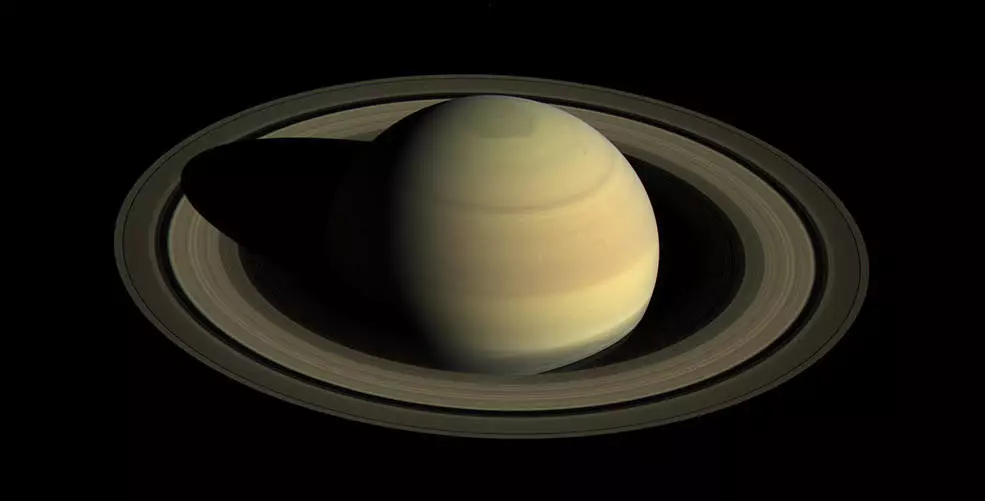
Using new data from NASA’s Cassini spacecraft, researchers believe they have solved a long-standing mystery in solar system science: how long a day lasts on Saturn. The answer is 10 hours, 33 minutes, and 38 seconds. Planetary scientists spent decades trying to pin down that number because the rotating gas giant has no fixed surface to track and its unusual magnetic field masks its rotation rate.
As it turns out, the answer was hidden in Saturn’s rings.
While Cassini orbited Saturn, its instruments examined the planet’s icy, rocky rings in unprecedented detail. Christopher Mankovich, then a graduate student in astronomy and astrophysics at the University of California, Santa Cruz, used those data to study wave patterns within the rings. His work showed that the rings respond to Saturn’s own oscillations, much as a seismometer records vibrations from an earthquake. Oscillations inside Saturn cause extremely small, periodic shifts in the distribution of its mass, making the surrounding gravitational field fluctuate. The rings also respond to Saturn’s magnetic field. Mankovich explained that particles throughout the rings feel these oscillations in the gravitational field. At certain locations, the oscillations nudge ring particles at just the right moment, allowing energy to build gradually in their orbits. That energy is then carried away as observable waves.
Mankovich’s study, published in The Astrophysical Journal on January 17, 2019, details how he developed models of Saturn’s internal structure that reproduced the waves observed in the rings. The models allowed him to trace motion inside the planet and ultimately determine its rotation period. The analysis yielded a period of 10 hours, 33 minutes, and 38 seconds, several minutes shorter than the estimate derived from Voyager radio signals in 1981.
Voyager’s estimate was 10 hours, 39 minutes, and 23 seconds, based on magnetic-field data. Cassini relied on magnetic data as well, but its early estimates ranged from 10 hours and 36 minutes to 10 hours and 48 minutes.
Scientists usually rely on a planet’s magnetic field to measure its rotation rate. Jupiter’s magnetic axis, like Earth’s, is not aligned with its rotation axis. As the planet spins, the magnetic axis therefore wobbles, producing a periodic radio signal from which scientists can derive the rotation rate. Saturn is different: its unusual magnetic axis is almost perfectly aligned with its rotation axis, so this method does not work. Researchers instead turned to waves in Saturn’s rings to probe the planet’s interior and pin down this long-sought fundamental property. The result delighted Saturn researchers, giving them their best answer yet to one of the planet’s most basic questions. The idea of using Saturn’s rings to study the planet’s seismology was first proposed in 1982, well before observations precise enough to do so became possible.
Co-author Mark Marley, now at NASA’s Ames Research Center, developed the idea in detail in his 1990 doctoral dissertation. Along with presenting the calculations, he predicted where the relevant features would appear in Saturn’s rings. Marley also pointed out that the planned Cassini mission could make the observations needed to test his idea. Twenty years later, during Cassini’s final years, scientists analyzed the mission data and found ring features exactly where Marley had predicted them.
Cassini’s mission ended in September 2017, when the mission team deliberately sent the fuel-starved spacecraft into Saturn’s atmosphere to prevent it from colliding with one of the planet’s moons. The mission was a collaboration among NASA, the European Space Agency (ESA), and the Italian Space Agency. NASA’s Jet Propulsion Laboratory (JPL) managed the mission for the agency’s Science Mission Directorate in Washington. JPL designed, developed, and assembled the Cassini orbiter; the radar instrument was developed jointly by JPL, the Italian Space Agency, and team members from the United States and several European countries.
 爱发电(点击图片跳转)