A Mathematician's Sense of Beauty: Penrose Tilings
Author: Martin Gardner
Translator: Tu Hong
Excerpted from Fractals, Take-Away Games, and Penrose Tilings, Shanghai Scientific and Technological Education Publishing House
Text and images selected from the WeChat account Fun Mathematics (ID: mathfun)
Sir Roger Penrose (1931– ) is a British mathematical physicist known for major work in general relativity and cosmology. He has also contributed to recreational mathematics and philosophy. This article is excerpted from Fractals, Take-Away Games, and Penrose Tilings, a volume in a classic collection of Martin Gardner’s writing on recreational mathematics.
In 1957, Scientific American ran my column on periodic tilings of the plane by congruent convex polygons. The piece was later reprinted in Time Travel and Other Mathematical Bewilderments. At its close, I promised a future column on nonperiodic tilings. This chapter reprints the 1977 column in which I kept that promise and first presented an extraordinary nonperiodic tiling discovered by the celebrated British mathematical physicist and cosmologist Roger Penrose. I will begin with a few definitions and some background.
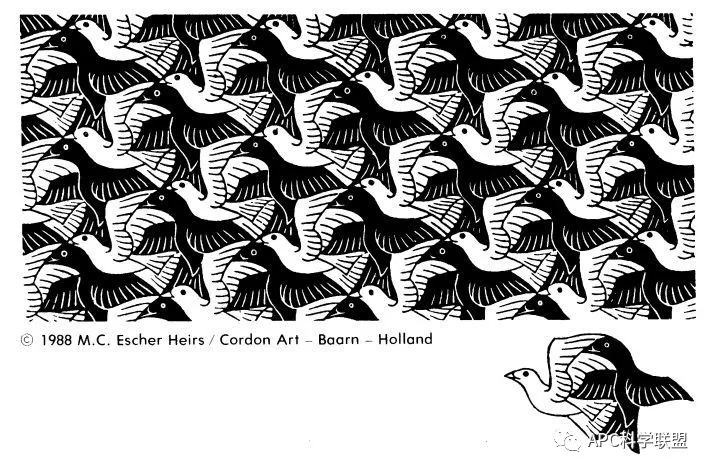
A tiling is periodic if some outlined region can tile the entire plane by translation, meaning that it is moved without being rotated or reflected. The Dutch artist M. C. Escher [Translator’s note: M. C. Escher (1898–1972) was a Dutch printmaker renowned for the mathematical character of his art. His work often features tessellations, impossible structures, paradoxes, and cycles, and gives visual expression to such mathematical ideas as fractals, symmetry, hyperbolic geometry, polyhedra, and topology.] became famous for pictures made by periodically tiling the plane with shapes that resemble living creatures. The image below is a representative example. A neighboring black bird and white bird form the fundamental region of its translational tiling. Imagine laying transparent paper over the plane and tracing the outline of every tile. If the tiling is periodic, you can slide the paper to a new position, without rotating it, and make every outline coincide again.
Infinitely many shapes, including the regular hexagon, can tile only periodically. Infinitely many others can tile either periodically or nonperiodically. A chessboard, for example, can easily be turned into a nonperiodic tiling of congruent isosceles right triangles or quadrilaterals. Bisect each square as shown at left in Figure (A) below, changing the orientation of the cuts so that no period develops. Dominoes can also form nonperiodic tilings quite easily.
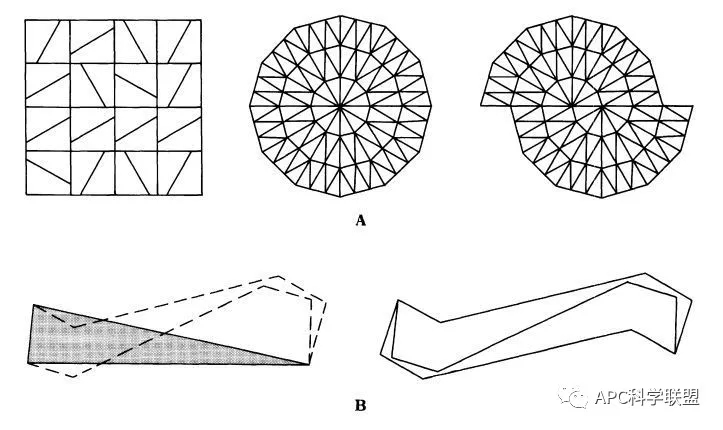
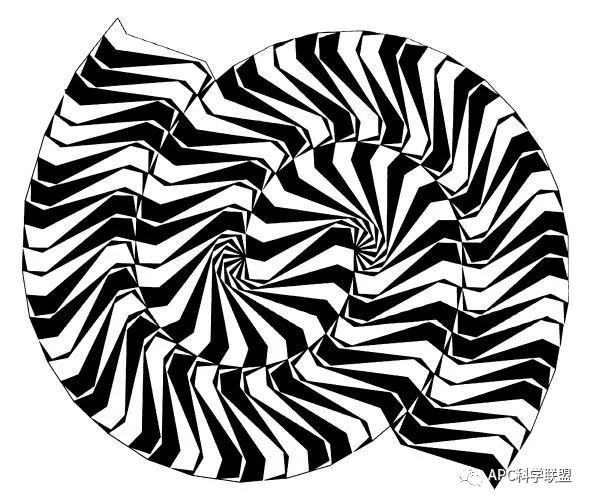
Isosceles triangles can also tile radially, as in the center of Figure (A) above. Although this tiling is highly ordered, it is plainly not periodic. As Michael Goldberg pointed out in a 1955 paper titled “Central Tessellations,” such a tiling can be cut in half and the two half-planes shifted by one or more steps to form the nonperiodic spiral shown at right in Figure (A). By replacing the two equal sides of the triangle with two congruent lines, the triangle can be distorted in infinitely many ways, as shown at left in Figure (B). If the new edges consist of straight segments, the resulting polygons—with 5, 7, 9, or 11 sides—can tile in spirals. The image below shows a striking pattern obtained in this way with a nonagon. Heinz Voderberg first discovered it by a complicated method; Goldberg’s way of deriving the figure makes it seem almost routine.
In every known nonperiodic tiling made from congruent shapes, the same shape can also tile periodically. The right side of Figure (B) above shows two of Voderberg’s nonagons joined to form an octagon, which plainly tiles periodically.
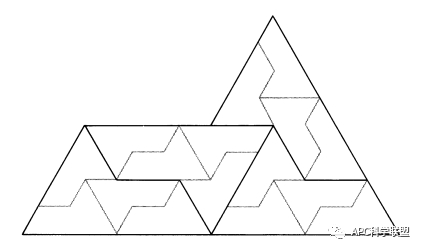
Another kind of nonperiodic arrangement can be produced by fitting a set of shapes together into larger copies of themselves. Solomon W. Golomb called such shapes “rep-tiles.” (See Chapter 19 of my book The Unexpected Hanging.) The image below shows how the shape known as the “sphinx” produces a nonperiodic tiling by generating ever-larger sphinxes. As in the preceding example, two sphinxes—one rotated 180°—can tile periodically in an obvious way.
Do any sets of tiles admit only nonperiodic tilings? Here “only” means that no single shape, no subset, and not even the set as a whole can tile periodically, although the full set can tile nonperiodically. Rotations and reflections are allowed.
For decades, experts believed that no such set existed, but the conjecture proved false. In 1961, Hao Wang [Translator’s note: Hao Wang (1921–1995) was a Chinese American philosopher and mathematical logician. He held posts at Harvard University, the University of Oxford, and Rockefeller University, and also served as a research engineer at the Burroughs Corporation, a technical expert at Bell Telephone Laboratories, and a visiting scientist at the IBM Research Center, among other roles.] became interested in tiling the plane with sets of unit squares whose edges were colored in different ways. These unit squares are known as Wang tiles. Wang also wrote an excellent 1965 article about them for Scientific American. His problem was to find a method for determining whether any given set of tiles could cover the plane so that adjacent edges always had matching colors, with rotations and reflections forbidden. The problem matters because it is connected to decision problems in symbolic logic. Wang conjectured that every set of tiles capable of covering the plane could do so periodically. He also proved that if this were true, a decision method for such tilings would exist.
In 1964, Robert Berger proved Wang’s conjecture false in his Harvard doctoral dissertation in applied mathematics. No universally applicable method exists, and therefore there is a set of Wang tiles that can tile only nonperiodically. Berger constructed such a set from more than 20,000 tiles. He later found a much smaller set of 104, and Donald Knuth [Translator’s note: Donald Knuth (1938– ) is a celebrated American computer scientist. He created the field of algorithm analysis and invented the TeX typesetting system and the Metafont type-design system. His Chinese name, Gao Dena, was chosen before his visit to China in 1977.] reduced the number to 92.
A set of Wang tiles can readily be converted into polygonal tiles that force nonperiodicity. Replace the colored edges with matching protrusions and indentations, as on jigsaw pieces, so that the polygons fit only where the colors previously matched. An edge that bore one color can then fit only an edge that bore the same color, and likewise for every other color. Allowing rotations and reflections, Raphael M. Robinson constructed six tiles that force aperiodic tilings in the sense described above (see the image below). In 1977, Robert Ammann [Translator’s note: Robert Ammann (1946–1994) was an American amateur mathematician who made several important contributions to the theory of quasicrystals and aperiodic tilings.] found a different set of six tiles that does the same. It remains unknown whether the number of square tiles can be reduced below six, though there is good reason to think six is the minimum.
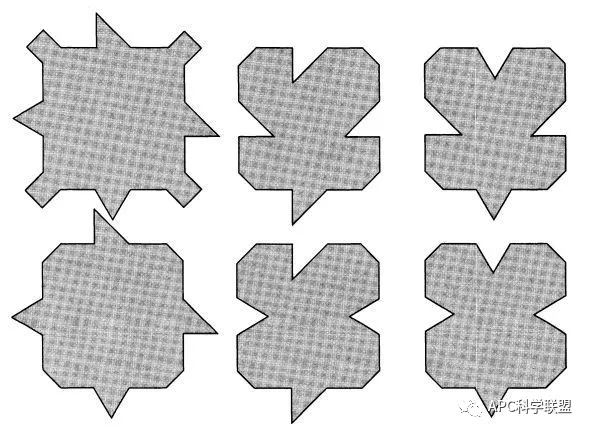
Penrose was Rouse Ball Professor of Mathematics at the University of Oxford. There he discovered several small sets of nonsquare tiles that force nonperiodicity. Although most of his work concerns relativity and quantum mechanics, he has maintained an active interest in recreational mathematics. He shared that pleasure with his father, the late geneticist L. S. Penrose. Together they invented the famous “Penrose stairs,” a staircase that loops endlessly without ever climbing higher. Escher depicted it in his print Ascending and Descending. In 1973, Penrose discovered a set of six tiles that forces aperiodic tilings. In 1974, he found a way to reduce the set to four. Soon afterward, he reduced it again, to two.
Because the tiles were suitable for commercial puzzle games, Penrose did not agree to make them public until he had applied for patents in Britain, the United States, and Japan. Those patents remain in force today. I am equally indebted to Conway for many results he obtained while studying Penrose tilings.
The shapes of a pair of Penrose tiles can vary, but the most interesting pair is the “dart” and “kite,” as Conway named them. Figure (A) below shows how both shapes can be obtained from a rhombus with interior angles of 72 and 108 degrees. Divide the long diagonal in the familiar golden ratio, (1+√5)/2=1.61803398…, [Editor’s note: In China, the golden ratio is generally written as (√5-1)/2=0.618…, while it is generally written abroad as (1+√5)/2=1.618…. The two are reciprocals; only the order of the ratio differs.] and connect that point to the two obtuse vertices. It is that simple. Let φ denote the golden ratio. As the figure shows, every line segment has length either 1 or φ. The smallest angle is 36 degrees, and every other angle is a multiple of it.
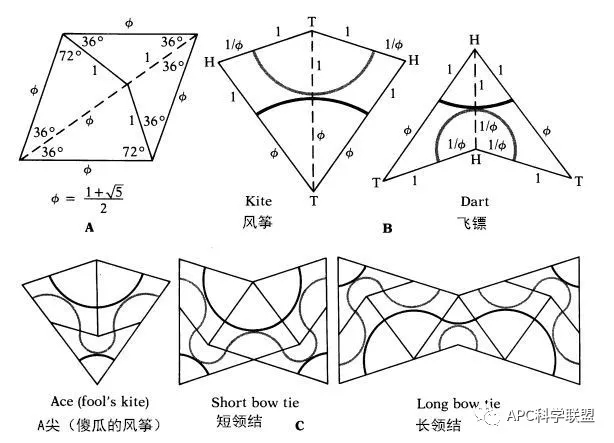
The rhombus can, of course, tile periodically, but Penrose tiles are not allowed to meet in that fashion. Equal-length edges must not match indiscriminately. Protrusions and indentations could enforce the restriction, but simpler devices work as well. One is to label each vertex H for “head” or T for “tail,” as shown in Figure (B), and permit joined edges only when like-labeled vertices meet. Two colors of dots at the vertices make this rule easier to follow. Conway proposed a more elegant device: draw two colors of arcs on each tile, shown in black and gray in the illustration. Each arc divides an edge and the axis of symmetry in the golden ratio. Adjacent edges may meet only when arcs of the same color connect.
To appreciate fully the beauty and mystery of Penrose tiling, you should make at least 100 kites and 60 darts. The tiles need to be colored on only one side. The required numbers of the two tiles, like their areas, stand in the golden ratio. You might expect to need more of the smaller darts, but the opposite is true: 1.618… times as many kites as darts are required. For an infinite tiling, this ratio is exact. Because it is irrational, the ratio provides the basis of Penrose’s proof that the tiling is nonperiodic. If the tiling were periodic, the ratio would plainly be rational.
A practical approach is to fit as many darts and kites as possible on one sheet of paper, at roughly five kites for every three darts, and draw the curves with a fine line. Photocopy the sheet as many times as needed, then color the curves, perhaps with red and green felt-tip pens. Conway found that making many copies of the three larger shapes in Figure © speeds construction and helps keep the pattern stable. As a pattern grows, darts and kites can continually be replaced by aces and bow ties. Indeed, any number of such paired shapes, each built from darts and kites, can be used in an infinite pattern.
One way to build a Penrose pattern is to arrange darts and kites around a vertex, then work radially outward. At every boundary position, you must choose a dart or a kite. Sometimes the rules force the choice; sometimes either tile seems to fit. A conflict may then appear farther on, where neither tile can be added legally, and you must return to the earlier position and choose differently. A sound strategy is to work around the boundary first, placing every tile whose choice is forced. None of these placements can create a conflict. You can then experiment at the ambiguous positions. The construction can always be continued indefinitely. With practice, you recognize more “forcing rules” that make the work faster. A dart, for example, must have two kites in its concavity, producing the familiar ace.
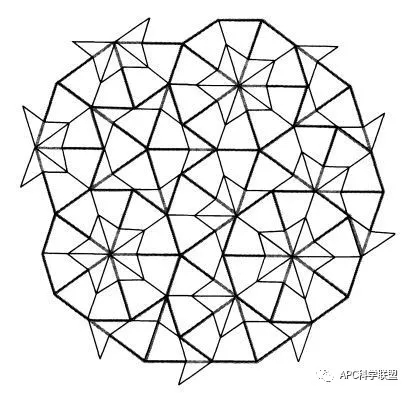
There are many ways to prove that the number of Penrose tilings is uncountable, just as the number of points on a line is uncountable. All these proofs rely on a remarkable phenomenon discovered by Penrose, which Conway called “inflation” and “deflation.” The image below shows the beginning of inflation. Imagine cutting every dart in half and then gluing together all the original short edges. The result is a new tiling composed of larger darts and kites, shown with heavy black lines.
Inflation can continue without end, with each new “generation” of tiles larger than the one before it. Notice that although the second-generation kite has the same size and shape as the first-generation ace, it is constructed differently. For this reason, the ace is also called the fool’s kite. It must never be mistaken for a second-generation kite. Deflation is simply the same process in reverse. On every Penrose tiling, we can draw generation after generation of ever-smaller darts and kites. This pattern, too, continues indefinitely, creating a fractal structure (see Chapter 3 of the original book).
Conway’s proof that there are uncountably many Penrose patterns can be outlined as follows; Penrose had already proved the result by another method. Mark one side of a kite’s axis of symmetry L for “left,” and the other R for “right.” Mark a dart in the same way with lowercase l and r. Choose a point at random in the tiling and record the letter that describes its position within the tile. Inflate the pattern once, find the same point on its second-generation tile, and record that letter. Continue through higher and higher orders of inflation. The result is an infinite sequence of symbols that, in effect, uniquely labels the original pattern as viewed from the chosen point.
Choosing another point in the original pattern may produce a sequence with a different beginning, but it will eventually reach a letter after which it agrees with the first sequence forever. If no such eventual agreement exists, the two sequences identify entirely different patterns. Not every possible sequence of the four symbols can be produced in this way, but it can be proved that the sequences labeling distinct patterns are as numerous as the points on a line.
We have so far ignored the colored curves in these tilings because they make the tiles harder to see. If you study colored tiles, however, the varied and beautiful designs formed by the curves will captivate you. Penrose and Conway independently proved that whenever a curve closes, it has fivefold axial symmetry, and the entire region inside it also has fivefold symmetry. In any pattern, there can be at most two unclosed curves of each color. In most patterns, every curve is closed.
Although Penrose patterns with high-order symmetry can be constructed—and infinitely many patterns have bilateral symmetry—most are like the universe: mysterious mixtures of order and unexpected departures from order. As the patterns expand, they always seem to be trying to repeat themselves, yet never quite manage it. Chesterton once suggested that an alien observing how many human features are repeated on the left and right might reasonably infer that our bodies contain a heart on each side. The world, he wrote, “seems just a little more mathematical and regular than it is; its exactitude is obvious, but its inexactitude is hidden; its wildness lies in wait.” Everywhere there is “some silent swerving from accuracy by an inch that is the uncanny element in everything … a secret treason in the universe.” These words describe Penrose’s planar world beautifully.
Penrose’s universe has a further surprise. In a peculiar finite sense, all Penrose patterns are alike because they obey the “local isomorphism theorem.” Penrose proved that every finite region in any one pattern occurs somewhere in every other pattern, and occurs there infinitely many times.
To grasp how extraordinary this is, imagine that you live on an infinite plane tiled by one of the uncountably many Penrose tilings. You can inspect your pattern tile by tile over an ever-expanding area. No matter how large an area you explore, you can never determine which tiling you inhabit. Traveling far away and inspecting disconnected regions does not help, because all those regions belong to one large but finite region, and that region is replicated exactly, infinitely often, in every pattern. This is of course obvious for any periodic tessellation, but Penrose universes are not periodic. They differ from one another in infinitely many ways, yet can be distinguished only at an unreachable limit.
Suppose you have explored a circular region of diameter d, which we will call your “town.” You are suddenly transported to a randomly chosen parallel Penrose world. How far must you travel to find a circular region whose streets exactly match those of your home town? Conway answered with a remarkable theorem. The distance between the boundaries of your home town and an identical town never exceeds half the cube of the golden ratio times d, or 2.11+ [Translator’s note: the plus sign (+) here indicates that (1.61803398…)³=2.1180399…] times d. This is an upper bound, not an average. Walk in the right direction and you will find an exact copy of home within that distance. The theorem also holds within the universe you already occupy. Every large circular pattern, among infinitely many different kinds, can be reached by traveling some distance in a suitable direction. That distance is less than about twice the pattern’s diameter and is more likely to be about equal to it.
This theorem is quite unexpected. Consider a patternless sequence of digits such as π, which displays a similar kind of isomorphism. If you select a finite string of 10 digits and then start from a random point in π, you are certain to encounter the same string if you go far enough. There is, however, no known upper bound on the distance you must travel, and the expected distance is far greater than 10 digits. The longer the finite string, the farther you can expect to travel before finding it again. In a Penrose pattern, by contrast, you are always very close to a copy of home.
There are only seven ways for darts and kites to fit exactly around a vertex. Let us begin with the two arrangements that, in Conway’s terminology, have fivefold axial symmetry.
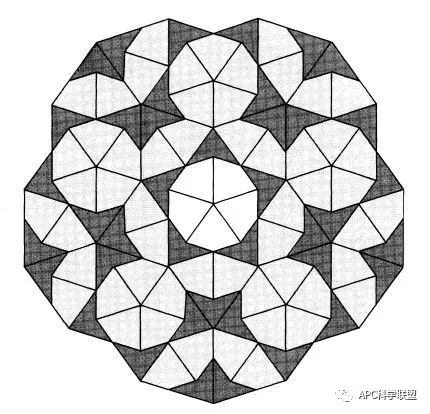
The sun, shown as the white region above, does not force the placement of any other tiles around it. If you add a few tiles while preserving fivefold axial symmetry, however, you are compelled to construct the beautiful pattern shown. It is uniquely determined out to infinity.
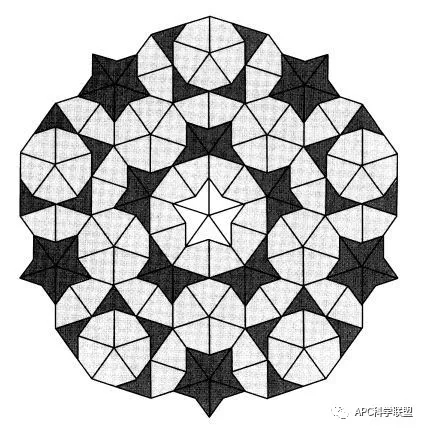
The star, represented by the white region above, forces ten light-gray kites around itself. Enlarge the pattern while continually preserving its fivefold axial symmetry, and you create another flower-like design, likewise infinite and unique. The star and sun patterns in their various forms are the only Penrose universes with perfect fivefold axial symmetry. In a delightful sense, they are equivalent: inflate or deflate either pattern and you obtain the other.
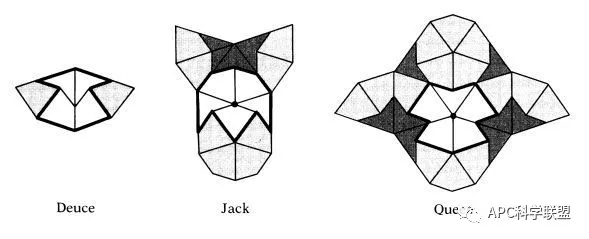
The ace is the third way to tile around a vertex. It does not force the use of any additional tiles. The deuce, jack, and queen appear as white regions in the image below, surrounded by the tiles whose placement they immediately force. As Penrose discovered—and Clive Bach later discovered independently—some of the seven vertex figures affect the placement of tiles that are not connected to the region under their direct influence.
The most remarkable Penrose universe, and the one essential to understanding these tiles, is the infinite cartwheel pattern shown in part below. At its center is a regular decagon outlined in heavy black lines, with each side made from one long and one short edge. Conway called this decagon the “cartwheel.” Every point in any pattern lies inside a cartwheel exactly like it. After one inflation, every point lies inside a larger cartwheel. The same holds at every generation, though the successive cartwheels need not have a common center.
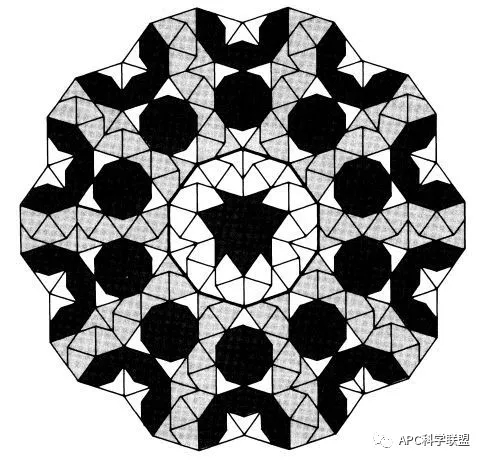
Notice the ten light-gray spokes radiating to infinity. Conway called them “worms.” They consist of alternating long and short bow ties, with the numbers of long and short bow ties in the golden ratio. Every Penrose universe contains infinitely many worms of arbitrary length. Inflate or deflate a worm and you obtain another worm along the same axis. In the infinite cartwheel pattern, two complete worms cross the central cartwheel, although their portions inside it are not gray. The other spokes are semi-infinite worms. Except for these spokes and the interior of the central cartwheel, the pattern has perfect tenfold symmetry. Between each pair of spokes, we see alternating, ever-larger portions of the sun and star patterns.
The two sides of any spoke in this infinite cartwheel pattern can be exchanged. Equivalently, every bow tie along the spoke can be reversed end for end. Apart from the tiles inside the central cartwheel, the altered spoke will still fit all its neighbors. The 10 spokes give 2¹º=1024 possible combinations. After equivalent rotations and reflections are removed, only 62 distinct combinations remain. Each leaves a region inside the cartwheel that Conway called a “decapod.”
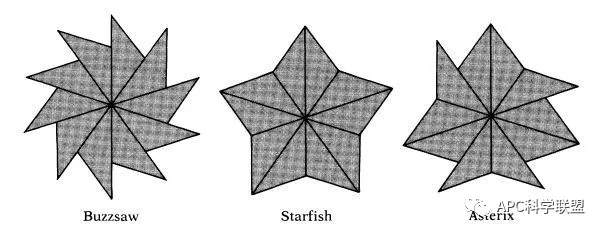
A decapod consists of 10 congruent isosceles triangles, each shaped like an enlarged half-dart. The decapods with the highest symmetry are the circular saw and starfish shown above. As with a worm, every triangle can be flipped. Once again ignoring rotations and reflections, we obtain 62 decapods. Imagine that every convex vertex on a decapod’s perimeter is labeled T and every concave vertex H. To continue the tiling, these Hs and Ts must match the heads and tails of the tiles in the usual way.
When the spokes are arranged as in the infinite cartwheel pattern, they form at their center the decapod called Batman. Batman, shown in dark gray, is the only decapod that can be tiled legally; no finite region has more than one legal tiling. Batman does not, however, force an infinite cartwheel pattern. It merely permits one. In fact, no finite part of a legal tiling can force an entire pattern, because every tiling contains that finite part.
Notice that the infinite cartwheel pattern is bilaterally symmetric, with its axis of symmetry running vertically through Batman. Inflate the pattern and it remains unchanged except for a reflection across a line perpendicular to that axis. Batman’s five darts and its two central kites are the only tiles in any Penrose universe that do not lie within a region of fivefold symmetry. Every other tile in this or any other pattern lies within infinitely many regions of fivefold symmetry.
Moving the worms in the spokes to form the other 61 combinations produces the other 61 decapods inside the central cartwheel. All 61 are “holes” in the following sense: a hole is any finite empty region that cannot be tiled legally and is surrounded by an infinite tiling. You might suppose that each decapod could sit at the center of infinitely many tilings, but Penrose’s universe plays another joke on us. Remarkably, 60 of the decapods force a single unique tiling, one different from the arrangement displayed by the spoke tiling. The only exceptions are Batman and one other decapod, named Asterix after the character in a French animated film. Like Batman, Asterix permits an infinite cartwheel pattern, but it also permits several other kinds of pattern.
This leads to a surprising conjecture. Conway had not completed a proof, but he believed that every possible hole, regardless of size or shape, is equivalent to a decapod hole in the following sense: rearrange the tiles around it, removing or adding finitely many tiles as needed, and any hole can be converted into a decapod. If so, any finite collection of holes in a pattern can be reduced to a single decapod. Remove enough tiles to join them into one large hole, then keep shrinking it until an untileable decapod remains.
Think of a decapod as a tile that has solidified. Apart from Batman and Asterix, each of the 62 decapods is like a flaw trapped inside a crystal. It forces a unique infinite cartwheel pattern, complete with spokes and all the rest, continuing forever. If Conway’s conjecture is true, then the outline of any “irregular tile”—Penrose’s term—that forces a unique tiling, no matter how large the tile, can be transformed into one of the 60 decapod holes.
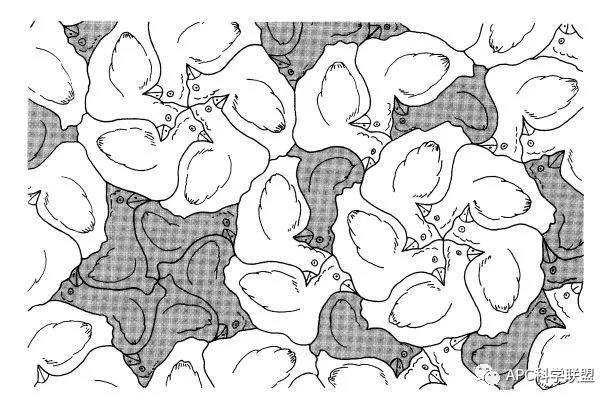
The same technique described earlier for turning an isosceles triangle into a polygon that tiles spirally can be used to transform kites and darts into other shapes. Escher used precisely this method to turn polygonal tiles into animal forms. The image above shows how Penrose converted his darts and kites into a flock of chickens that can tile only nonperiodically. Notice that although the chickens are asymmetrical, none of them needs to be flipped to cover the plane. Sadly, Escher did not learn about Penrose’s tiles before he died. Had he known of them, he would have reveled in their possibilities.
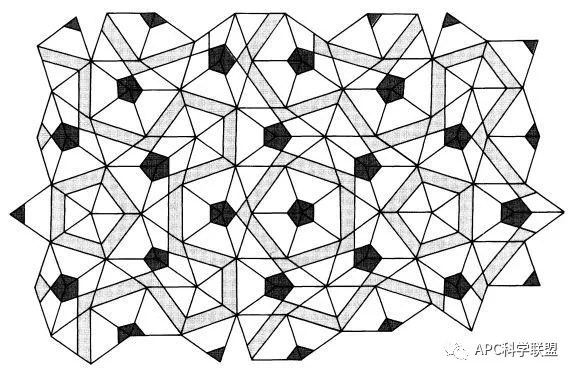
By dividing darts and kites into smaller tiles and recombining them in other ways, one can construct other pairs of tiles with similar properties. Penrose discovered an exceptionally simple pair: the two rhombs in the sample pattern above, all of whose sides have equal length. The larger has interior angles of 72 and 108 degrees; the smaller has interior angles of 36 and 144 degrees. As before, the ratio of their areas and of the numbers of tiles required is the golden ratio. The various tilings inflate, deflate, and cover the plane in uncountably many nonperiodic ways. Protrusions and indentations or some system of coloring can force the nonperiodicity. One such coloring proposed by Penrose is represented by the light- and dark-gray regions in the illustration.
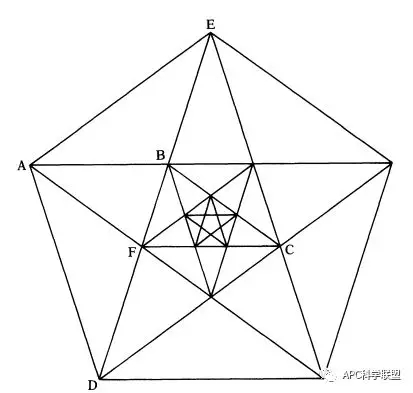
A close look at the pentagram above shows how closely the two tile sets are related to each other and to the golden ratio. The figure was a mystic symbol of the ancient Greek Pythagoreans, and Goethe’s Faust used it to trap Mephistopheles. Its construction can continue inward and outward forever, each line segment standing in the golden ratio to the next shorter one. All four Penrose tiles appear in the figure. The kite is ABCD, the dart AECB, and the two rhombs AECD and ABCF. Although the rhombs are not drawn at the proper relative sizes, both tile sets rest on what Conway liked to call the same “golden stuff.” Any theorem about kites and darts can be translated into one about Penrose rhombs, or any other pair of Penrose tiles, and vice versa. Conway preferred darts and kites; other mathematicians favored the simpler rhombs. Robert Ammann discovered many other aperiodic tile sets. One set consists of two convex pentagons and a convex hexagon and forces nonperiodicity without edge markings. He also found several pairs of another kind, each with a hexagon whose interior angles are five 90-degree angles and one 270-degree angle.
Are there pairs of tiles unrelated to the golden ratio that force nonperiodicity? Can a pair of similar tiles force nonperiodicity? Is there a pair of convex tiles that forces nonperiodicity without edge markings?
The principal open question, of course, is whether a single shape exists that can tile the plane only nonperiodically. Most experts believe that no such shape exists, but no one is remotely close to a proof. We have not even proved that if such a tile exists, it must be nonconvex.
 爱发电(点击图片跳转)