
The Cambrian Explosion and Early Life
The Cambrian Explosion and Early Life
Author: John Smith
Reviewed by: Dongda
Before we begin
Paleontology, as its name suggests, studies life from its earliest origins to the recent past. Geologists divide Earth's history into units based on the sequence of rock layers and the fossils found in them. Just as biology classifies organisms by kingdom, phylum, class, order, family, genus, and species, the geologic time scale is divided into eons, eras, periods, epochs, ages, and chrons. Each smaller unit belongs to a larger one. The relationship resembles that of the Zhìdé era name (583–587), which belongs to the Chen dynasty, itself part of the Northern and Southern Dynasties. Units larger than a period cover too much time for our purposes, while smaller units are more detailed than we need. The familiar Jurassic, Triassic, and Cretaceous are all periods.
The name “Cambrian” came from a rock stratum studied in Cambria, Wales. A Japanese scholar later rendered the sound with the Chinese characters 寒 (kan), 武 (bu), and 纪 (ki), forming kanbuki, and the term subsequently entered Chinese. Other period names were translated by meaning; the Cretaceous, for example, was named for deposits of chalk. The Chinese name for the Cambrian is purely phonetic, and the individual characters do not define the period.
The Cambrian explosion
The Cambrian stands out for its explosion of life. Before the period began, life consisted mainly of algae and bacteria, with only a very small number of invertebrates. Our knowledge of these earlier organisms comes from the relatively few fossils and microfossils that survive (Figures 1 and 2).
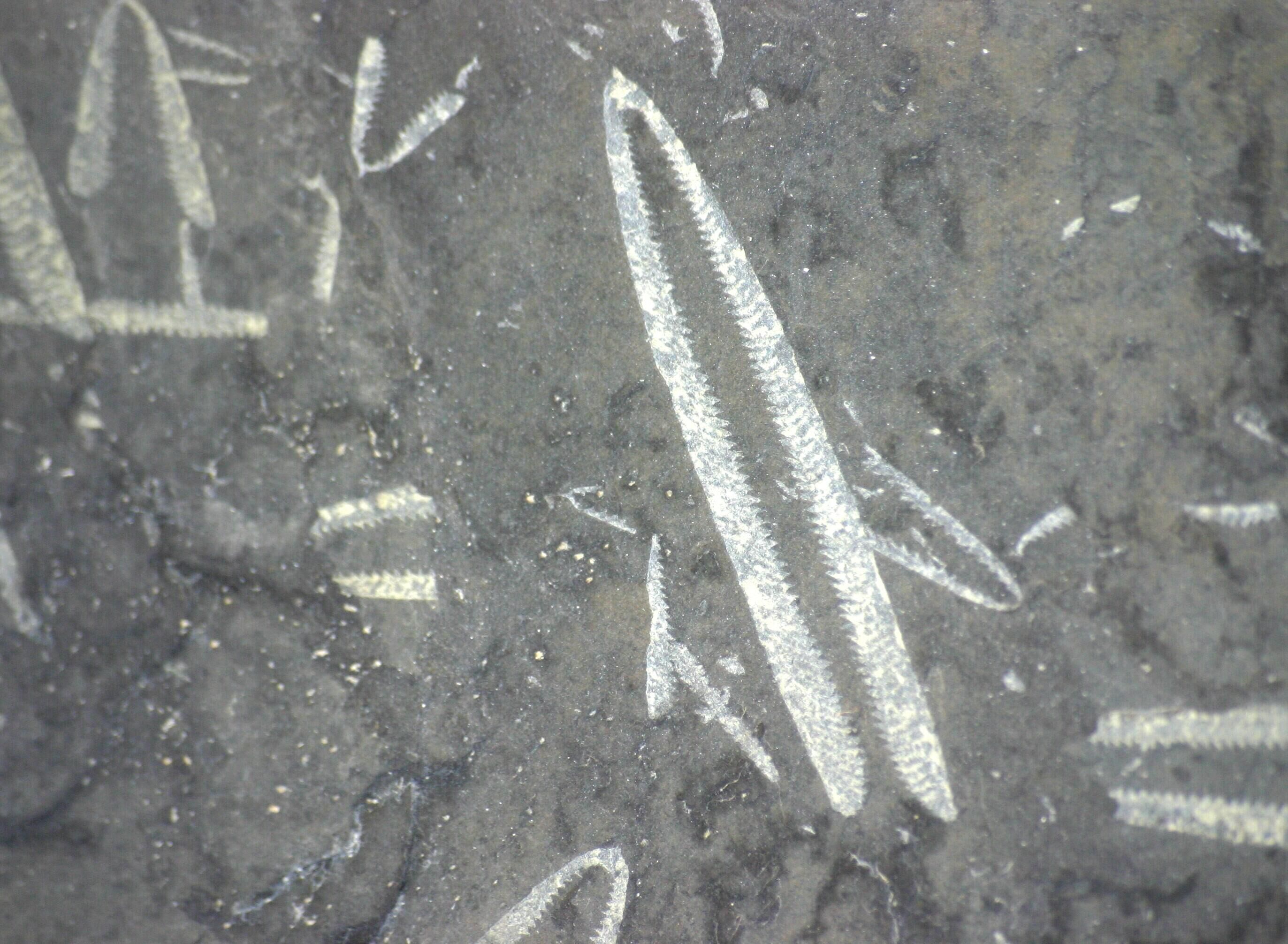
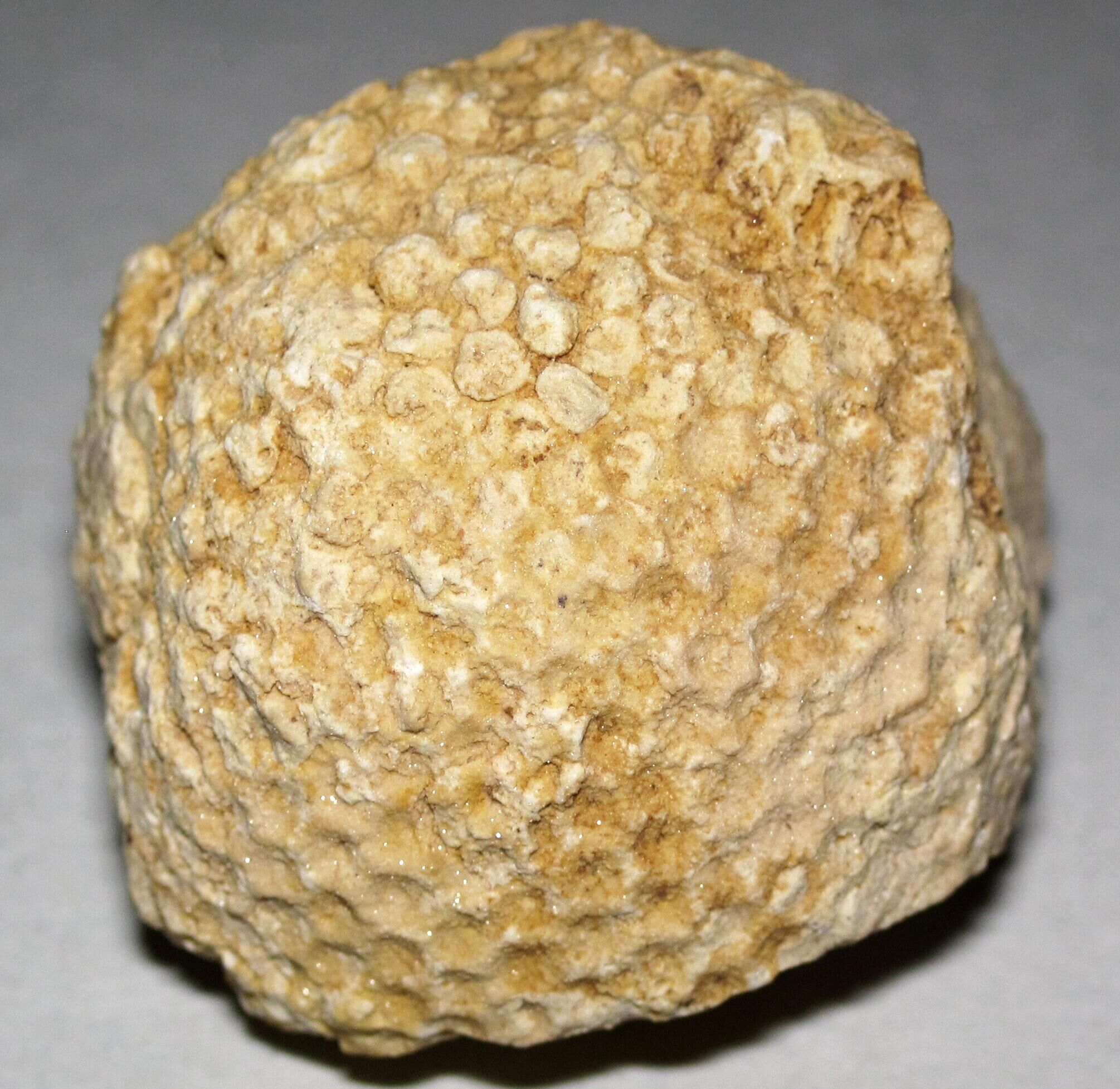
Large numbers of marine invertebrates appeared during the Cambrian, many far more complex than earlier organisms. One familiar example is the trilobite.
Trilobites are among the best-known ancient organisms. These arthropods had segmented, calcified exoskeletons, so they fossilized unusually well and are among the most common fossils recovered from the period. That abundance may tell us as much about preservation as it does about the Cambrian ecosystem: calcified shells leave fossils much more readily than algae do.
What can we hope to learn from an organism's fossil?
We first look for its distinctive features. Is it actually an organism we already recognize? How should we classify it? How did it live, what environment did it occupy, did it have symbiotic partners, and what did it eat? We can begin answering those questions by examining a classic arthropod.
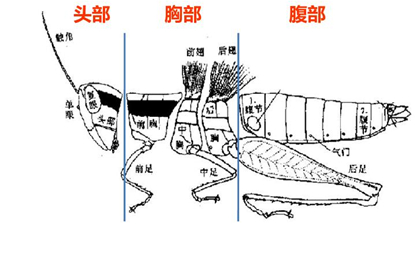
Its body has a head, thorax, and abdomen, along with numerous segments, paired symmetrical appendages, and a hard outer covering.
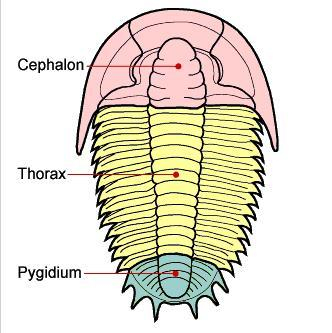
- Head, thorax, and abdomen √
- Body segments √
- Symmetry √
We cannot directly reconstruct the hard covering of an organism that lived hundreds of millions of years ago, but the fossil itself provides several clues. Bones and exoskeletons fossilize more readily than soft tissues, which usually disappear almost completely. This also helps explain why fossils of soft-bodied animals are rare. The sheer number of specimens that have survived suggests that the preserved structures were skeletal, and their outward form identifies them as exoskeletons rather than endoskeletons.
Once we identify the organism as an arthropod, the layer that contained it and the other fossils found there indicate that it was marine. With no obvious structures for swimming or maintaining buoyancy, it most likely lived on the seafloor.
How did it feed? Was it a predator, or did it filter nutrients from sand and seawater? Other fossils offer some evidence:
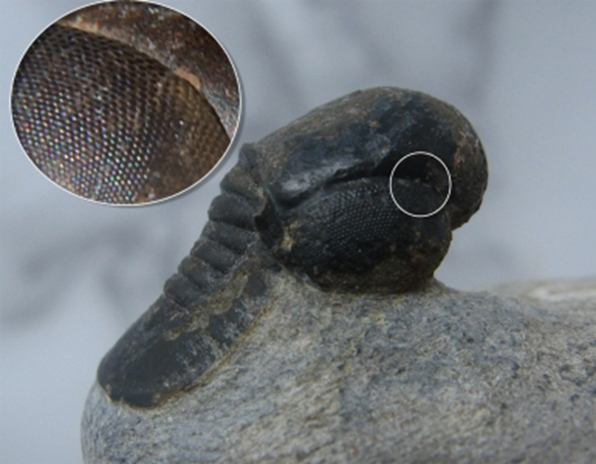
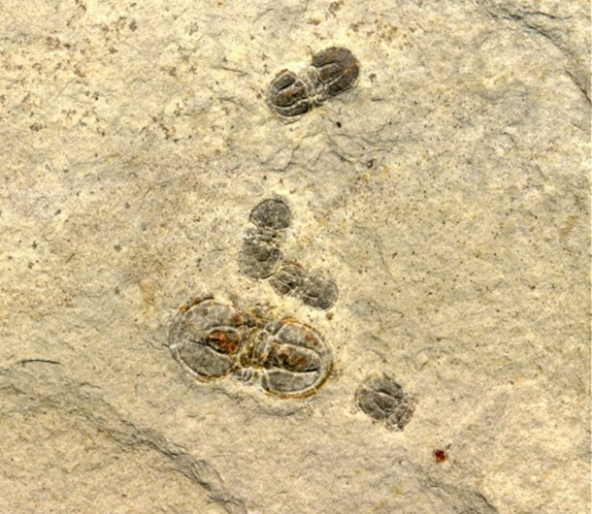
Figure 3 shows a trilobite fossil attached to another organism. The enlarged area has a clear boundary, indicating that the two impressions came from separate organisms. In Figure 4, the impression of a smaller organism is plainly visible within that of the larger trilobite. Together, the specimens suggest that trilobites, or at least some trilobite species, were predators.
This is only a preliminary reading of the evidence. A paleontologist examines many kinds of fossils from the same organism to develop a fuller picture of the species. Every living thing eventually becomes part of the past, and studying that past can help us understand what lies ahead.
Image sources
https://www.fossilguy.com/species/invert/trilo/utah/agnostid_trilobite_fossil3b.jpg
http://www.evolution-biologique.org/echelle-du-temps/echelle-des-temps-geologiques/ordovicien/la-locomotion-des-trilobites.html
All articles in this blog are licensed under CC BY-NC-SA 4.0 unless stating additionally.
 爱发电(点击图片跳转)