Author: Abaiter
Reviewer: Shiguang
Few countries have a spaceflight history as dramatic as Russia's. Tracing that history over time, this article offers a brief account and assessment of the Soviet and post-Soviet Russian space programs through two main threads: theory and engineering. For each theory, we will introduce the underlying mechanics and its engineering applications from a quantitative perspective. For each mission, we will gather as much information as possible about its scientific objectives, payload specifications, and instruments. For each space transportation system, we will present figures such as payload capacity to different orbits and specific impulse. Together, these details will let us see how Soviet and Russian spaceflight rose and declined before we turn to one final question: where does the future of Russian spaceflight lie? Without further ado, let us go back more than a century and see where modern spaceflight began its journey from dream to reality.
The Space Dream Begins
Travel back to a village in Russia's Ryazan Governorate in the 1860s, and we might find a group of lively children. If one of them is always carrying a book or earnestly explaining his extraordinary ideas to the others, we had better not interrupt him: he may be the future father of rocketry, Konstantin Tsiolkovsky. The fifth child in his family, Tsiolkovsky was bright from birth and possessed an almost obsessive fascination with the unknown. He loved to read and daydream, often imagining how beautiful the view would be if he could climb as high as a cat. Yet his childhood was full of hardship. At the age of ten, he contracted scarlet fever after going skiing. Although he survived, he lost almost all his hearing. His companions drifted away, and he spent his days immersed in the worlds of books and fantasy, where he found solace.
As he grew older, his family's limited means and his impaired hearing kept Tsiolkovsky from completing a conventional education. His father nevertheless believed that he deserved a higher education and sent him to Moscow. Unable to enroll in a school there, Tsiolkovsky studied in libraries instead. He read widely during this period and encountered cutting-edge theories and ideas. In 1977, he passed the examination for rural teachers and became a secondary-school teacher. He built a laboratory in his rented home and, unaware of earlier work, spent some time independently deriving theories about gases that had already been discovered. His interests later shifted to aviation and spaceflight, and he eventually derived the rocket equation. With his pen, he began transforming human spaceflight from an impractical fantasy into an endeavor that could actually be pursued.
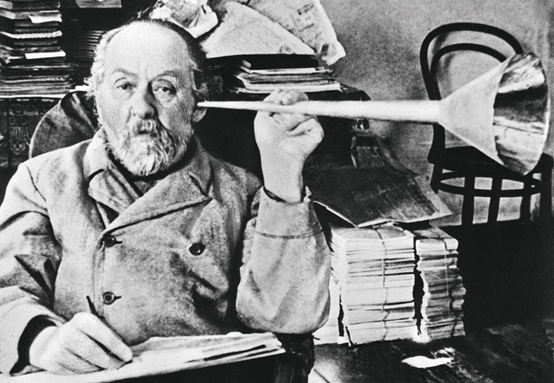 Konstantin Tsiolkovsky
 Tsiolkovsky's rocket equation is as follows:
v=ωln(km)
Here, v is the rocket’s final velocity, ω is the velocity of the exhaust gas relative to the rocket, and km is the ratio of the rocket’s initial mass to its final mass. The equation tells us, above all, that the more mass a rocket loses by expelling gas backward, the faster it travels. That may sound self-evident, but its implications are profound. When ln(km) is greater than 1—in other words, when km is greater than the natural constant e, or approximately 2.72—the rocket itself travels faster than the gas it expels. This is surprising, because common sense tells us that an object cannot be accelerated to v by something moving at a constant speed below v. How does a rocket manage it? The key is that a rocket is a variable-mass system: as it expels gas, its own mass decreases. The rocket and its exhaust therefore form a momentum-conserving system. At every moment, viewed from an inertial frame moving at the rocket’s velocity, the rocket expels gas backward and its body accelerates. According to this theory, even if a rocket expelled gas no faster than a human breath, given enough time it could accelerate to the speed of light. Another crucial implication is that the equation sets the minimum ratio between fuel mass and the mass of the rest of the rocket. At a fixed exhaust velocity, the greater the payload mass that must reach a given speed, the more fuel the rocket must carry. A higher exhaust velocity, in turn, allows a higher ratio of payload mass to fuel mass. This is why electric propulsion is being developed today. By accelerating charged particles to very high velocities, electric propulsion reduces the fuel mass required, allowing a larger payload or a higher travel speed. Even today, Tsiolkovsky’s equation continues both to constrain and to guide the development of human spaceflight.
Tsiolkovsky's rocket equation made his name immortal, but one of his remarks has proved no less influential: “Earth is the cradle of humanity, but one cannot live in a cradle forever.” Generations of spaceflight pioneers have carried these familiar words like a sacred flame. What many people do not know is the second half: “At first, they will cautiously venture beyond the atmosphere, and then they will conquer the Solar System.” The history of Soviet spaceflight would bear out that prophecy.
Getting beyond the atmosphere was no easy task. After the October Revolution, Soviet Russia faced a bleak economy and considerable domestic turmoil. During the New Economic Policy and the Five-Year Plans, the Soviet Union prioritized the heavy industry vital to the country's survival. Spaceflight was being explored only on a small scale around the world, so the Soviet Union devoted little effort to it. The world soon descended into the smoke of the Second World War. During that war, however, Germany's development and deployment of the V-2 rocket under Wernher von Braun caught the attention of the Soviet leadership. They quickly recognized in it both an important future direction for national defense and the arms industry and the shadow of humanity's future cast into the present. A man was therefore released from a Siberian prison labor camp. He would become the most important figure in the history of Soviet spaceflight: Sergei Pavlovich Korolev.
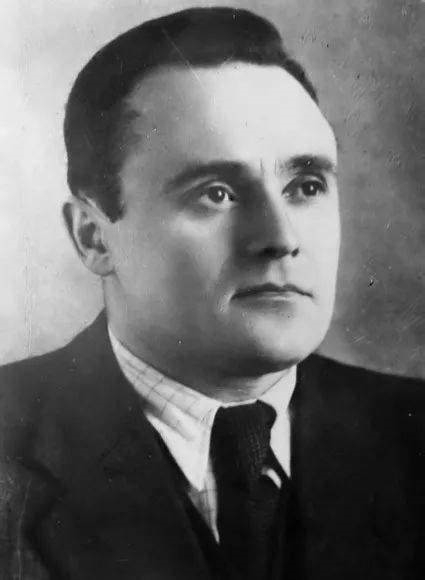 Sergei Pavlovich Korolev
 Korolev was born in 1907 in Zhytomyr, in the Ukrainian Republic of the Soviet Union. From childhood, he was fascinated by anything that could fly. He even tried to fly like a bird by using bedsheets as wings. Once he realized that he could not become a bird, he understood that humans would need aerodynamics to take to the sky. He studied the subject and independently designed a successful glider. In 1929, Korolev, by then a university graduate and aircraft designer, visited Tsiolkovsky, the father of spaceflight introduced above. Their meeting changed the history of Soviet spaceflight. Korolev resolved to shift his work from aviation to spaceflight, from within the atmosphere to beyond it.
In 1931, Korolev and other Soviet rocket enthusiasts formed the Group for the Study of Reactive Motion and began developing rocket engines. When people of great intelligence and ambition work together, they can produce first-rate results at extraordinary speed. In 1933, the group created the world's first liquid-oxygen-and-gasoline rocket engine. Soon afterward, it test-launched the Soviet Union's first liquid-fueled rocket. That same year, the Soviet Union established the world's first rocket research institute, with Korolev serving as deputy director.
As the Soviet purges expanded, however, Korolev was swept up in them and sent to Siberia. Accounts differ on why he was imprisoned. Some believe he was simply a victim of the widening purges, while others think the state deliberately jailed him to protect him during the campaign. Before long, in any case, he was transferred to a special prison, where he continued his rocket research. In the bitter cold of Siberia, Korolev had only his thoughts, paper, and pen for company. Yet the drawings that emerged from that prison sent the Soviet Union's first generation of missiles and its medium-range missiles soaring into the sky. No one knows how he spent each day and night in prison or what occupied his thoughts. I imagine, however, that they must have transcended his own honor and disgrace, even the boundaries of nations and the barriers of ideology, and flown into the endless reaches of space. Perhaps on every sleepless night, he was already riding the rockets he would later design, looking back at Earth from beyond the atmosphere and contemplating human survival and existence.
During the Second World War, Korolev was released because the state needed him; he was later rehabilitated. After the war, he became chief designer of Soviet ballistic missiles. In 1947, the Soviet Union launched its first prototype ballistic rocket. In 1949, it successfully launched its first missile, the R-1A. In 1957, the R-7, humanity's first intercontinental ballistic missile, completed a successful test flight. The Soviet Union had now cautiously ventured beyond the atmosphere. Next, it would launch larger rockets, place satellites in Earth orbit, and advance farther into the Solar System. Following the course Tsiolkovsky had described, Soviet spaceflight entered its years of glory.
Years of Glory
In 1957, as the R-7 missile made its first flight, engineers also completed a launch vehicle derived from the R-7: Sputnik. As its name suggested, it would carry humanity's first artificial satellite into space. That satellite, Sputnik 1, was a metal sphere 0.58 m in diameter and weighed 83.6 kg. Its construction was not complex. It contained two radar transmitters and 4 antennas for studying the transmission of radar signals through the ionosphere and communicating with the ground. It also carried a barometer and a thermometer to record physical parameters in the upper atmosphere. The satellite's scientific objectives were simple, but its significance was immense: for the first time, humanity would place an artificial object in Earth orbit. A dream dating back to the age of Newton was finally about to become reality.
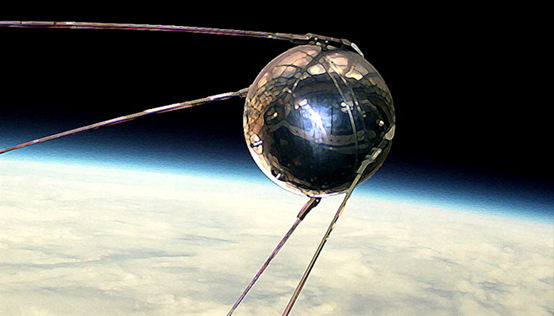 Sputnik 1
 On October 4, 1957, Sputnik 1 rose from the Baikonur Cosmodrome aboard a Sputnik launch vehicle with a thunderous roar. Good news soon arrived: the satellite had successfully entered orbit. People on the ground detected its signal and obtained scientific data from space for the first time. They cheered both the mission's success and the Soviet Union's early lead over the United States in the Space Race.
No account of Soviet spaceflight can avoid the United States. As we have seen, the first artificial satellite's scientific objectives were quite limited. Its political significance was the main force behind the rapid development and launch of both the satellite and its launch vehicle. Beating the United States to the first artificial Earth satellite would demonstrate the superiority of the Soviet system and the sophistication of Soviet technology. It would raise national pride, stabilize the socialist system, advance the international communist movement, and project a powerful international image capable of producing diplomatic victories. Driven by the same objective, the Soviet Union promptly launched the second Earth satellite on November 3 that same year, sending a small dog named Laika into space.
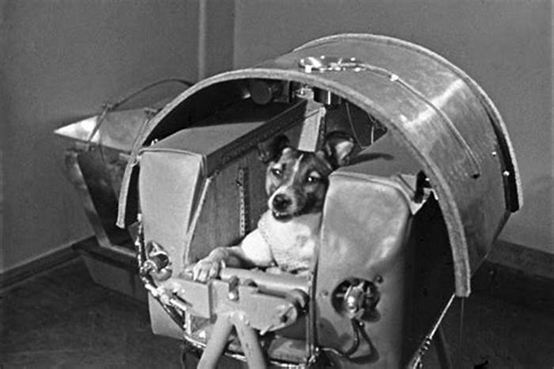 Laika
Laika The satellite, including the dog, had a mass of 508.3 kg, a substantial increase over the first. On May 15 of the following year, Sputnik 3, with a mass of 1,327 kg, was likewise launched successfully and placed in orbit. All these launches used the Sputnik launch vehicle, whose performance specifications deserve a brief introduction:
- Rocket configuration: one core stage + four conical boosters.
- Overall parameters: total length 29.167 m; maximum base diameter 10.3 m; liftoff mass 267.3 t; liftoff thrust 3,904.4 kN; thrust-to-weight ratio 1.49; low Earth orbit payload capacity 1,327 kg.
- Booster parameters: total length 19.8 m; diameter 2.68 m; liftoff mass 42.5 t; structural mass 3.5 t; propellant mass 39 t; RD-107 engine, each with four main combustion chambers and two vernier chambers; liquid oxygen/kerosene propellant; sea-level thrust 821 kN; main engine sea-level specific impulse 2,452.5 N·s/kg and vernier specific impulse 2,442 N·s/kg; operating time 120 s.
- Core-stage parameters: length 28.75 m; diameter 2.95 m; liftoff mass 95.7 t; structural mass 7.2 t; propellant mass 88.5 t; RD-108 engine; the same propellant as the boosters; rated total sea-level thrust 722.3 kN, with a corresponding derated value of 620.3 kN; total vacuum thrust 912.3 kN; vacuum specific impulse 3,021.5 N·s/kg; operating time 300 s.
Having conquered low Earth orbit, the Soviet Union set its sights on the nearest large natural body: the Moon. Engineers soon developed the Luna launch vehicle from the Sputnik rocket. It departed from the single-stage configuration and used a multistage design for the first time. Its longer operating time allowed it to send an artificial object into lunar orbit.
On January 2, 1959, Luna 1 lifted off from Baikonur aboard a Luna launch vehicle. Two days later, it flew past the Moon at a distance equal to 1/80 of the Earth–Moon distance. Because the Moon's gravity did not capture it, Luna 1 ultimately became an artificial planet of the Solar System, orbiting the Sun like Earth. It was the first human-made object to escape Earth's gravity. The Soviet government announced that humanity's first lunar probe had passed close to the Moon. The news immediately made headlines around the world, and the Soviet–American race to the Moon began.
Luna 1 had been intended to strike the Moon, but a trajectory error caused it to miss. The Soviet Union clearly had no intention of stopping there. On September 12 of the same year, Luna 2 rose into the sky along a corrected path toward the Moon. This time, an object hurled by human hands struck the surface of a body beyond Earth for the first time. Luna 2's radio communications equipment was destroyed on impact, ending its contact with Earth, but the data transmitted before the collision still provided important information: the Moon had no magnetic field and no radiation belts comparable to Earth's Van Allen belts. The American Explorer 1 satellite had discovered the Van Allen belts in 1958. Finding them on its first passage through the region demonstrated the comparatively meticulous nature of American spaceflight work, the same meticulousness that made the Apollo program possible.
The Soviet lunar program continued at full speed. Just one month after Luna 2 was launched, Luna 3 lifted off successfully and took humanity's first photograph of the far side of the Moon. Long-term tidal locking has brought the Moon's rotation and orbital periods toward the same value, so the same side always faces Earth. We call it the near side of the Moon. Luna 3 allowed us to overcome billions of years of tidal locking and glimpse the far side for the first time.
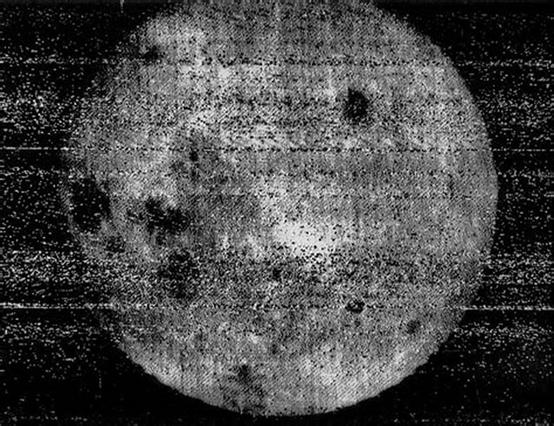 The far side of the Moon
 The Soviet crewed spaceflight program proceeded in parallel with the lunar program. On August 19, 1960, Sputnik 5 was launched. This experimental spacecraft in the Soviet Vostok program carried 2 Soviet space dogs, Belka and Strelka, 1 gray rabbit, 40 mice, 2 rats, and a number of flies, plants, and fungi. The spacecraft returned successfully the next day, bringing every living passenger back unharmed. Strelka even gave birth to 6 puppies afterward. One wonders whether she ever told her children about looking down at Earth from space.
Perhaps not, because a dog's language may not convey that much information. That task would require a human. The success of Sputnik 5 proved that crewed spaceflight was feasible. The following year, on April 12, 1961, Yuri Gagarin boarded the world's first crewed spacecraft, Vostok 1, and rode a Vostok launch vehicle into space.
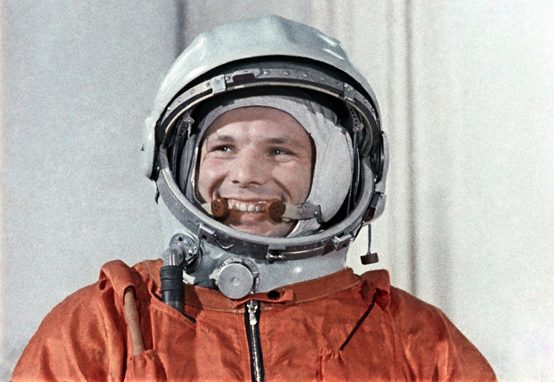 Yuri Gagarin
 “The spacecraft is operating normally. I can see Earth through the porthole. Everything is proceeding according to plan.” Eight minutes later, radio waves carried this message from space. The first human being to enter space was reporting his safety to Mother Earth. Two hours later, after the fastest trip around the world in history, Gagarin and his spacecraft reentered the atmosphere. At an altitude of 7 km, Gagarin separated from the spacecraft, opened his parachute, and made a successful soft landing. The spacecraft's parachute apparently failed to slow it sufficiently: witnesses said it was still traveling at considerable speed when it struck the ground. Gagarin, however, once again stood on solid earth. According to one account, women from a nearby farming family recoiled in terror when they saw him descend from the sky in his strange clothing. They relaxed only after Gagarin told them in Russian that he was a Soviet citizen just like them and now needed a telephone to call Moscow.
The Soviet Union had no shortage of tough men like Gagarin, or of tough women. In 1963, Valentina Vladimirovna Tereshkova, the first woman in space, also flew aboard a Vostok spacecraft. She spent more than 70 hours in space and orbited Earth 48 times. Her photographs of Earth's atmosphere later became important evidence for identifying the top of the atmosphere. She is still alive and active in public life, and she hopes to take part in an expedition to Mars. It is worth noting that she originally submitted the proposal adopted last year to amend the Russian constitution with respect to presidential terms. After sending the first woman into space, the Soviet Union went on to achieve humanity's first multi-person spaceflight and first spacewalk.
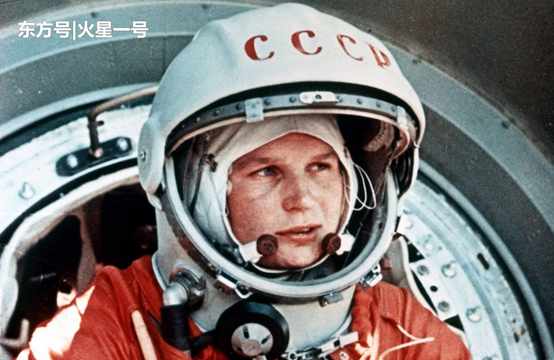 Valentina Vladimirovna Tereshkova
 Crewed spaceflight is a systems-engineering undertaking, but the rocket that carries astronauts into space is especially important. The Vostok launch vehicle had two operating modes, one for lunar exploration and the other for crewed spaceflight. Its demanding payload requirements gave it a far greater liftoff mass than earlier rockets. Its detailed specifications are shown below:
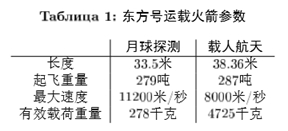
The success of the Soviet crewed space program caused a sensation. It also gave Soviet spaceflight engineers tremendous confidence and courage, convincing them that the human body could conquer more distant reaches of space. Their next objective was, of course, the Moon. By then, in 1962, the Soviet Union had successfully launched humanity's first probe to fly past Mars. This success suggested that a higher-thrust rocket could send humans to the Moon. The Molniya launch vehicle was created to meet that need. In 1966, Luna 9, carried by a Molniya, achieved the first soft landing of a human-made probe on the lunar surface.
Molniya was the first launch vehicle with a three-stage core. Its principal performance specifications were as follows:
- Dimensions and mass:
- Total length: 43.44 m
- Maximum core diameter: 2.99 m
- Liftoff mass: 305000 kg
- Boosters:
- Quantity: 4
- Engine: RD-107-8D74K
- Propellant: kerosene/liquid oxygen
- Booster thrust: 994.7 kN
- Operating time: 119 s
- First stage:
- Engine: 1 RD-108-8D75K
- Propellant: kerosene/liquid oxygen
- Thrust per engine: 940.8 kN
- Operating time: 301 s
- Second stage:
- Engine: 1 RD-0108
- Propellant: kerosene/liquid oxygen
- Thrust per engine: 294 kN
- Operating time: 200 s
- Third stage:
- Engine: 1 S1-5400
- Propellant: kerosene/liquid oxygen
- Thrust per engine: 66.7 kN
- Operating time: 192 s
- Payload capacity:
- Low Earth orbit: 6783 kg
- Geosynchronous orbit: 1600 kg
That same year, Venera 3, launched aboard a Molniya, also became humanity's first probe to reach Venus and make a hard landing there. Later, in 1975, a Molniya sent Venera 9 into orbit, and the probe returned what remains humanity's only photograph of Venus. But that comes later in the story.
Another high-capacity launch vehicle, Proton, was developed around the same time. It later became a workhorse of Russian space transportation and carried out many space-station launches.
Yet a crewed lunar landing would clearly require an even more powerful rocket. The United States was then developing the Saturn V, one of the highest-thrust rockets in human history. Unwilling to fall behind, the Soviet Union developed the N-1, which became the largest firework in human history, bar none.
Development of the N-1 was completed in 1965, and it underwent 4 launches between 1969 and 1972. Every launch failed, and the first 3 ended in low-altitude explosions that caused enormous damage. The N-1's first stage had 30 engines controlled by the KORD thrust-control system. Problems with KORD caused the first two failures. The first occurred because the KORD system's frequency was close to the resonant frequency of the first stage. This made KORD overly sensitive to a voltage fluctuation in engine No. 12, which it misread as a failure, prompting it to shut down the engine. Because thrust had to remain balanced, shutting down one engine triggered a chain reaction that ultimately shut down every engine. The rocket lost thrust, coasted freely, struck the ground 52 km away, and exploded. The second failure began when an engine ingested foreign debris and exploded. KORD immediately sent shutdown commands to the other engines, causing the rocket to fall back onto the launch pad and produce the largest non-nuclear explosion in human history. The third and fourth launches came closer to success, but both failed because of problems that could have been discovered in ground testing. In short, all 4 failures were virtually inevitable. With funding in short supply, conflicts of interest kept the various chief engineers and engineering departments from cooperating effectively, while Korolev's death left the development team even more leaderless. Objectively speaking, controlling 30 high-thrust engines at once may simply have been extremely difficult while computer technology remained immature. Together, these factors defeated the N-1. After the United States succeeded in landing on the Moon, the Soviet Union gradually abandoned both the N-1 and its crewed lunar-landing program. Yet the N-1 laid the groundwork for the still more powerful Energia launch vehicle, which would become the final crescendo in the history of Soviet spaceflight.
The Final Crescendo
After losing the Moon race, the Soviet Union turned to other fields. It launched Salyut 1, humanity's first space station, in 1971 aboard the Proton-M rocket mentioned earlier. Because that rocket used the highly toxic propellant unsymmetrical dimethylhydrazine, it was jokingly called the “ultimate toxic launch.” That same year, the Mars 2 probe achieved humanity's first hard landing on Mars. Just 5 days later, Mars 3 reached Mars, completed humanity's first soft landing there, and successfully transmitted information from the planet back to Earth, though it operated for only 7 s. In 1975, the Soviet Venera 9 returned humanity's first image of the Venusian surface, which is also the only photograph humanity has of the surface of Venus. In 1984, Svetlana Savitskaya walked in space, becoming the first woman to move freely outside a spacecraft. In 1986, Halley's Comet returned, and the Soviet Vega probe flew past it. That same year, construction began in earnest on the Soviet Mir station, humanity's first third-generation space station. With its lunar ambitions thwarted, the Soviet Union immediately embarked on new explorations and created one marvel after another.
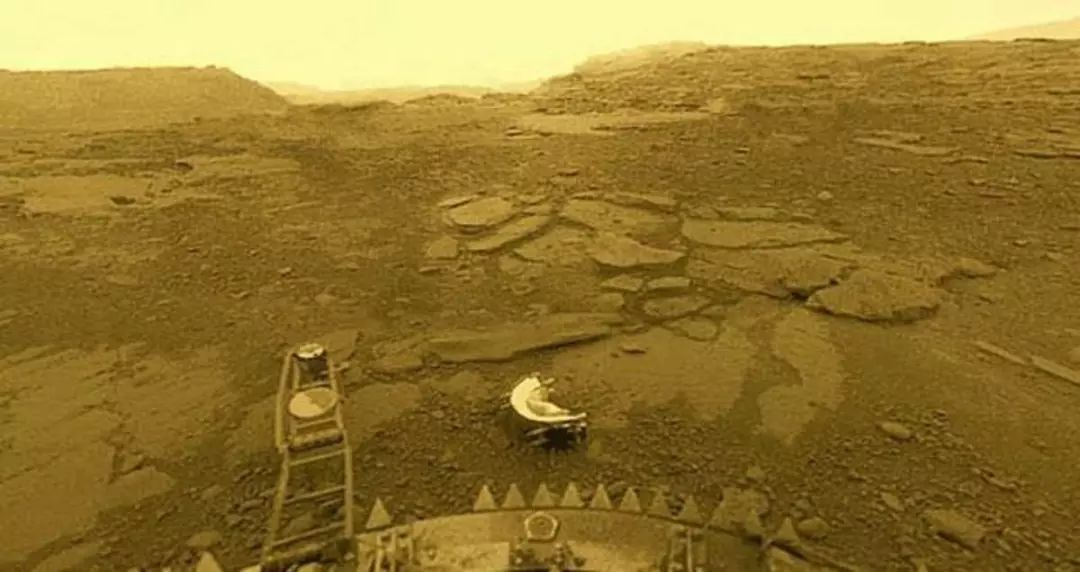 Photograph of the surface of Venus taken by Venera 9
 Amid this succession of triumphs, the Soviet Union finally unveiled the major project it had kept under wraps for 20 years: Energia, the world's most capable launch vehicle to date. Its development could be traced back to the 1960s. In 1973, the United States made a technological transition, abandoning the Saturn V in favor of the Space Shuttle, while the Soviet Union continued researching high-energy cryogenic propulsion. Drawing on the N-1's technological legacy and following a long period of research, evaluation, design, and manufacturing, Energia finally made its first flight in 1987. Energia was a prototype platform. It could carry a space shuttle and could even be adapted for rocket recovery, much as SpaceX does today. A technical malfunction kept its first flight from reaching orbit, but the vehicle was already a qualitative improvement over the N-1. On its second test flight, Energia successfully carried the Buran space shuttle into space. Buran then returned automatically, glided, and landed. Once again, the hegemonic West felt the pressure of an apparently imminent Soviet sweep of the spaceflight field. If Energia entered routine service and began to be recovered and reused, the West would have no advantage left in spaceflight.
To understand the mindset of the hegemonic West, consider Energia's specifications:
- Dimensions and mass:
- Total length: 60 m
- Booster diameter: 3.9 m
- Booster height: 38.3 m
- Second-stage core diameter: 7.7 m
- Mass: 2400000kg, 2400T.
- Core stage:
- Engines: 4 RD-0120 engines
- Propellant: liquid oxygen/liquid hydrogen
- Thrust: 5,800-7,500kN
- Specific impulse: 359 s at sea level, 455 s in vacuum
- Operating time: 480-500 s.
- Booster stage:
- Engines: 4 RD-170 engines
- Propellant: kerosene/liquid oxygen
- Thrust: 29000-32000kN
- Time: 309 s at sea level, 338 s in vacuum.
Clearly, this was a behemoth. Its boosters alone were taller and heavier than the entire Vostok-series rockets described earlier. Nor was its enormous size merely for show: the core stage plus 2 booster stages could produce more than 70000 kN of thrust, nearly 100 times that of the Sputnik launch vehicle. By comparison, the American Saturn V could provide only 34000 kN of thrust and was dwarfed by Energia. Moreover, the Saturn V was no longer in service, so in practice the United States no longer possessed such payload capability. The age of Soviet supremacy in space seemed about to begin.
Fate, however, had other plans. The 2 Energia test flights just described were the only 2 launches it would ever make. Gorbachev came to power 2 years before Energia's first launch and soon began economic reforms. While Energia was undergoing flight tests, Gorbachev's reforms moved into the political sphere and gradually spun out of control. A powerful nation was approaching its end.
The Great Roc’s Broken Wings
After the Soviet Union collapsed, misguided shock therapy impoverished the people of the new Russia while creating a class of oligarchs. The organizational and economic foundations on which the space program depended were severely damaged, and Russia could no longer sustain construction and launch projects on Energia's immense scale. Yet the legacy of the past remained: a deep reserve of talent and technical support on the ground, existing rocket designs and production models, and the Mir space station in orbit. With the docking of its final 2 modules in 1995 and 1993, Mir was completed. The finished station was 87 m long, had a mass of 123 t, and offered 470 cubic meters of usable volume. As the world's first long-duration crewed space station, it spent 15 years in orbit, far exceeding its design life of 5 years. It circled Earth more than 80000 times, traveled 3.5 billion km, conducted 22000 scientific experiments, and completed 23 international scientific research programs. A total of 31 Soyuz crewed spacecraft and 62 Progress cargo spacecraft docked with it. It also docked 9 times with American Space Shuttles, and astronauts on joint missions made 78 spacewalks from this “human-made celestial palace,” spending a total of 359 h 12 min outside the station. Over the years, 28 long-term expeditions and 16 short-term expeditions worked aboard it; astronauts from 12 countries, 135 people in all, served on the station. They conducted numerous life-science, space-materials, and medical experiments, producing exceptionally valuable results and data. They photographed many stars and planets, detected elementary particles and cosmic rays, and greatly expanded humanity's knowledge of the universe. They also explored the possibility of using space to forecast earthquakes, volcanic eruptions, floods, and other natural disasters. In 2001, the station was deliberately deorbited and burned up in the atmosphere. People said, “The last territory of the Soviet Union disappeared into the sky at that moment.”
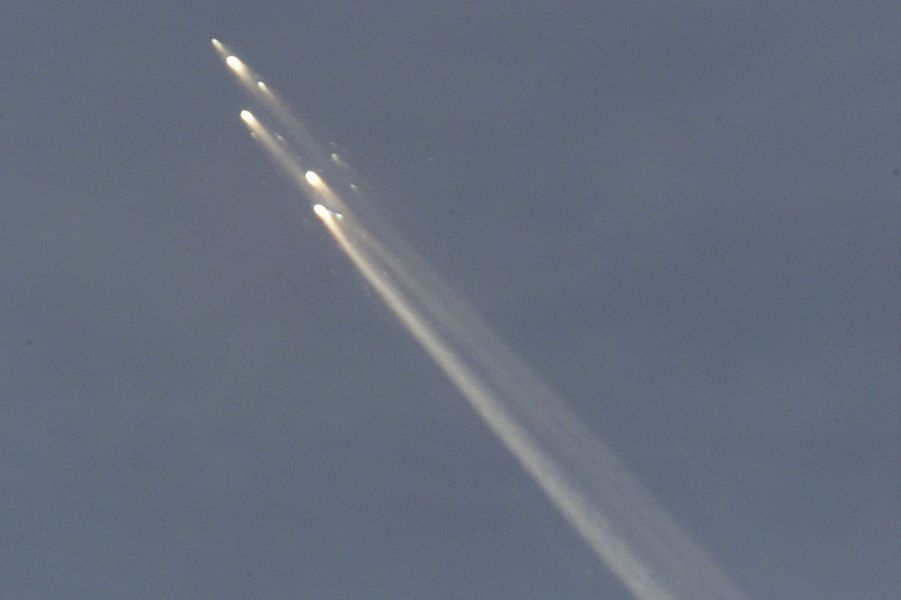 The space station burning up in the atmosphere
 The International Space Station (ISS) took the baton from Mir, and Russia made major contributions to its construction. Russia launched the station's first module, Zarya, aboard a Proton-M rocket. The ISS ushered in a new era in humanity's peaceful use of space. Unfortunately, because China's spaceflight capabilities were not yet strong and its ideology differed from that of the West, the Western countries led by the United States did not allow China to join this large international collaborative project.
After the Soviet Union collapsed, Russia never again achieved a spectacular “world first” in spaceflight. In the new century, it instead often drew worldwide attention for an extraordinarily high rocket-launch failure rate. China's first Mars probe, Yinghuo-1, failed to enter orbit in 2011 because of a problem with the Russian rocket carrying it, strengthening China's resolve to explore Mars independently. Meanwhile, the United States continued pushing the frontiers of human exploration, though much more slowly after the fall of its old rival. In 1995, it was the first to send a probe into Jupiter orbit and then into Jupiter's atmosphere. In 1997, humanity's first Mars rover, Mars Pathfinder/Sojourner, landed on Mars. In 2004, humanity's first probe entered Saturn orbit and landed on Titan. In 2011, MESSENGER became the first spacecraft to enter Mercury orbit. In 2012, Voyager 1 became the first human-made probe to leave the Solar System. In 2015, New Horizons made the first flyby of Pluto, and that same year SpaceX successfully recovered the first stage of a Falcon 9 rocket. In 2018, the Parker Solar Probe was launched to study the Sun from an unprecedentedly close distance… Even China, a relative newcomer, achieved humanity's first soft landing on the far side of the Moon, the first launch of a spacecraft to the Earth–Moon L2 point, and the unprecedented feat of completing Mars orbit, landing, and roving in a single mission. Yet Russian spaceflight, whose foundations once rivaled those of the United States, had not produced even one more first for humanity.
It is not that Russia has no desire to revive its space dream. In 2016, the Roscosmos State Corporation was created by merging the Russian Federal Space Agency with the United Rocket and Space Corporation, aiming to return to space with a more unified effort. During the recently passed 2020 Mars launch window, Russia had planned to restart its Mars exploration program, but various circumstances prevented it from doing so. In my view, inadequate funding is the fundamental problem facing Russian spaceflight. Spaceflight is inherently expensive and often offers no immediate return. As part of the capitalist world, Russia conducts its space activities according to the workings of capital markets: money always flows toward the highest returns. American space technology is now clearly ahead of Russia's, while Europe as a whole is no less capable. Russia once competed with the United States and Europe by offering certain launches at low cost, carving out a niche in the market, but these missions were usually confined to low Earth orbit and lacked deep-space exploration programs. Russia's low launch-success rate creates another problem. It substantially undermines the price advantage of Russian spaceflight products, because when the alternative is risking the loss of an entire satellite, customers still tend to choose safer products even at a higher price. Moreover, as Musk's rocket-recovery technology has matured, Russia's former price advantage has disappeared. In short, Russian spaceflight has not yet moved beyond the Soviet brute-force model of overcoming problems through sheer scale. That model enabled enormous projects, but it also tolerated enormous failures and fireworks: we could simply launch another one. The social system has changed, however, and Russia's approach to spaceflight no longer suits the present environment.
And yet…
Space Is There
Yes, space is there. Every great nation wishes to look up at the stars, but only the greatest can turn their exploration into reality and give something back to all humanity. Russia, the nation that gave birth to the father of human spaceflight, will surely restore its spacefaring strength. The opportunity ahead is clear, and it comes from the East. April 23, 2021, was not only the author's birthday (scratch that), but also a milestone in Sino-Russian space cooperation: the International Lunar Research Station presentation, jointly hosted by the China National Space Administration and the Roscosmos State Corporation, was held in Nanjing. At the meeting, Chinese and Russian representatives announced to the world that the two countries would jointly build a lunar research station. We can clearly see that, as China rises in every field, the next wave of human spaceflight is drawing near. China plans to establish an Earth–Moon economic zone by the middle of this century. Its creation will mark the point at which spaceflight begins to generate direct economic returns. Cooperation on the lunar research station shows that China and Russia will work together more extensively to explore the universe. Russia can use this opportunity to revive ambitious projects from its past, such as improving and producing Energia, thereby complementing China's existing spaceflight capabilities (China has not yet mastered super-heavy-lift launch-vehicle technology). At the same time, it can work with Chinese personnel on issues such as rocket operational stability, increasing the success rate of Russian launches and improving the space program's funding situation. By the time the Earth–Moon economic zone is largely established, a Russian space system capable of launching powerful, safe, and reliable rockets will become a new engine of Russian economic growth. Russia cannot give up the universe. After all, Tsiolkovsky's words still ring in our ears:
“Earth is the cradle of humanity, but one cannot live in a cradle forever.”

 爱发电(点击图片跳转)