
Did Neptune's Tiny Moon Come from Proteus?
Author: A Millisecond of Eternity
“A Moon That Shouldn’t Exist”
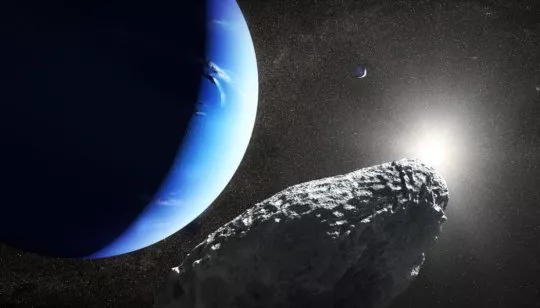
After several years of analysis, a team of planetary scientists finally had an explanation for the mysterious Neptunian moon they discovered with the Hubble Space Telescope in 2013.
The tiny moon, named Hippocamp, orbits unusually close to the much larger Proteus. Ordinarily, a moon as large as Proteus should clear smaller moons from its path or draw them in through its gravity.
So why is Hippocamp still there? It is probably a fragment of Proteus, knocked loose when a comet struck the larger moon billions of years ago. Hippocamp is only 20 miles (about 34 kilometers) across and has just one-thousandth the mass of Proteus, whose diameter is about 260 miles (about 418 kilometers).
“The first thing we realized was that you would not expect to find such a tiny moon right next to Neptune’s largest inner moon,” said Mark Showalter of the SETI Institute in Mountain View, California. “In the distant past, as the larger moon slowly migrated outward, Proteus was once where Hippocamp is now.”
Images taken by Voyager 2 in 1989 support this idea. They show a vast impact crater on Proteus, nearly large enough to have shattered the moon. “In 1989, we thought the huge depression must simply be a crater,” Showalter said. “With Hubble, we now know that a small piece of Proteus was left behind—the object we know today as Hippocamp.” The moons’ orbits are now 7,500 miles (about 12,070 kilometers) apart.
The history of Neptune’s moon system has been both violent and complicated. Billions of years ago, Neptune captured its large moon Triton from the Kuiper Belt, a densely populated, disk-shaped region beyond Neptune’s orbit filled with icy and rocky bodies. Triton’s gravity disrupted Neptune’s original family of moons before it settled into a relatively stable circular orbit. Debris from the shattered moons then came back together to form a second generation. Later comet impacts continued to break those moons apart and may have created Hippocamp, a possible third-generation moon.
“Based on estimates of the enormous number of comets, it is fairly clear that other moons in the outer Solar System have been struck and disrupted by comets many times, then reassembled, in a cycle that repeats over and over,” said Jack Lissauer of NASA’s Ames Research Center in Silicon Valley, California, a coauthor of the new study. “Proteus and Hippocamp provide a somewhat dramatic example of how moons are sometimes broken into several pieces by comets.”
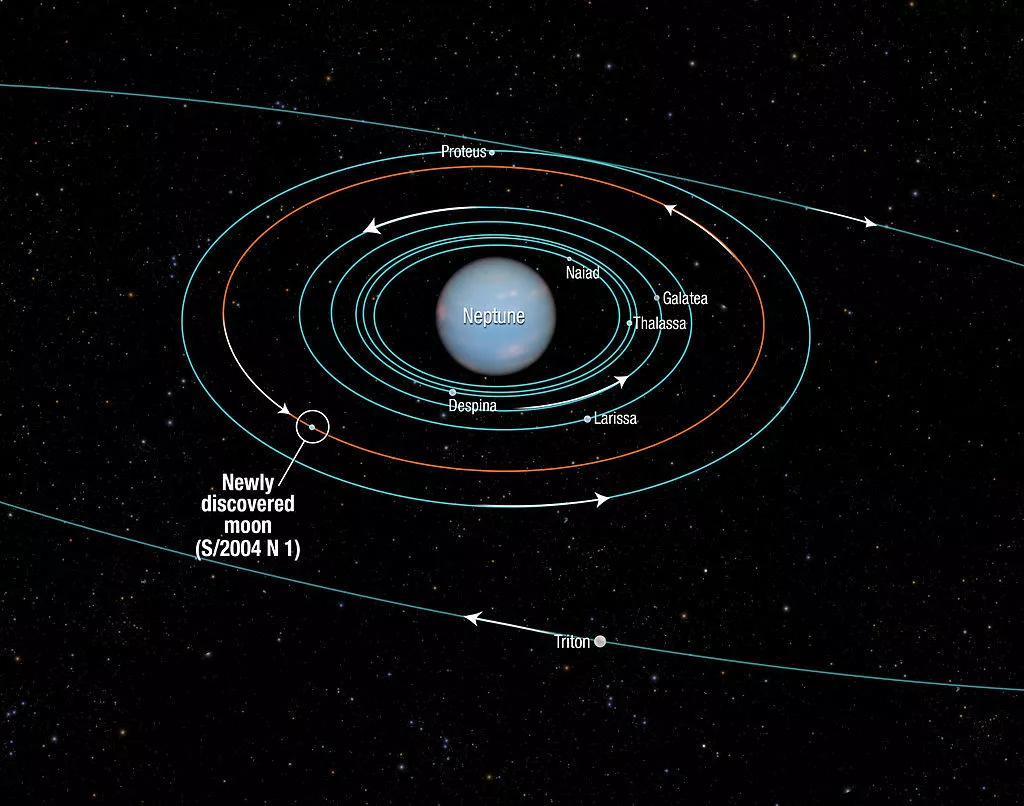
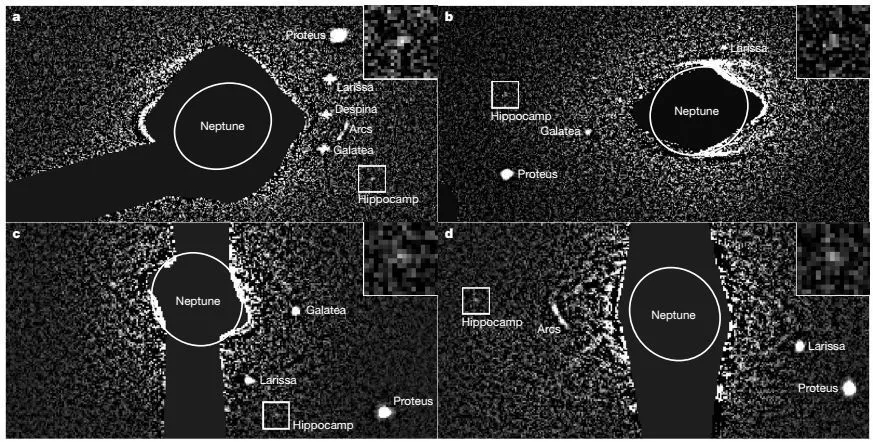
Hippocamp, originally designated S/2004 N 1, is about 34 kilometers (20 miles) across and completes an orbit of Neptune in less than one Earth day. Its discovery on July 1, 2013, raised the number of known Neptunian moons to 14. Hippocamp was too faint for Voyager 2 to see when the probe flew past Neptune and its moons in 1989. Mark Showalter of the SETI Institute found it by analyzing archival Hubble images taken between 2004 and 2009.
The moon received the formal designation Neptune XIV on September 25, 2018, and the name Hippocamp in February 2019.
The name Hippocamp comes from a horse-headed, fish-tailed creature in Greek mythology. The seahorse’s scientific name is Hippocampus, also the name of an important brain region involved in memory. Under International Astronomical Union rules, Neptune’s moons must be named for creatures from the undersea worlds of Greek and Roman mythology.
References
 爱发电(点击图片跳转)