
Farewell, Opportunity: Remembering a Mars Exploration Pioneer
Author: A Millisecond of Eternity
A record-setting NASA mission on Mars has come to an end. One of the longest-running and most successful feats in interplanetary exploration, the Opportunity rover mission concluded after nearly fifteen years on the Martian surface. Its legacy laid the groundwork for NASA’s return to Mars.
In June 2018, a severe planet-wide dust storm blanketed Opportunity’s location on Mars, and the rover stopped communicating with Earth. Engineers at the Space Flight Operations Facility at the Jet Propulsion Laboratory (JPL) sent more than 1,000 recovery commands in an effort to reestablish contact, but none succeeded. The solar-powered rover last communicated on June 10, 2018.
NASA Administrator Jim Bridenstine said, “It is because of trailblazing missions such as Opportunity that there will come a day when our brave astronauts walk on the surface of Mars.” He added, “And when that day arrives, some portion of that first footprint will be owned by the men and women of Opportunity, and a little rover that defied the odds and did so much in the name of exploration.”
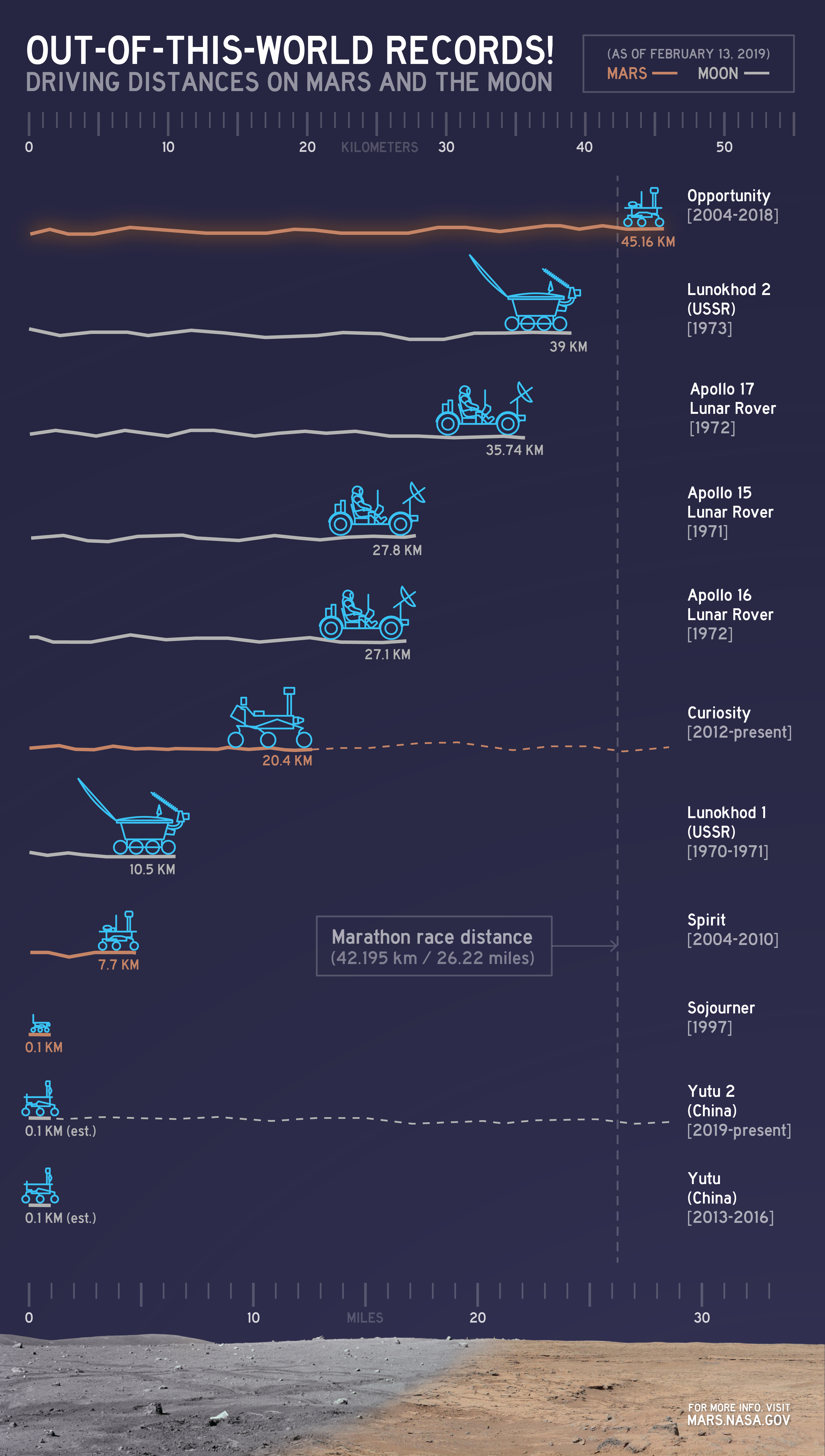
Opportunity was designed to operate for only 90 days and travel 1,000 meters. Its endurance, scientific value, and longevity exceeded every expectation. It lasted sixty times longer than planned, and by the time it reached its final resting place in Perseverance Valley, it had traveled more than 45 kilometers.
Thomas Zurbuchen, associate administrator of NASA’s Science Mission Directorate, said, “For more than a decade, Opportunity has been an icon in the field of planetary exploration, teaching us about Mars’ ancient past as a potentially habitable planet, and revealing uncharted Martian landscapes.” He continued, “Whatever loss we feel now must be tempered with the knowledge that the legacy of Opportunity continues—both on the surface of Mars with the Curiosity rover and InSight lander—and in the clean rooms of JPL.”
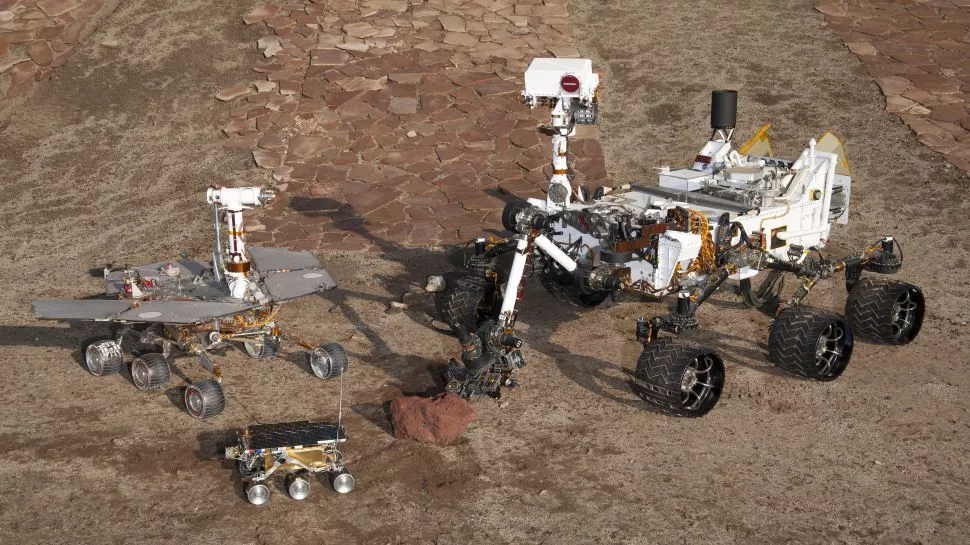
JPL Mars Exploration Rover project manager John Callas said, “We have made every reasonable engineering effort to try to recover Opportunity and have determined that the likelihood of receiving a signal is far too low to continue recovery efforts.”
Opportunity landed in Mars’s Meridiani Planum region on January 24, 2004, seven months after launching from Cape Canaveral Air Force Station in Florida. Its twin rover, Spirit, had landed more than twenty days earlier in the 166-kilometer-wide Gusev Crater on the other side of Mars. Spirit traveled nearly eight kilometers before its mission ended in May 2011.
From the day Opportunity landed, a team of mission engineers, rover drivers, and scientists on Earth worked together to overcome one challenge after another and move the rover between geological sites on Mars. They plotted safe routes across rough terrain so that the 174-kilogram Martian explorer could maneuver around rocks and boulders. At times, it climbed gravel-covered slopes as steep as 32 degrees—an off-world record—explored crater floors and hilltops, and crossed what may once have been riverbeds. Its final journey took it to the western edge of Perseverance Valley.
JPL Director Michael Watkins said, “I cannot think of a more appropriate place for Opportunity to endure on the surface of Mars than one called Perseverance Valley. The records, discoveries and sheer tenacity of this intrepid little rover are a testament to the ingenuity, dedication and perseverance of the people who built and guided her.”
Opportunity had already lost steering in one front wheel in 2005. A stuck heater severely limited the power available to the rover, and a Martian sand ripple nearly trapped it for good. Two years later, a dust storm lasting two months put the rover in danger. Opportunity lost its 256-megabyte flash memory in 2015 and steering in its other front wheel in 2017. Whenever it encountered an obstacle, the team on Earth found a way around it and kept the rover operating. The massive dust storm that formed in the summer of 2018, however, proved too much even for the most seasoned Mars explorer in history.
Callas said, “When I think of Opportunity, I will recall that place on Mars where our intrepid rover far exceeded everyone’s expectations. But what I suppose I’ll cherish most is the impact Opportunity had on us here on Earth. It’s the accomplished exploration and phenomenal discoveries. It’s the generation of young scientists and engineers who became space explorers with this mission. It’s the technical legacy of the Mars Exploration Rovers, which is carried aboard Curiosity and the upcoming Mars 2020 mission. Farewell, Opportunity, and well done.”
References
- https://www.nasa.gov/press-release/nasas-record-setting-opportunity-rover-mission-on-mars-comes-to-end
- https://www.space.com/mars-rovers-after-opportunity.html
- https://www.nature.com/articles/d41586-019-00575-2
- https://www.space.com/27-latest-mars-shots-spirit-opportunity/2.html
- https://www.borntoengineer.com/nasa-mars-opportunity-rover-records-dead
 爱发电(点击图片跳转)