
Why Meteor Showers Arrive on Schedule: It All Starts with a Speck of Space Dust
This summer, the annual Perseid meteor shower has arrived right on schedule. Why do meteor showers return at the same time every year? And why are they named after constellations? Let us start with a speck of space dust and trace the cosmic paths behind meteors.
Author: emmm
Reviewed by: Situ Mo
A meteor may be the briefest and most brilliant “firework” in the night sky. A streak of light tears through the darkness without warning, vanishes an instant later, and leaves only startled cries behind. Right now, the Perseid meteor shower is approaching its peak, making this the best time of year to “run into” a meteor. But before you marvel at the sky, have you ever wondered what lies behind that flash of light?
What is a meteor?
Before discussing meteors in detail, let us distinguish three terms that are easy to confuse: meteoroid, meteor, and meteorite. In the terminology of the International Astronomical Union, they describe three different stages:
- Meteoroid: a solid particle orbiting the Sun. Think of it as a tiny “grain of sand” flying through space.
- Meteor: the process and phenomenon that occurs when a meteoroid enters Earth’s atmosphere, burns, and emits light. It is the fleeting luminous trail left in the atmosphere by a “speck of space dust.”
- Meteorite: if the particle is large enough not to burn up completely, this is the surviving debris that reaches the ground. A meteorite is an actual rock you can touch.
The smallest micrometeoroids are only a few dozen micrometers across, thinner than a human hair, and weigh just one hundred-millionth of a gram. When they enter the atmosphere, they slow down extremely gradually. Their mass is so small that air resistance quickly cancels their speed. They produce no light visible to the naked eye, but drift downward and eventually become suspended particles in the atmosphere. The meteoroids that produce visible meteors usually weigh between a few milligrams and several kilograms, ranging in size from a grain of salt to a basketball. Larger meteoroids, including objects several or even dozens of meters in diameter, often draw a blinding streak across the night sky when they enter the atmosphere. They are no longer called mere meteors, but “explosive” fireballs. Some particularly powerful examples can even create impact craters, although such events are exceedingly rare.
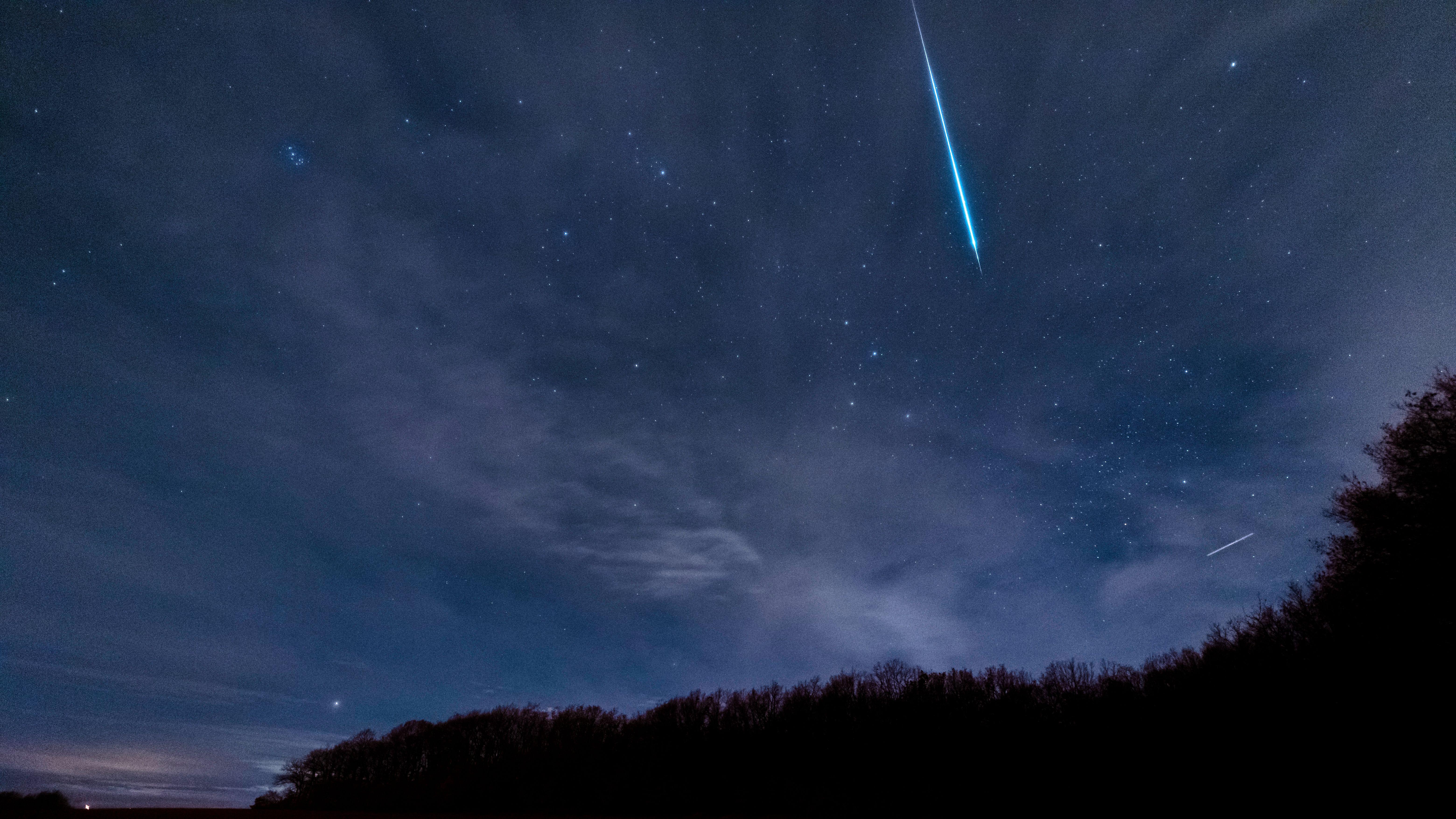
We have already mentioned “fireballs.” Put simply, any meteor brighter than the “brightest planet in the night sky,” Venus, can be called a fireball. Exceptionally bright examples become superbolides. A fireball’s path may be easy to see even in daylight. Sometimes its luminous trail persists for tens of seconds or even several minutes, a phenomenon known as a persistent train. Some fireballs break apart in the air, producing a tremendous explosion that can be heard from the ground.
What is a meteor shower?
Most meteor showers begin with comets.
Comets are often called “dirty snowballs.” They consist of ice, dust, and rocky debris. When a comet approaches the Sun along its long, highly elongated orbit, ice on its surface sublimates into gas. The gas carries vast quantities of dust and grit away from the comet’s nucleus. These ejected particles do not leave the Solar System. Instead, they continue orbiting the Sun along roughly the comet’s original path. A ring of material, a “dust stream” or “meteoroid swarm,” gradually forms around the comet’s orbit.
Every return of the comet “restocks” the stream. Perturbations from gravity, radiation pressure, and other forces gradually spread the grains along the comet’s orbit, forming an elliptical band filled with debris.
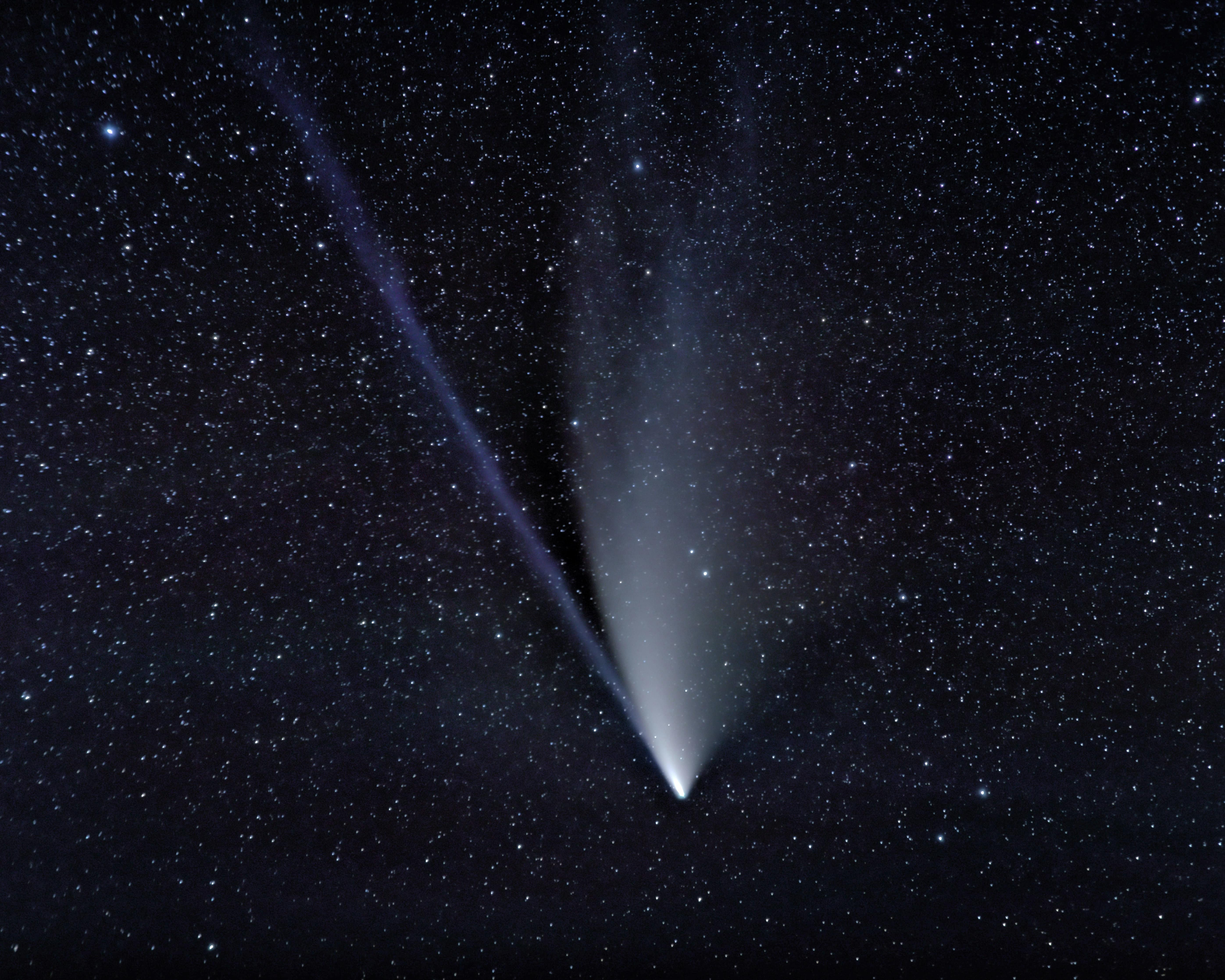
Earth’s orbit also passes through these bands. When Earth runs into one, particles in the comet’s orbit plunge into the atmosphere at an extremely high relative speed. Meteors do not burn because of “frictional heating.” More precisely, a particle moves so fast that the air cannot get out of its way and is violently compressed in front of it, producing ram-pressure heating. The particle’s surface temperature instantly rises to several thousand degrees Celsius, causing it to melt and vaporize while ionizing the surrounding air into luminous plasma. The result is the meteor we see.
This explains why major showers such as the Perseids seem to have a “fixed date” every year. Each August, Earth passes through the dust stream left by Comet Swift–Tuttle (109P/Swift-Tuttle), and the Perseids return on schedule. Each December, Earth crosses the stream left by Phaethon (3200 Phaethon), bringing the Geminids. As long as Earth’s orbit and the position of the dust stream do not change greatly, a meteor shower’s active period will “clock in” at the same time year after year.
Dust streams are not uniform, of course. If Earth happens to cross a fresh, dense clump that has only recently left its parent comet, a meteor storm can erupt, producing thousands or even tens of thousands of meteors per hour. Comet Tempel–Tuttle (55P/Tempel-Tuttle), the source of the Leonids, orbits the Sun every 33.2 years. As it approaches the Sun, it leaves large quantities of fresh dust along its orbit. The Leonids therefore become far more active every 33 years and may even produce a meteor storm.
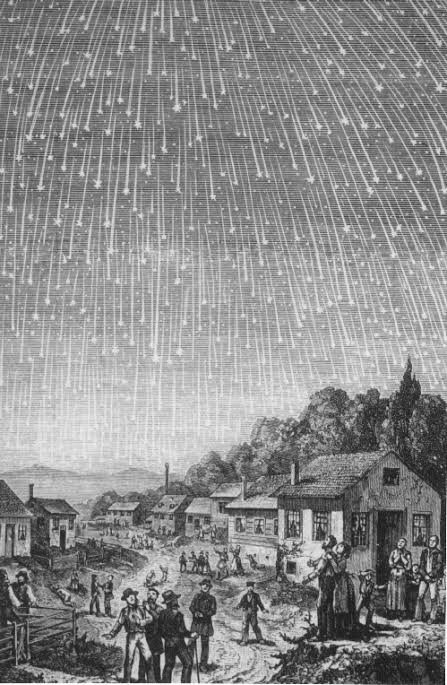
But wait. The Perseids, the Leonids… Why are all these meteor showers named after constellations? Their origins plainly have no direct connection with the constellations in their names.
Before the formal explanation, let us use our imaginations. Picture a great many infinitely long parallel lines laid out in front of you. Because of perspective, or the familiar effect of objects looking “larger nearby and smaller far away,” the lines appear to converge on a point, as if they all emerged from it. The image below shows parallel lines on a plane; drawing the same situation in space would look rather cluttered.
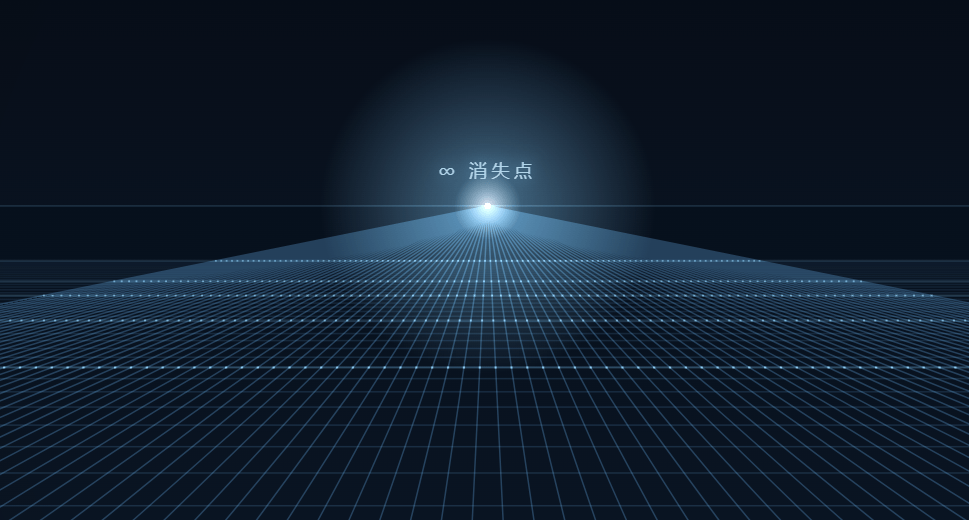
Meteors behave in the same way. The dust particles in a single meteor shower travel in roughly parallel directions, so the meteors appear to emerge from one point in the sky. This radiant is likewise only a “perspective vanishing point” seen by the observer, not the place where the meteors truly originate. A meteor shower is usually named after the constellation in which its radiant lies.
In formal English naming, the Latin name of the constellation containing the radiant takes the suffix -id or -ids, meaning “a group of meteors from that constellation.” For example:
- Radiant in Perseus → Perseids → Perseid meteor shower
- Radiant in Leo → Leonids → Leonid meteor shower
- Radiant in Gemini → Geminids → Geminid meteor shower
- Radiant in Lyra → Lyrids → Lyrid meteor shower
Their Chinese translations use the straightforward form “[constellation] meteor shower.”
If several different dust streams have radiants in the same constellation, however, the constellation’s name alone is not enough. Astronomers distinguish the streams by using a bright star near the radiant. What if one constellation contains several meteor showers whose radiants all happen to lie near the same bright star? Astronomers then add a directional term to the name. Here are some examples:
- Eta Aquariids: the radiant lies near Eta Aquarii
- Southern Delta Aquariids: the radiant lies near Delta Aquarii, on its southern side
- Northern Delta Aquariids: the radiant lies near Delta Aquarii, on its northern side
- Alpha Capricornids: the radiant lies near Alpha Capricorni
Meteor-shower names can therefore contain Greek letters, as in the Eta Aquariids and Southern Delta Aquariids.
The International Astronomical Union’s Meteor Data Center also assigns each recognized meteor shower a three-letter code for use in observation records, such as:
- Perseids = PER
- Leonids = LEO
- Geminids = GEM
- Eta Aquariids = ETA
Meteor-shower naming also has special cases inherited from history. The most famous is the Quadrantids. Their radiant is actually near the modern constellation Boötes, but their name comes from Quadrans Muralis, an eighteenth-century constellation that was later abandoned. Once a name has been used for a long time, it is difficult to change, so “Quadrantids” has survived to the present.
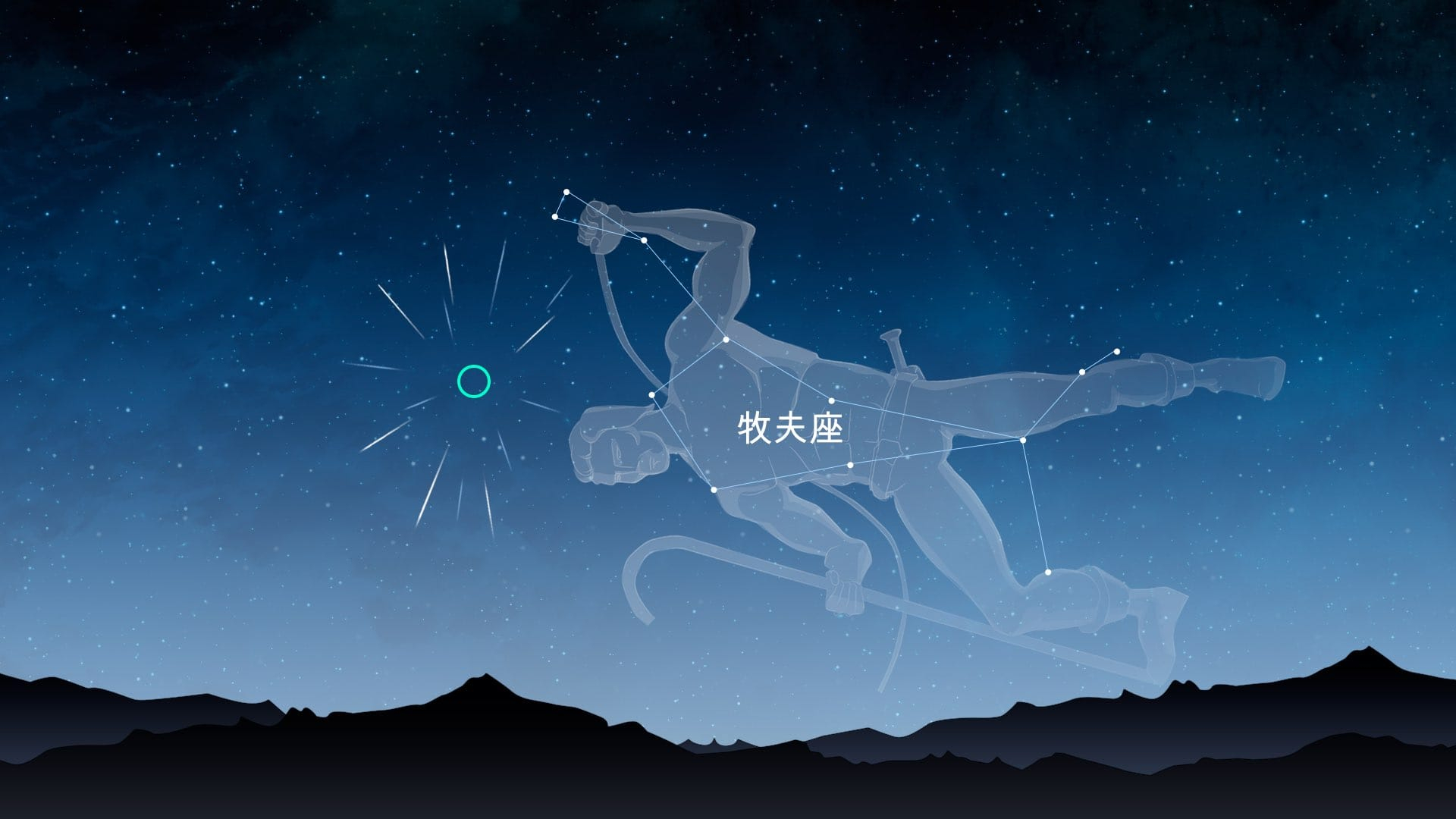
Meteor showers are not named after their parent comets, either. Halley’s Comet, for example, produces both the Eta Aquariids and the Orionids, yet “Halley” appears in neither name.
Finally, here are several famous meteor showers and a few facts about each:
- Perseids: the parent body is Comet 109P/Swift–Tuttle. The shower peaks around August 12–13 each year, with a ZHR of about 100.
- Geminids: the parent body is asteroid (3200) Phaethon. The shower peaks around December 14; its meteors tend to be slower and brighter, and its ZHR can exceed 100.
- Quadrantids: the parent body may be 2003 EH1. The shower peaks on January 3–4 and has a substantial ZHR, but the peak usually lasts only a few hours.
- Leonids: the parent body is Comet 55P/Tempel–Tuttle, and the shower is active in mid-November. It normally produces only a dozen or so meteors per hour, but in some years following the return of its parent comet, storms bring thousands or even tens of thousands per hour.
- Eta Aquariids: the parent body is Comet 1P/Halley. The shower peaks in early May, with a ZHR of about 40–60, and is better seen from the Southern Hemisphere.
Here, ZHR means Zenithal Hourly Rate. Put simply, it is “the largest number of meteors you could see per hour if the radiant were directly overhead and the night sky completely dark.” This is an idealized value. In actual observations, light pollution, cloud cover, the radiant’s altitude, and other factors can dramatically reduce the number you see.
 爱发电(点击图片跳转)