
The 2022 Nobel Prize in Physiology or Medicine
Introduction
Humans have always wondered about their origins: Where do we come from? How are we, Homo sapiens, related to the other human groups that came before us? What sets Homo sapiens apart from them?
Through pioneering research, Professor Svante Pääbo accomplished what had seemed impossible: he sequenced the genome of an extinct human relative, the Neanderthal. He also discovered a previously unknown human group, the Denisovans. Just as importantly, Pääbo found that genes from these now-extinct groups entered the Homo sapiens gene pool after our ancestors left Africa about 70,000 years ago. This ancient genetic legacy still matters physiologically today, affecting, for example, how our immune systems respond to infection.
Pääbo’s work gave rise to a new discipline: paleogenomics. By revealing the genetic differences between living humans and extinct human groups, his discoveries laid the foundation for research into what makes Homo sapiens uniquely human.
Where Do We Come From?
Questions about where we come from and why we are unique have preoccupied people since ancient times. Paleontology and archaeology are central to the study of human evolution. Evidence from these fields indicates that anatomically modern humans, Homo sapiens, first appeared in Africa about 300,000 years ago. Our closest known relatives, the Neanderthals, developed outside Africa and lived in Europe and western Asia from about 400,000 to 30,000 years ago, when they became extinct. Around 70,000 years ago, groups of Homo sapiens migrated from Africa to the Middle East and then spread through the rest of the world. Homo sapiens and Neanderthals therefore coexisted across much of Eurasia for tens of thousands of years. But what was the relationship between them? Genomic information might offer clues. By the late 1990s, scientists had sequenced almost the entire human genome, a major achievement that later allowed them to investigate genetic relationships among different human populations. Studying the relationship between people living today and extinct Neanderthals, however, required scientists to sequence genomic DNA extracted from ancient human remains.
A Seemingly Impossible Task
Early in his scientific career, Svante Pääbo became fascinated by the possibility of using modern genetic methods to study Neanderthal DNA. He soon recognized the serious technical challenges involved. Over time, chemical reactions break DNA into short fragments. After thousands of years, only trace amounts remain, heavily contaminated with DNA from bacteria and present-day humans (Figure 1). While working as a postdoctoral researcher with Allan Wilson, a pioneer in evolutionary biology, Pääbo began developing methods for studying Neanderthal DNA. That effort would continue for decades.
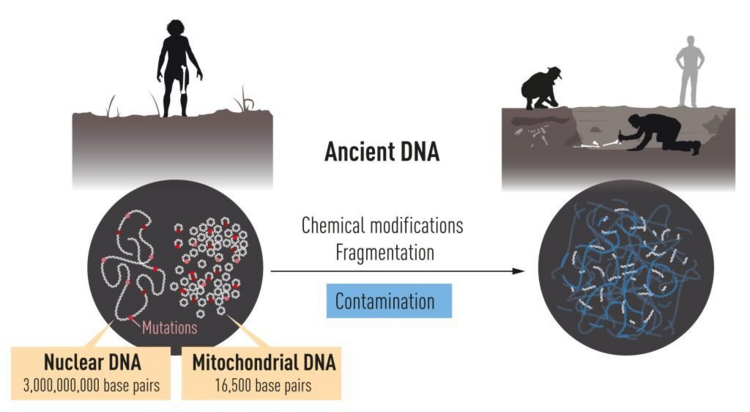
In 1990, Pääbo joined the University of Munich. As a newly appointed professor, he continued his work on ancient human DNA and chose to analyze Neanderthal mitochondrial DNA. Mitochondria are organelles with DNA of their own. Their genome is small and contains only a tiny fraction of a cell’s genetic information, but a sample can contain thousands of mitochondria, greatly improving the odds of success. Using the methods he had developed, Pääbo sequenced a region of mitochondrial DNA from a 40,000-year-old bone. For the first time, researchers had a genetic sequence from an extinct human relative. Comparisons with present-day humans and chimpanzees showed that Neanderthals were genetically distinct.
Sequencing the Neanderthal Genome
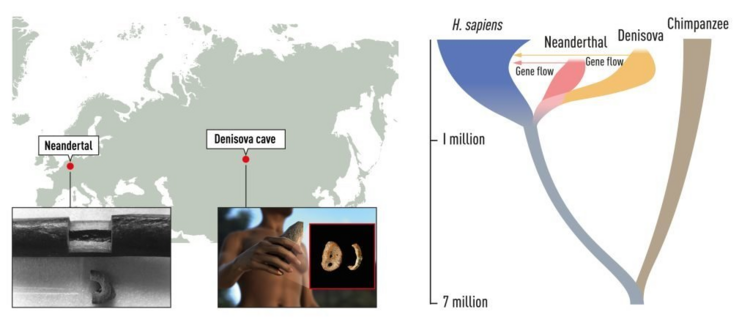
Because the small mitochondrial genome provided only limited information, Pääbo next took on the much harder task of sequencing the Neanderthal nuclear genome. Around this time, he was given the opportunity to establish a Max Planck Institute in Leipzig, Germany. There, Pääbo and his team steadily refined their methods for isolating and analyzing DNA from ancient human remains. They also made use of new technologies that had made DNA sequencing far more efficient. Pääbo recruited key collaborators with expertise in population genetics and advanced sequence analysis. The effort paid off: in 2010, he published the first Neanderthal genome sequence. Comparative analyses indicated that the most recent common ancestor of Neanderthals and Homo sapiens lived around 800,000 years ago.
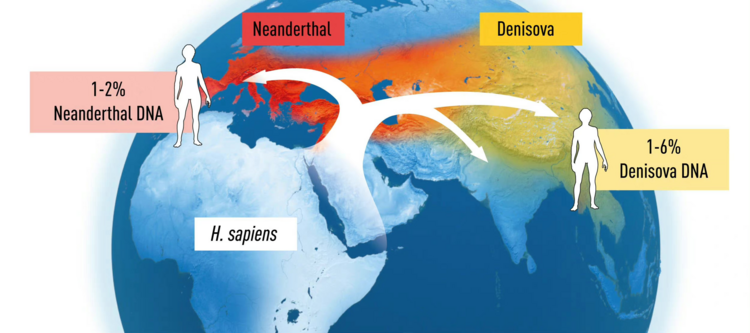
Pääbo and his colleagues could now investigate how Neanderthals were related to modern humans from different parts of the world. Comparative analyses showed that Neanderthal DNA sequences were more similar to those of present-day people of European or Asian descent than to those of present-day people of African descent. The finding meant that Neanderthals and Homo sapiens had interbred during the thousands of years when they coexisted. In modern people of European or Asian ancestry, approximately 1–4% of the genome comes from Neanderthals (Figure 2).
A Remarkable Discovery: The Denisovans
In 2008, a fragment of a 40,000-year-old finger bone was found in Denisova Cave in southern Siberia. The bone contained exceptionally well-preserved DNA, which Pääbo’s team sequenced. The result caused a sensation: its DNA sequence differed from every known sequence from Neanderthals and present-day humans. Pääbo had discovered a previously unknown human group, later named the Denisovans. Comparisons with DNA sequences from present-day people around the world showed that gene flow had also occurred between Denisovans and Homo sapiens. This relationship was first identified in populations in Melanesia and other parts of Southeast Asia, whose genomes contain up to 6% Denisovan DNA.
Pääbo’s discoveries changed our understanding of human evolutionary history. When Homo sapiens left Africa, at least two now-extinct human populations were living in Eurasia. Neanderthals inhabited western Eurasia, while Denisovans occupied the continent’s eastern regions. As Homo sapiens spread beyond Africa and migrated eastward, they encountered and interbred with both Neanderthals and Denisovans (Figure 3).
Paleogenomics and Its Relevance
Professor Svante Pääbo’s research established a new scientific discipline: paleogenomics. After his initial discoveries, his group analyzed genome sequences from several other extinct human groups. Pääbo’s findings created a body of evidence that scientists have used extensively to better understand human evolution and migration. New sequence-analysis methods indicate that ancient human groups may also have interbred with Homo sapiens in Africa. However, ancient human DNA degrades more rapidly in tropical climates, and no genome from an extinct African human group has yet been sequenced.
Pääbo’s discoveries have shown that ancient genetic sequences inherited from our extinct relatives still affect people today. One example is the Denisovan gene EPAS1, which offers an advantage at high altitudes and is common among present-day Tibetans. Neanderthal genes that affect our immune responses to different kinds of infection provide other examples.
What Makes Us Uniquely Human?
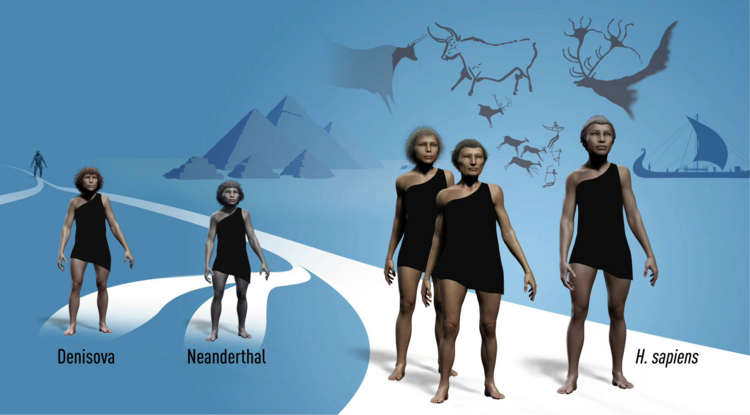
Homo sapiens created diverse cultures and great art, and learned to cross oceans and reach every part of the planet (Figure 4). Neanderthals also lived in groups and had large heads (Figure 4). They used tools as well, but those tools changed very slowly over hundreds of thousands of years. The genetic differences between Homo sapiens and our closest extinct relatives remained unknown until Pääbo’s work identified them. His ongoing research examines the functional effects of those differences, with the ultimate goal of explaining what makes us uniquely human.
Translation: DeepL
Proofreader: Shiguang
Original: https://www.nobelprize.org/prizes/medicine/2022/press-release/
 爱发电(点击图片跳转)