
Automotive Styling and Aerodynamics
Author: 未名
Reviewer: 未名
Introduction
In 1886, Karl Benz built the world’s first three-wheeled automobile powered by an internal-combustion engine. What chiefly distinguished it from a horse-drawn carriage was its powertrain; the basic form of the modern four-wheeled car came from Daimler. Over the next century and more, vehicle bodies evolved along with the demand for greater mobility and changing aesthetic tastes. From the Beetle to the ponton body and then the wedge shape, designers have pursued forms that reduce drag without sacrificing visual appeal. This article briefly examines the relationship between automotive styling and aerodynamics.
Automotive Styling and Aerodynamic Drag
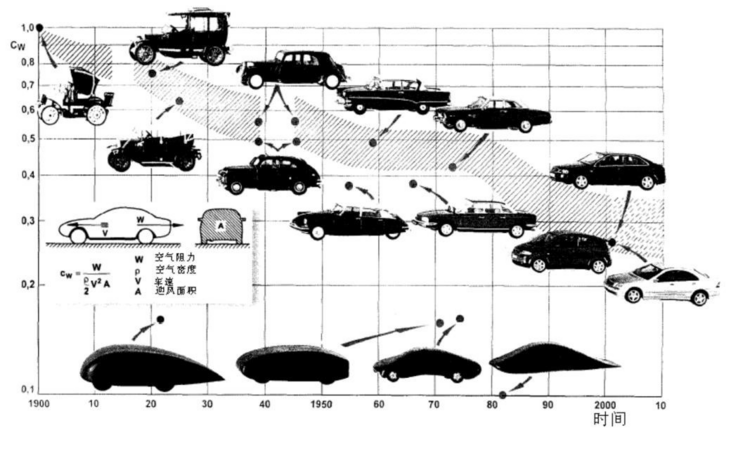
At constant speed on a level road under normal atmospheric pressure, a car's aerodynamic drag consists of pressure drag and skin-friction drag. Depending on the relative contribution and the part of the vehicle involved, this drag can be classified as form drag, induced drag, roughness and interference drag, or internal-flow drag. About 69% of a car's fuel is used to overcome air resistance, and form drag accounts for 58% of its aerodynamic drag. Body shape is therefore critical to reducing resistance. The drag coefficient is defined as Cw=F_drag/(ρ/2 v_∞² A), where v_∞ is the velocity of the vehicle relative to the uniform airflow far upstream, and A is its frontal area. Figure 1-1 compares the drag coefficients of several vehicle shapes moving at the same constant speed through the same horizontal, uniform, ideal airflow. The differences among them are substantial.
We will now consider each type of aerodynamic drag in turn.
Form Drag
Pressure drag accounts for 80–90% of a car's form drag, while skin friction contributes only 10–20%. Figure 1-2 illustrates the pressure drag on several shapes in the same ideal fluid:
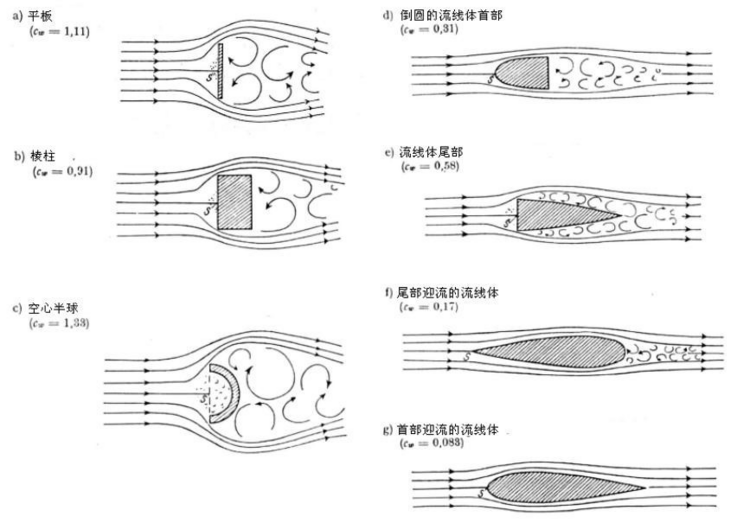
On a bluff body, such as a flat plate set across the flow or a rectangular block, pressure rises sharply near the largest cross-section. The flow then separates and forms a vortical wake behind the body. The resulting asymmetric pressure distribution over the surface produces pressure drag. Rounding an edge can delay or prevent separation as the flow passes it, thereby reducing pressure drag. The same principle applies to cars.
Now consider skin-friction drag: 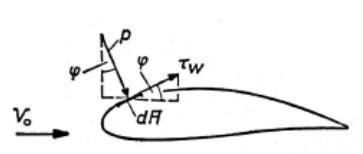
Figure 1-3 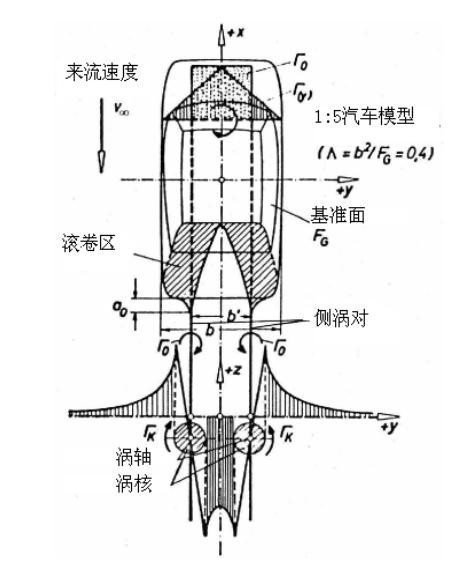
Figure 2-1. Induced drag around a car 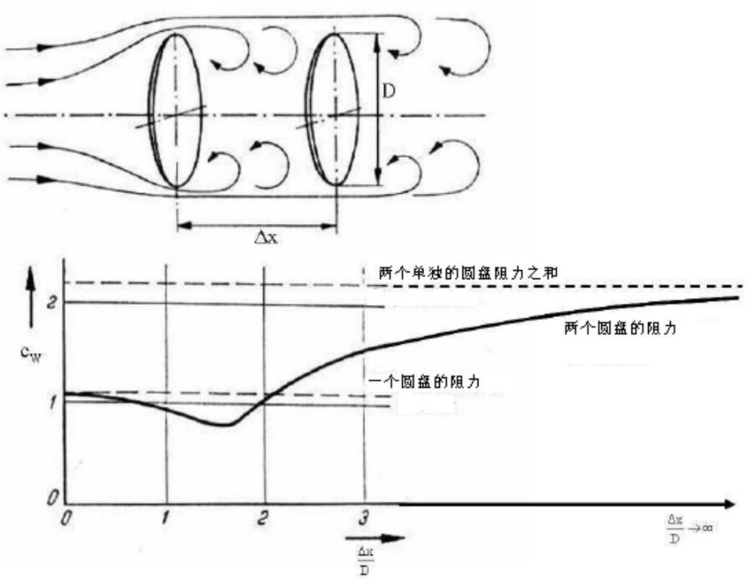
Figure 2-2 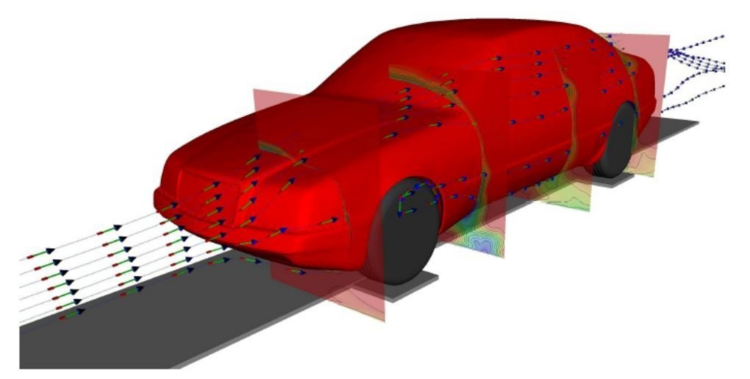
Figure 3-1 
F_top < F_bottom 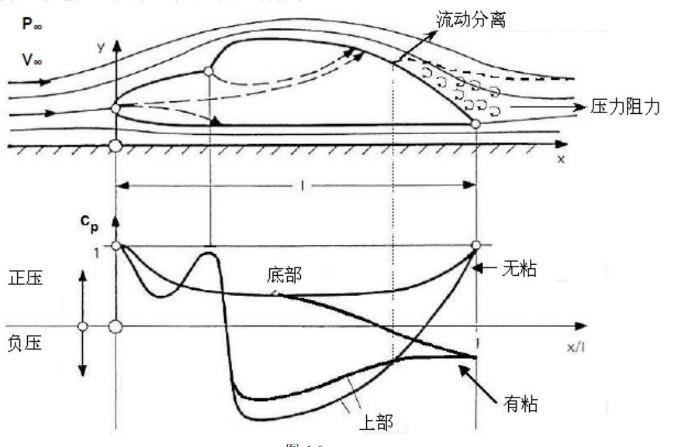
Figure 3-2
The velocity gradient and molecular viscosity within the boundary layer produce wall shear stress τw at every point on the surface. The sum of the components of this stress in the direction of flow is the skin-friction drag.
When the flow remains attached, friction can account for a large share of the total drag; when extensive separation occurs, its share is much smaller. This is why dimples help a golf ball travel farther. On a streamlined body, including some vehicles, skin-friction drag makes up a relatively large proportion of the total.
All liquids and gases are viscous. When adjacent fluid parcels move at different speeds, friction acts between them. Viscosity also causes the fluid next to a solid surface to adhere to it. This fluid slows the layers moving past it, forming a boundary layer that produces frictional drag. A laminar boundary layer interacts less strongly with the surface than a turbulent one, so it produces less frictional drag and absorbs less energy. On a streamlined body, friction therefore accounts for a comparatively large share of the total drag.
A car therefore needs a smooth surface finish.
Induced Drag
Induced drag arises from the pressure difference between the upper and lower surfaces of the body, although it is not itself lift. This pressure difference adds a vertical component to the horizontal freestream. Air moves around the sides of the body to equalize the pressure, generating vortices that travel downstream. Producing these vortices continuously consumes energy and therefore creates induced drag. Induced drag is related to aerodynamic lift, as discussed below.
Roughness and Interference Drag
Roughness and interference drag include the resistance caused by surface discontinuities and accessories that protrude through the boundary layer around the car. Chassis and suspension components, wheels, mirrors, auxiliary lights, and windshield wipers all contribute.
Interference drag may be positive or negative, with opposite effects on total resistance. Positive interference drag arises between nearby or connected objects. A side mirror, for example, disturbs the car's original flow field, causes earlier separation, and increases aerodynamic drag. Negative interference drag occurs because every object in a flow leaves a region of slower-moving fluid behind it. A second object placed within that region experiences less resistance than it would in undisturbed flow. For example, when two discs are aligned at a suitable distance, their combined drag is lower than the sum of the drag on each disc tested separately (Figure 2-2). The same principle applies to tractor-trailers: an aerodynamically optimized tractor can reduce the combination's overall drag.
Internal-Flow Drag
Internal-flow drag, also called internal drag, is produced as air passes through the vehicle for engine cooling and ventilation. It includes momentum losses at the outlet and pressure losses through the radiator and engine compartment, both of which consume additional energy. Internal-flow drag accounts for about 5–12% of total aerodynamic drag.
Automotive Styling and Aerodynamic Lift
A car's aerodynamic lift arises from its shape (Figure 3-1).
Under ideal conditions, Bernoulli's equation gives:
Applied to the shape of a car, this gives, under ideal conditions:
The result is an aerodynamic lifting force.
In practice, the underbody also matters. Figure 3-2 shows simplified two-dimensional inviscid and viscous flows, along with the pressure distributions around a car:
A car's rolling resistance is proportional to the normal force on its wheels. Increasing aerodynamic lift reduces that force and therefore reduces rolling resistance. At first glance, lift might seem to lower the vehicle's total resistance. Greater lift, however, also reduces traction and stability while producing additional induced drag that may far exceed the reduction in rolling resistance. Using lift to reduce drag is therefore a poor tradeoff. A large increase in lift compromises high-speed stability and creates a safety hazard. Above 70 km/s, for example, some cars may begin to feel “light” as aerodynamic instability reduces the driver's sense of contact with the road, potentially contributing to a rollover or skid.
This led to the wedge-shaped car. These aerodynamically optimized bodies, most commonly found on sports cars, may also use spoilers to generate downforce. Their aerodynamic lift can even be negative, greatly improving stability at high speed.
(Some of the text and figures in this article draw on Aerodynamics of Road Vehicles.)
All articles in this blog are licensed under CC BY-NC-SA 4.0 unless stating additionally.
 爱发电(点击图片跳转)