
The Formation and Evolution of White Dwarfs
Author: Congyu
Reviewer: Yuandao
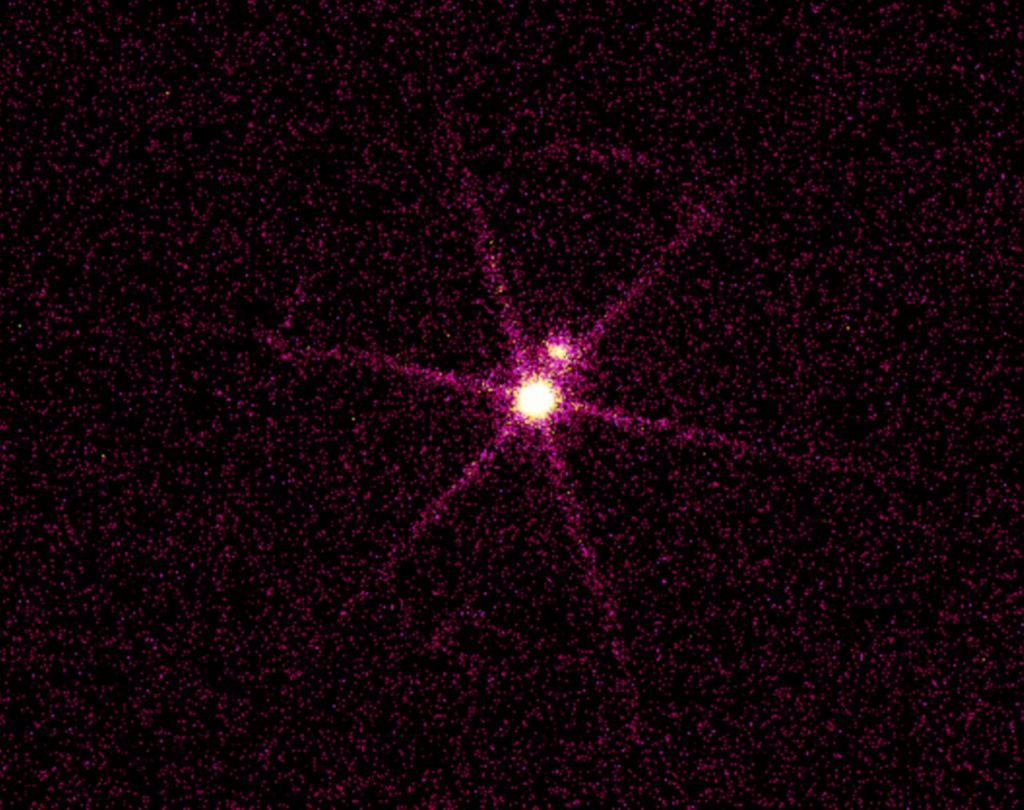
Sirius is the brightest star in Earth’s night sky, and we can see it every winter. In 1844, German astronomer and mathematician Friedrich Bessel calculated that Sirius must be a binary system with a companion about as massive as the Sun. The companion was so faint that it remained unseen for years. It was finally photographed in 1862, shining with only one-thousandth the brightness of Sirius. Astronomers later obtained its spectrum and began to recognize a new class of object: the white dwarf.
The Late Evolution of Sun-like Stars
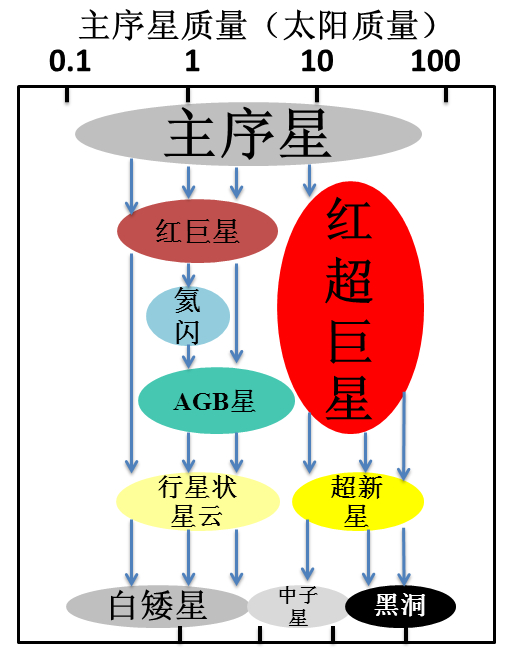
To understand how white dwarfs form, we must begin with the post-main-sequence evolution of low- and intermediate-mass stars. Stars below 2.3 solar masses are generally classified as low-mass stars, while those between 2.3 and 8 solar masses are considered intermediate-mass stars. These categories reflect the different ways the stars evolve and end their lives, as we will see below.
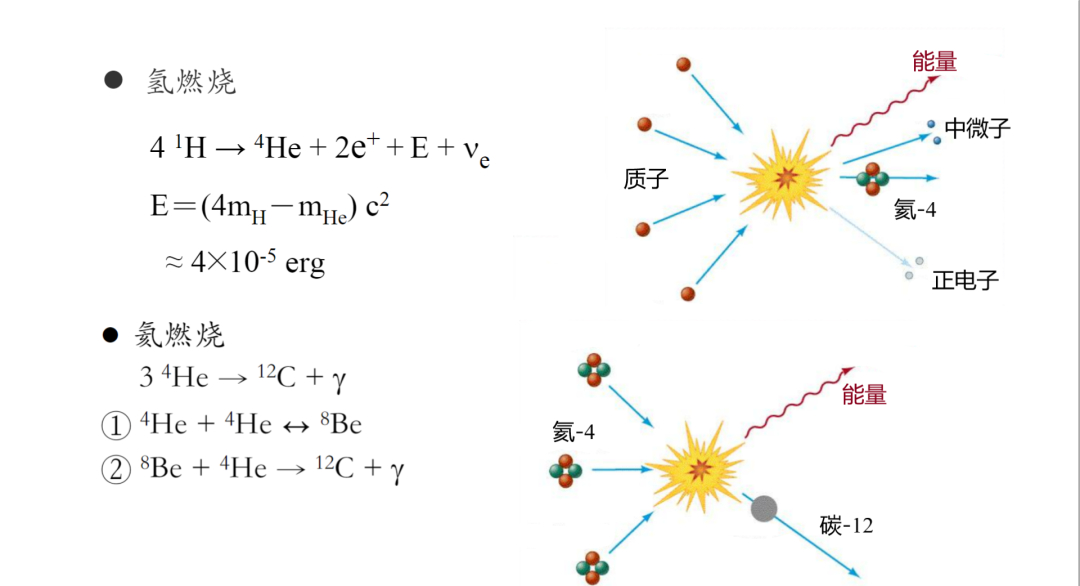
As hydrogen fusion consumes the fuel in a star’s core, a growing core made mainly of helium develops. Gravity causes this core to contract, raising its temperature, pressure, and density as the star enters the red-giant phase. Its evolution then follows one of two paths. In an intermediate-mass star, the core becomes hot enough to ignite helium through the triple-alpha process, which fuses helium into carbon. A low-mass star’s core is initially too cool for helium fusion and cannot rely on radiation pressure to resist gravity. Its electrons instead become degenerate, and electron degeneracy pressure opposes further contraction.
What is degeneracy pressure? The Pauli exclusion principle states that no two identical fermions can occupy the same quantum state. In a degenerate electron gas, for example, each orbital can hold at most two electrons, one in each spin state; any additional electrons must occupy higher-energy states. Filling those states generates degeneracy pressure. Because the lowest-energy states fill quickly, most particles in a degenerate gas have far more energy, and therefore far more momentum, than they would in an ordinary gas. The resulting pressure can greatly exceed that of a normal gas, allowing the core to withstand stronger gravity at much higher densities. Theory shows that electron degeneracy pressure depends on density. At the same density and temperature, lower-mass particles become degenerate more readily, so electrons are the first particles in a stellar core to do so.
As a degenerate core continues to contract, its temperature rises. In low-mass stars between 0.5 and 2.3 solar masses, the core eventually becomes hot enough for helium fusion and ignites explosively in a “helium flash.” This lifts the degeneracy. Once the core exhausts its helium, these stars, like intermediate-mass stars, develop a core made mainly of carbon and oxygen. The star has now reached the final phase of its life: the asymptotic giant branch (AGB). The carbon–oxygen core also becomes electron-degenerate, giving it the basic structure of a white dwarf. The star’s enormous luminosity and powerful stellar winds strip away its envelope. What remains is an isolated carbon–oxygen white dwarf, while the expelled material forms a planetary nebula. Stars below 0.5 solar masses never develop a core hot enough to fuse helium; they end as helium white dwarfs.
The Structure and Properties of White Dwarfs
Nuclear reactions have ceased inside a white dwarf. It is the ash left behind when a star’s active life ends. White dwarfs occupy the lower-left region of the Hertzsprung–Russell diagram: they are faint, hot, and dense. Sirius’s companion, for example, is about as massive as the Sun but only about the size of Earth. Its surface temperature is roughly 27,000 K, yet its luminosity is only 1/360 that of the Sun. Although a white dwarf’s interior may be as hot as 10^8 K, electron degeneracy pressure still dominates over thermal pressure. Degenerate electrons also conduct heat efficiently, leaving the interior nearly isothermal. Surrounding the core, which occupies most of the star’s volume, is a thin envelope of nondegenerate ideal gas. This cooler envelope transports energy by convection and radiation far less efficiently than the isothermal core conducts it. By slowing the loss of internal energy, the envelope helps explain why white dwarfs cool so gradually.
The white-dwarf mass–radius relation tells us that as a white dwarf gains mass, its radius shrinks. The increase in internal density and electron degeneracy pressure counters the stronger gravitational force, while the electron gas gradually shifts from nonrelativistic to relativistic degeneracy. A white dwarf cannot shrink indefinitely, however, so its mass has an upper bound: the Chandrasekhar limit. This is the greatest mass that a degenerate electron gas can support; beyond it, electron degeneracy pressure can no longer prevent collapse. The value depends only on the ratio of atomic mass to atomic number. That ratio is 2 for both helium and carbon–oxygen white dwarfs, so both have the same upper mass, the familiar value of about 1.45 solar masses.
Accretion and Eruptions
If a white dwarf is part of a close binary system, its companion may expand late in life until it fills its Roche lobe. Matter from the companion then flows through the first Lagrange point and onto the white dwarf. What happens next depends strongly on the accretion rate. If the rate is too low, the accumulated hydrogen undergoes runaway fusion on the white dwarf’s surface. The resulting nova ejects the accreted material, and the cycle may repeat as a recurrent nova. If the rate is too high, the hydrogen-rich envelope expands rapidly and the white dwarf instead becomes an asymptotic giant branch star once again.
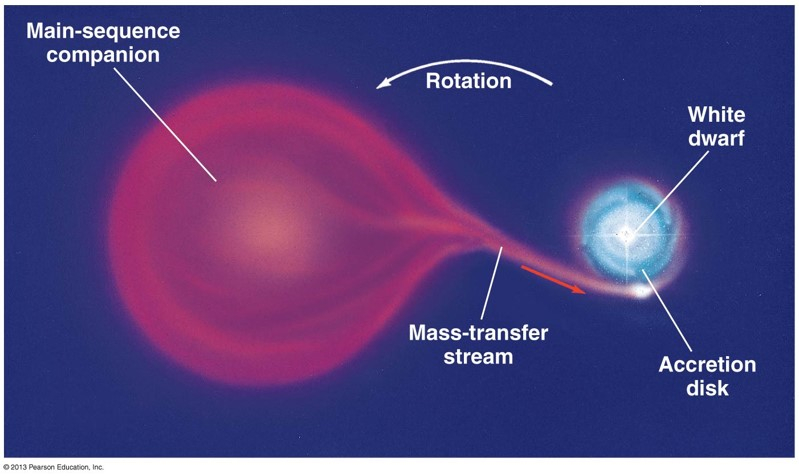
Stable accretion occurs only within a narrow range of rates. When a white dwarf’s mass approaches the Chandrasekhar limit, a thermonuclear explosion follows. It releases more energy than the star needs to maintain hydrostatic equilibrium, with catastrophic results: the white dwarf is torn apart in a Type Ia supernova. Because the progenitors of Type Ia supernovae have roughly the same mass, near the Chandrasekhar limit, their explosions have similar luminosities and absolute magnitudes. That makes them one of astronomy’s standard candles for measuring distance.
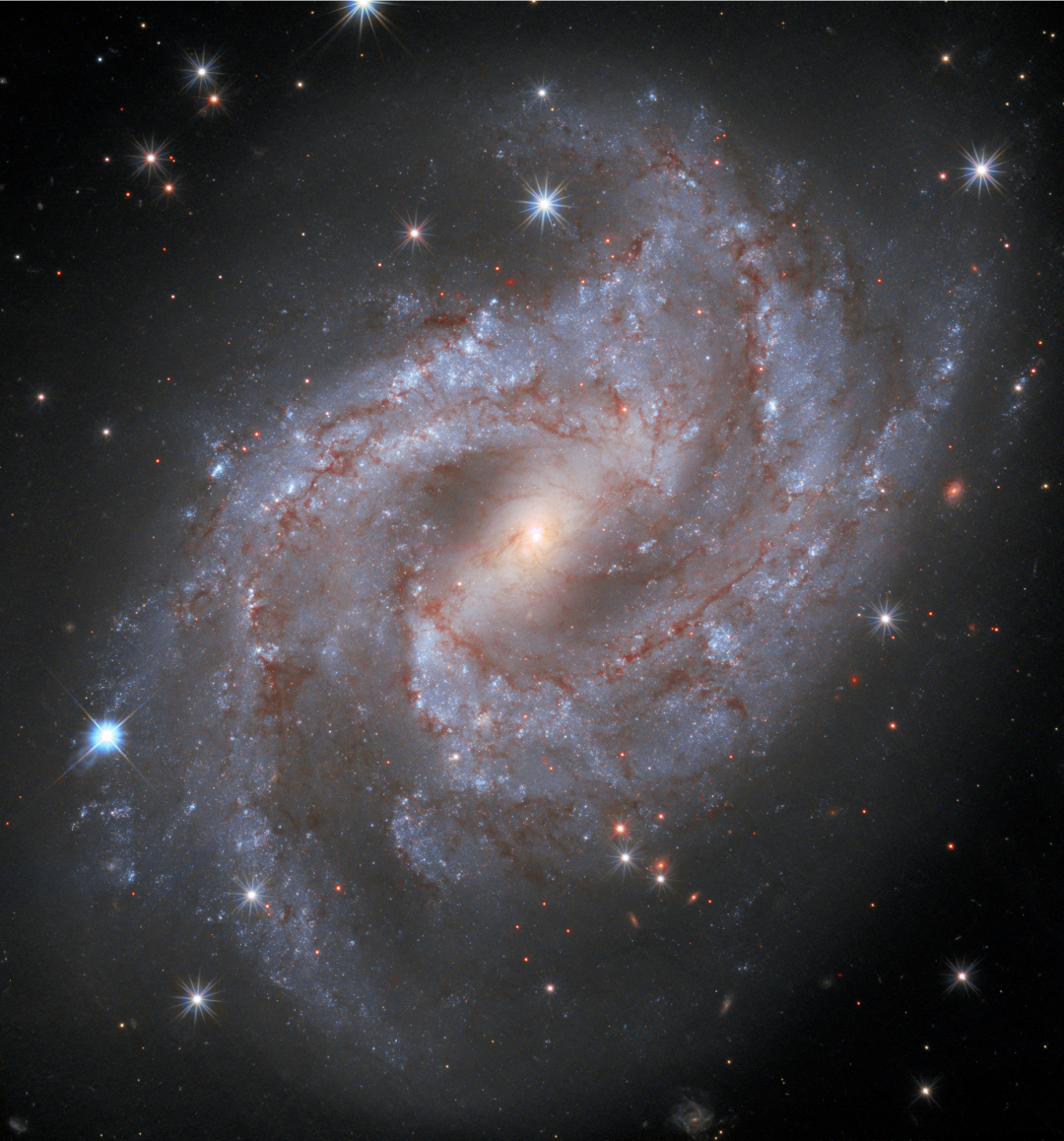
White-dwarf explosions usually leave no remnant, but there are exceptions. If both stars in a binary system are white dwarfs, gravitational-wave emission drains angular momentum from the system until the two draw close enough to merge. Numerical simulations suggest that the less massive, less dense white dwarf is completely disrupted and accreted by the other. If accretion proceeds rapidly, electron capture by the products of carbon ignition reduces the pressure, causing the star to collapse and ultimately form a neutron star.
References
Introduction to Astrophysics, Xiang Shouping, University of Science and Technology of China Press
Introduction to Stellar Structure and Evolution, Li Yan, Peking University Press
 爱发电(点击图片跳转)