
Years, Months, and Days: How Astronomy Measures Time
Author: 丛雨
Reviewed by: 毫秒
Ask how long a year, month, or day lasts, and the familiar figures of 365 days, 30 days, and 24 hours probably come to mind. In astronomy, however, each of these units comes in several forms with different lengths. Here is a brief introduction to a few of them.
Sidereal and Solar Days
The Sun, Moon, and stars appear to rise in the east and set in the west because Earth rotates. One rotation takes 23 h 56 m 4 s and is called a sidereal day. This is plainly different from the 24-hour day of everyday life, known as a mean solar day. Why? Earth rotates on its axis while also orbiting the Sun. Imagine that Earth stopped rotating. During the time it took to complete one orbit, people on Earth would still experience one cycle of day and night, although the Sun would rise in the west and set in the east because Earth orbits counterclockwise. A solar day is the length of one complete day–night cycle. Once we account for Earth’s orbital motion, a sidereal day and a solar day cannot be the same, as the diagram below shows.
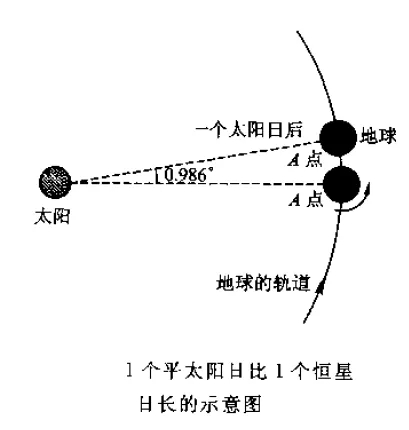
After Earth completes one sidereal rotation, point A must turn through a small additional angle to return to the same position relative to the Sun. A mean solar day is therefore longer than Earth’s rotation period. And because Earth’s orbital speed is not uniform, the actual length of a solar day varies. This varying day is called an apparent solar day.
Sidereal and Synodic Months
The Moon is Earth’s only natural satellite and one of the most striking sights in the sky. Its changing phases are closely tied to the lunar months of the traditional Chinese calendar. As the Moon orbits Earth, its position relative to the Sun changes from our point of view, altering how much of its sunlit side we can see. A complete cycle of phases lasts 29 d 12 h 44 m 3 s (29.53 days) and is called a synodic month. The Moon’s orbital period around Earth, by contrast, is 27 d 7 h 43 m 11.5 s (27.32 days), known as a sidereal month.
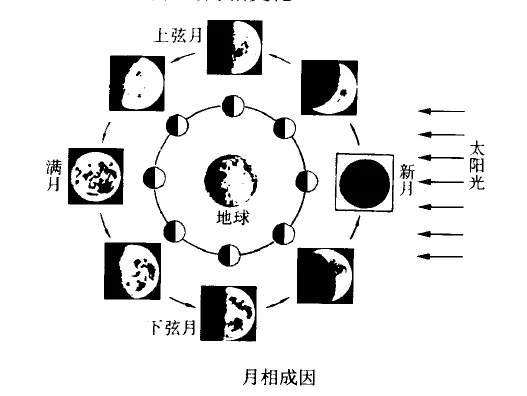
Why does the cycle of lunar phases differ from the Moon’s orbital period? For the same reason that a sidereal day differs from a solar day: Earth orbits the Sun and carries the Moon along with it. Add the Moon’s orbit around Earth to the diagram from the previous section. By the time the Moon completes one orbit around Earth, the Earth–Moon system has also moved through an angle around the Sun. The Moon must continue a little farther before the Sun, Earth, and Moon return to the same relative positions and the cycle of phases is complete. The accompanying figure combines a diagram showing why a mean solar day is longer than a sidereal day with one showing the cause of the lunar phases; these correspond to Sections I, “Sidereal and Solar Days,” and II, “Sidereal and Synodic Months.”
Now consider another question: how long is a full day–night cycle on the Moon? Combining the two ideas above gives the answer. One solar day on the Moon lasts exactly one synodic month. Earth has tidally locked the Moon, so the same side always faces us and the Moon’s rotation and orbital periods are equal. Apply the same reasoning to that orbital, or rotational, period, and one synodic month emerges as the length of a complete lunar day–night cycle.
Sidereal and Tropical Years
If you assume that one orbit of Earth around the Sun simply defines a year, you are badly mistaken. Astronomy recognizes many kinds of “year.” We will introduce only two: the sidereal year and the tropical year.
A sidereal year is Earth’s orbital period: 365 d 6 h 9 m 10 s (365.256 days). A tropical year, the cycle of the seasons, lasts 365 d 5 h 48 m 46 s (365.242 days). Why is Earth’s orbital period not also the seasonal cycle? The main reason is that the gravity of the Sun and Moon affects Earth’s rotation axis. Earth is not a perfect sphere, and its axis is tilted by 23°26′. Solar and lunar gravity cause the axis to wobble clockwise around the direction perpendicular to the ecliptic plane, Earth’s orbital plane, in a cycle of 26,000 years. This phenomenon is called precession. The resulting shift in Earth’s axis makes the interval between two consecutive passages of the Sun directly over either tropic shorter than Earth’s orbital period.
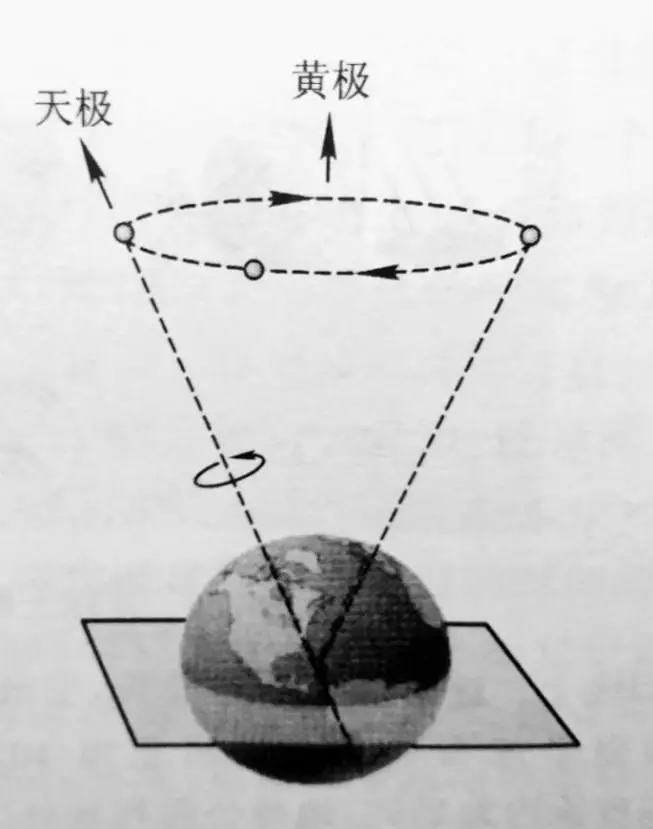
If you know the celestial coordinate system, you may have heard of two effects of precession: the changing north celestial pole and the motion of the vernal equinox. On the celestial sphere, the wobble of Earth’s rotation axis appears as the north celestial pole circling the north ecliptic pole. Polaris, Alpha Ursae Minoris, is our pole star today, but around 3,000 years ago Thuban, Alpha Draconis, lay close to the north celestial pole. Precession also causes the vernal equinox, one of the intersections of the ecliptic and celestial equator, to drift slowly westward along the ecliptic. More precisely, then, a tropical year is the interval between two successive passages of the Sun through the vernal equinox.
Astronomical units of time and period are far more complicated than this article can cover. This has been only a brief introduction to part of the subject, with every effort made to keep it accurate. Astronomers have also worked hard to reconcile these measures with the conventions of daily life. Leap seconds, leap months, and leap years are all tools people have adopted to minimize the gap between physical time and civil time.
References
1.Fundamentals of Astronomy, Liu Xuefu, Higher Education Press
2.Astronomy, Time, and Calendars, Li Zhiping and Jia Huange, China Meteorological Press
 爱发电(点击图片跳转)