
Five-Minute Immunology: The Complement System
Author: 神州
Reviewer: A Millisecond of Eternity
In “Five-Minute Immunology: How Do Antibodies Adapt?”, we caught a glimpse of a few of the immune system’s many mechanisms. Now let’s take a closer look at another part of that system.
Last time, we saw how important antibodies are to immunity. But antibodies cannot do every job on their own. They usually bind to antigens, neutralizing their toxicity or keeping them from attaching to cells. Antibodies can also clump antigens together so that phagocytes can engulf them. Against an intact pathogen such as a bacterium, however, binding to antigens on its membrane does not kill the whole cell outright. That job calls for help from another part of the immune system: the complement system.
Unlike an antibody, complement is not a single large protein. It is a coordinated system of functional proteins that work together in the immune response. Once activated, these proteins set off a chain of reactions that ultimately produces a membrane attack complex (MAC). The MAC can lyse bacteria and other pathogens. So how does this system work?
In the classical pathway of complement activation, complement proteins do not recognize and bind pathogens very efficiently on their own, so antibodies usually mark the target first. When an antibody binds to an antigen on a pathogen’s surface, it forms an antigen–antibody complex and changes shape, exposing sites that complement proteins can recognize and bind. This starts the activation process.
The classical pathway can be divided roughly into three stages:
- Recognition
- Activation
- Membrane attack
1. Recognition
At this stage, a multimolecular complex called C1 recognizes and binds to specific sites exposed by the antigen–antibody complex. This binding activates C1 esterase.
2. Activation
C1 esterase cleaves two other complement components, C4 and C2, to form C3 convertase. C3 convertase then cleaves C3, amplifying the complement response and helping to form C5 convertase.
3. Membrane Attack
C5 convertase activates the remaining complement components in sequence. They ultimately assemble into a MAC on the target cell membrane. Once formed, the MAC can damage and lyse the cell.
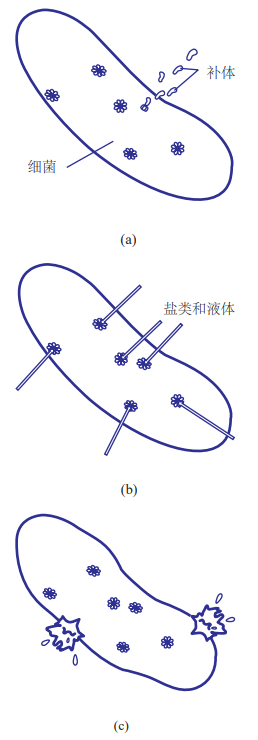
The MAC is a tube-shaped macromolecular complex that changes the permeability of the target cell membrane. In effect, it punches a hole in the cell. Small molecules, ions, and water can pass through freely, while large molecules such as proteins cannot. The membrane eventually loses its ability to maintain the osmotic difference between its two sides, and the cell lyses. Large amounts of Ca2+ also enter the cell, contributing to its death.
In short, antibodies mark a pathogen and complement moves in to destroy it. This bacteriolytic action is one of the body’s important defenses against infection. But if the body produces antigen–antibody complexes against its own tissues, complement can damage healthy cells as well. The body therefore has several complement inhibitors that limit MAC formation and keep these complexes from attacking its own cells.
 爱发电(点击图片跳转)