How Do We Measure the Distances to Stars?
Author: Star Life
Reviewer: Abaiter
Under good conditions, a glance at the night sky reveals a vault full of stars. To understand these celestial objects, people observe and measure them, then use the resulting data in theoretical calculations. The branch of astronomy devoted to observing stars, planets, deep-sky objects, and other bodies in the universe and obtaining the quantities needed for those calculations is called astrometry. Today, let us look at how astronomers measure the distances to stars.
Stars lie at different distances from the Sun, but all of them are extremely far away. The ordinary units of length we use on Earth are impractical for stellar distances, so astronomers use other units instead. One is the light-year, the distance light travels through a vacuum in one year, about 9.4605 trillion kilometers. Stellar distances are immense: even Proxima Centauri, the nearest star, is 4.2 light-years from the Sun, while other stars are hundreds, thousands, or even hundreds of millions of light-years away. The light-year is not the only unit available. For very distant stars and galaxies beyond the Milky Way, even a light-year can seem small, so astronomers defined another, larger unit from observation: the parsec.
The stellar positions we see in the night sky are apparent positions, projections onto the celestial sphere. As Earth travels around the Sun, the same star appears in slightly different places when Earth reaches opposite sides of its orbit. By measuring that difference, we can use geometry to calculate the star’s distance.
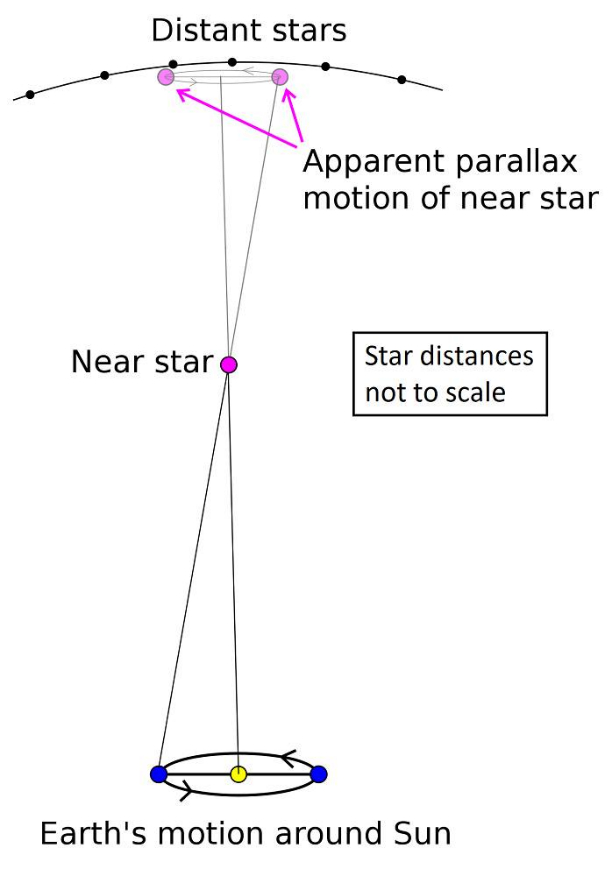
This change in a star’s apparent position caused by Earth’s revolution is called annual stellar parallax. It also gives us a unit of length: if a star’s annual parallax is 1 arcsecond—an arcsecond is an angular unit equal to one three-thousand-six-hundredth of a degree—then the star is 1 parsec from Earth, or about 3.26 light-years or 30.8 trillion kilometers.
Annual stellar parallax gives us a simple formula: the distance r from Earth to a star is 1/π, where π is half the star’s total annual parallax.
Now consider this question:

An astronomical unit is the distance from Earth to the Sun, about 150 million kilometers, far less than one light-year. One parsec equals 3.26 light-years, so the answer is C. We generally use astronomical units for planets within the Solar System, and light-years or parsecs for stars and more distant galaxies.
Once we know the units used for stellar distances, we can begin measuring them. With sufficiently precise observations, the method above lets us determine a star’s annual parallax and then calculate its distance. This is the trigonometric-parallax method. It played a major role in early stellar measurements, but the farther a star is from us, the smaller its annual parallax becomes. The measurement grows more difficult and the error larger until the angle is almost beyond our ability to detect. Trigonometric parallax is therefore unsuitable for distant stars, and other methods are needed.
Another useful astronomical technique is spectroscopic parallax. It relies on the empirical linear relationship between the intensity ratios of certain lines in a star’s spectrum and its absolute magnitude. Measuring the ratios of selected pairs of spectral lines yields the absolute magnitude, which can then be used to find the distance. Absolute magnitude represents a star’s intrinsic brightness, while observation tells us how bright it appears from our location. Because brightness decreases with distance, the two values allow us to calculate the distance. Spectroscopic parallax is fairly accurate and has its own formula. Once the absolute magnitude has been found from the spectral-line ratios, the distance d follows from the distance-modulus equation mv − Mv = 5lgd − 5.
For example, suppose an observed star has an apparent magnitude of +15 and its spectrum identifies it as a G2 V star. The H–R diagram gives it an absolute magnitude of +5. The distance-modulus formula then gives d=1000 PC = 3260 l.y. (light-years).
Note that l.y. means light-year, while the symbol for parsec is p.c.
Spectroscopic parallax can accurately measure the distances to many stars. Another common technique, the Cepheid-variable method, is specifically suited to Cepheid variables. A Cepheid’s pulsation period, the time required for one cycle of brightness variation, is proportional to its luminosity, so these stars can be used to measure interstellar and intergalactic distances. Most Cepheids are F-type stars at maximum luminosity, meaning moderately hot stars, and G-type stars at minimum luminosity, meaning cooler stars like the Sun. The archetype is Delta Cephei. John Goodricke discovered its variability in 1784, and in 1912, Henrietta Leavitt of the Harvard College Observatory discovered the period–luminosity relationship described above. Cepheid variables are therefore known as “cosmic yardsticks.” These are only some of the methods used to measure stellar distances, and each has its own formulas, calculations, and range of application.

For this question, the properties of trigonometric parallax tell us that the farther a star is from us, the smaller its annual parallax. This is one reason the method cannot measure very distant stars. The image shows that star B has the smaller annual parallax, so the answer is B.

The annual parallax of a nearby star is easier to measure, so the answer is A.
These are several ways to measure stellar distances. The vast universe is waiting to be explored, so what are we waiting for? Let us get started!
 爱发电(点击图片跳转)