
Try It at Home: The Biuret Test for Protein
Author: Shenzhou
Reviewer: Weiming
The biuret test for protein works on a simple principle and is relatively easy to perform. This article explains the reaction and outlines a very safe procedure that anyone with the necessary materials can try at home.
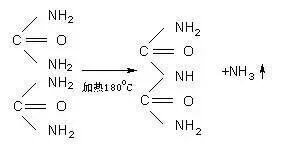
When urea is heated to 180°C, two urea molecules first condense, releasing one molecule of ammonia and forming biuret. The reaction equation is shown below:
Biuret contains the -CO-NH- group. Under alkaline conditions, it reacts with Cu2+ ions to form a purplish-red chelate. Its structure is shown below:
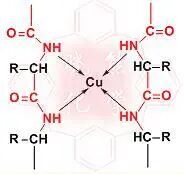
The basis for using this reaction to detect proteins should now be clear. Proteins are made up of many amino acids joined by peptide bonds, so dipeptides and larger polypeptides contain structures similar to those in biuret. Under alkaline conditions, proteins, dipeptides, and larger polypeptides can therefore react with Cu2+ to produce a purplish-red compound, with deeper color indicating a higher protein content. The same principle also means that substances with similar structures can affect the result. Compounds containing groups such as -CS-NH2, -CH2-NH2, or -CRH-NH2, along with substances containing excessive ammonium salts, will interfere with the reaction.
As the principle above shows, amino acids do not undergo this reaction. The test can therefore also indicate how extensively a protein has been hydrolyzed.
Detailed Procedure
① Place a small amount of urea in a test tube, then hold a piece of moist litmus paper at the mouth of the tube. Heat the tube until the paper turns blue, and continue until the contents have evaporated to dryness before stopping. Once the tube has cooled, use a graduated pipette to add 1 ml of 10% NaOH solution and shake well. Add 2–4 drops of 1% CuSO4, shake again, and observe how the color of the solution changes.
② Place diluted egg white in a test tube. Use a graduated pipette to add 1 ml of 10% NaOH solution and shake well. Add 2–4 drops of 1% CuSO4, shake again, and observe how the color of the solution changes. (Required materials: spatula, graduated pipette, pipette bulb, test-tube holder, test-tube rack, urea, NaOH, and CuSO4.)
P.S. At home, you can use diluted egg white as the protein sample. When preparing the biuret reagent, be careful not to add too much CuSO4: it will produce blue Cu(OH)2 and interfere with the color you are trying to observe. If you have the materials, you can also try the reaction with amino acids and biuret.
 爱发电(点击图片跳转)